Cancer has many talents, and one of its rudest is convincing your immune system to mind its own business. This phase I study tested a two-drug combo - ipatasertib plus atezolizumab - in people with treatment-refractory solid tumors and recurrent glioblastoma, and the interesting bit was not just that patients tolerated it reasonably well. It was that the combo seemed to change the immune vibe inside tumors in exactly the direction you would want: fewer FOXP3-positive regulatory T cells, more CD8-positive killer T cells, and a few striking durable responses in recurrent glioblastoma [1]. For a disease that treats most therapies like junk mail, that gets attention.
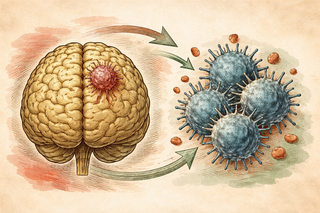
When the bouncers work for the wrong club
A quick map of the biology, minus the chalkboard headache. The PI3K/AKT pathway is one of the cell’s main growth-and-survival circuits. In cancer, it often gets jammed in the "go, go, go" position, helping tumor cells grow, dodge death, and generally act like they own the place [3]. It also does something especially annoying: it can help tumors build an immune-suppressive neighborhood.
That matters because atezolizumab, a PD-L1 blocker, works by taking the brakes off T cells. But if those T cells never make it into the tumor - or if they arrive and find the place crawling with immune-suppressive cells - then releasing the brakes does not help much. It is like fixing the engine on a car that is still locked in the garage.
Glioblastoma is particularly nasty here. It hides behind the blood-brain barrier, mutates like it is trying to win an award, and lives in a microenvironment that tends to exhaust or exclude T cells [2,4,5]. Basically, if your immune system were a security company, glioblastoma would be the client that keeps disabling the cameras and bribing the night shift.
What the trial actually did
This was an early-phase, open-label trial, so the first job was safety, not victory laps. Adults with advanced refractory cancers went into one cohort, and patients with recurrent glioblastoma went into another. The recommended phase 2 dose ended up being ipatasertib 400 mg daily plus atezolizumab 1200 mg every 3 weeks, with no dose-limiting toxicities reported at that dose [1].
That is the tidy clinical sentence. The more interesting bench-scientist sentence is this: they looked under the hood. And under the hood, the combo appeared to shrink the population of FOXP3-positive regulatory T cells - the immune cells that often calm things down when you really do not want calm - while increasing infiltration by CD8-positive effector T cells, the cells you would actually like showing up to a tumor with bad intentions [1].
That mechanistic readout matters. Plenty of cancer papers wave vaguely in the direction of "immune modulation" like a labmate presenting a western blot with one suspiciously perfect band. This one at least gives a biologically coherent story for why the combo might help.
Why this is more than a chemistry experiment
The big idea is simple: maybe some tumors resist immunotherapy not because checkpoint drugs are useless, but because the tumor has already redecorated the immune landscape into a no-go zone. PI3K/AKT signaling has been implicated in that kind of immune escape for years, and reviews have argued that combining pathway inhibition with immunotherapy makes solid biological sense [3]. The problem has been getting that logic to survive contact with actual patients, actual tumors, and the usual clinical chaos.
This study does not settle that. It is phase I. The numbers are small. "Exceptional responders" is not the same thing as "new standard of care." Anyone who has spent time around early translational oncology knows one good-looking signal can disappear after the sequel, like the world's most expensive magic trick.
Still, recurrent glioblastoma is not a setting where you casually shrug off durable responses. Reviews and systematic analyses keep landing on the same miserable theme: checkpoint inhibitors alone have mostly underperformed in GBM, and future progress will probably come from combinations that reshape the tumor microenvironment rather than politely knocking on the front door [2,4,5]. That is exactly where this study plants its flag.
The part where optimism wears a lab coat and reads the fine print
If these findings hold up in larger studies, the real-world impact could be meaningful. Not just for glioblastoma, but for other tumors where PI3K/AKT activation helps create an immune desert. The appealing scenario is that pathway inhibition makes the tumor less welcoming to regulatory T cells and more accessible to cytotoxic T cells, turning a cold tumor at least lukewarm enough for checkpoint blockade to matter.
But the caveats are not decorative. We still need to know which patients benefit most, whether PTEN loss or other pathway markers predict response, how durable the benefit is, and whether the immune changes seen in biopsies reliably translate into longer survival. Cancer biology loves a plot twist. Usually several.
For now, this paper offers something better than hype and more useful than hand-waving: a plausible mechanism, manageable early safety, and a hint that in some very hard cancers, especially recurrent glioblastoma, the immune system may not be absent so much as badly managed. Sometimes the job is not building a whole new army. Sometimes it is just getting the right cells back in the room.
References
-
Tiu C, Yau W, Silva D, et al. Phase I trial of ipatasertib plus atezolizumab enhances PI3K/AKT pathway immune responses in solid tumors and refractory glioblastoma. Clinical Cancer Research. 2026. DOI: https://doi.org/10.1158/1078-0432.CCR-25-4364
-
Liu Y, Zhou F, Ali H, et al. Immunotherapy for glioblastoma: current state, challenges, and future perspectives. Cellular & Molecular Immunology. 2024;21:1354-1375. DOI: https://doi.org/10.1038/s41423-024-01226-x PMCID: https://pmc.ncbi.nlm.nih.gov/articles/PMC11607068/
-
Zhao HF, Wang J, Tony To SS. Targeting PI3K/Akt signal transduction for cancer therapy. Signal Transduction and Targeted Therapy. 2021;6:425. DOI: https://doi.org/10.1038/s41392-021-00828-5
-
Preddy P, Nellan A, Woltjer R, et al. Checkpoint: Inspecting the barriers in glioblastoma immunotherapies. Seminars in Cancer Biology. 2022;86(Pt 3):473-481. DOI: https://doi.org/10.1016/j.semcancer.2022.02.012 PMCID: https://pmc.ncbi.nlm.nih.gov/articles/PMC9363531/
-
Schonfeld M, et al. The landscape of immune checkpoint inhibitor clinical trials in glioblastoma: a systematic review. Neuro-Oncology Advances. 2024;6(1):vdae174. DOI: https://doi.org/10.1093/noajnl/vdae174
Disclaimer: The image accompanying this article is for illustrative purposes only and does not depict actual experimental results, data, or biological mechanisms.