If dense breast tissue had a social media bio, it would absolutely read: "Thick, mysterious, and accidentally blocking the radiologist's view." Not evil. Not dramatic. Just standing there like a fog machine in a detective movie while everybody tries to spot the actual problem.
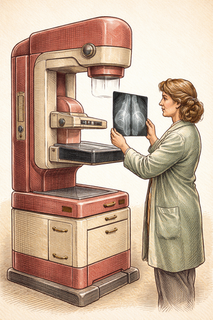
That, in a nutshell, is the issue behind Danielle B. Holt's short 2026 JAMA piece on breast density masking and why breast cancer screening needs to get more personal, not just more enthusiastic (Holt 2026). And yes, "personalized screening" can sound like one of those phrases consultants charge by the syllable for. But here, it points to a real problem.
The Mammogram Problem Nobody Loves to Talk About
Mammograms save lives. Also, mammograms are not magical. Both things can be true at once, which is annoying if you prefer your medical debates with Marvel-level good guys and bad guys.
Dense breast tissue matters for two reasons. First, it is linked to a higher risk of breast cancer. Second, it can mask cancers on a mammogram because dense tissue and tumors both show up as white. That means the image can turn into a visual game of "find the polar bear in a snowstorm," except with much worse stakes.
Holt's main point is not that mammography is bad. It is that treating all screened women as if mammography works equally well for all of them is a little too tidy for real biology. Nearly half of screening-eligible women have dense breasts, so this is not some niche edge case for three people and a very stressed radiologist (Holt 2026).
Dense Does Not Mean Doomed
This is where cancer communication often goes off the rails. Dense breasts do not mean cancer is present. They also do not automatically mean every person needs an MRI, ultrasound, contrast-enhanced mammogram, and a séance.
What they do mean is that the usual screening tool can be less sensitive, and that should change the conversation.
A 2024 analysis in the American Journal of Epidemiology tackled an old argument: is breast density mainly making cancers harder to see, or is it also tied to genuinely higher cancer risk? Annoyingly for anyone hoping for a simple answer, it appears to be both. The study supported the idea that higher density is associated with increased breast cancer onset, not just missed detection (Lange et al. 2024).
So the issue is not merely "the mammogram missed it." Sometimes the biology is riskier to begin with.
More Screening Is Not Automatically Better Screening
Here comes the part where the hype machine needs a timeout.
Supplemental imaging can help. A 2023 Radiology systematic review and meta-analysis found that among women with dense breasts and a negative mammogram, MRI detected more additional cancers than other supplemental options (Hussein et al. 2023). A newer 2025 systematic review reached a similar general conclusion: MRI adds the most extra cancer detection, while tomosynthesis and ultrasound add less (Wang et al. 2025).
But extra detection is not the same thing as a free lunch. More imaging can also mean more callbacks, more biopsies, more false alarms, and more people spending a week trying not to mentally redecorate an oncology waiting room.
That tradeoff showed up clearly in a 2024 JAMA Internal Medicine modeling study. In simulated average-risk women, biennial digital breast tomosynthesis from ages 50 to 74 averted 7.4 breast cancer deaths per 1000 women, with 151 false-positive biopsy recommendations. Adding MRI for women with extremely dense breasts nudged deaths averted to 7.6, but false-positive biopsies rose to 180. Expanding MRI to women with extremely or heterogeneously dense breasts pushed that to 8.0 deaths averted and 343 false-positive biopsies (Stout et al. 2024).
That is the whole precision-screening argument in one awkward package: better detection, yes, but at a cost. Biology refuses to be simple because apparently it enjoys watching us work.
Why This Is Heating Up Now
In the US, breast density notifications became a federal requirement on September 10, 2024, meaning mammography facilities now have to tell patients if their breasts are dense and explain that this can both raise cancer risk and make mammograms less sensitive (FDA).
At the same time, the 2024 USPSTF breast cancer screening statement said there is still insufficient evidence to recommend for or against supplemental ultrasound or MRI after a negative mammogram, regardless of breast density (Nicholson et al. 2024). Translation: doctors and patients are being told more, while the evidence base is still frustratingly incomplete.
That is exactly why Holt's argument lands. The answer is probably not "everyone gets the same thing" and not "everyone gets everything." It is smarter risk-based screening. The 2025 WISDOM trial added fuel to that idea by finding risk-based screening performed similarly to annual screening for later-stage cancer outcomes in its follow-up window (Esserman et al. 2025).
So no, this is not a flashy breakthrough with triumphant music swelling in the background. It is better. It is a push toward honesty. Dense breasts change what screening can and cannot do, and pretending otherwise is not simplicity. It is just denial in a lab coat.
References
Holt DB. Breast Density Masking and the Need for Precision Screening. JAMA. 2026;335(16):1385-1386. https://doi.org/10.1001/jama.2026.2443
Nicholson WK, Silverstein M, Wong JB, et al. Screening for Breast Cancer: US Preventive Services Task Force Recommendation Statement. JAMA. 2024;331(22):1918-1930. https://doi.org/10.1001/jama.2024.5534
Stout NK, Miglioretti DL, Su YR, et al. Breast Cancer Screening Using Mammography, Digital Breast Tomosynthesis, and Magnetic Resonance Imaging by Breast Density. JAMA Internal Medicine. 2024;184(10):1222-1231. https://doi.org/10.1001/jamainternmed.2024.4224
Hussein H, Abbas E, Keshavarzi S, et al. Supplemental Breast Cancer Screening in Women with Dense Breasts and Negative Mammography: A Systematic Review and Meta-Analysis. Radiology. 2023;306(3):e221785. https://doi.org/10.1148/radiol.221785
Lange JM, Gard CC, O'Meara ES, Miglioretti DL, Etzioni R. Breast density and risk of breast cancer: masking and detection bias. American Journal of Epidemiology. 2024;194(2):441-448. https://doi.org/10.1093/aje/kwae245
Esserman LJ, WISDOM Study Group. Risk-Based vs Annual Breast Cancer Screening: The WISDOM Randomized Clinical Trial. JAMA. 2025. https://doi.org/10.1001/jama.2025.24784
Disclaimer: The image accompanying this article is for illustrative purposes only and does not depict actual experimental results, data, or biological mechanisms.