This new ACS Nano paper takes a wild but surprisingly logical idea and runs with it: what if a tumor could leave a readable note in your urine, and what if that note showed up on a strip test you could see with your own eyeballs? Not a giant MRI machine. Not a lab packed with blinking equipment. A strip. Like the humble cousin of a pregnancy test who went to graduate school.
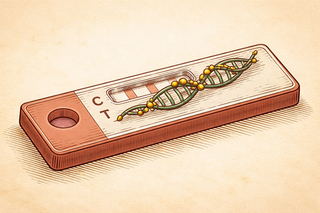
The team built a nanosensor designed to respond to two enzymes that many cancer cells lean on more heavily than normal cells: APE1, a DNA-repair enzyme, and telomerase, the notorious chromosome-maintenance mechanic that helps cancer cells keep dividing long past the point where polite cells would retire and move to Florida. When both enzymes get involved, the sensor’s DNA gets cut and extended in sequence, eventually producing a small gold-tagged strand that can be excreted into urine and picked up by a lateral flow assay. In plain English: tumor chemistry gets translated into a bathroom-readable signal (Wang et al., 2026).
That matters because urine tests are seductive for obvious reasons. They are noninvasive, repeatable, and far less dramatic than a tissue biopsy. Nobody has ever said, "Good news, your cystoscopy is basically a spa treatment."
Why These Two Enzymes Are Such Sneaky Characters
Telomerase is one of cancer biology’s classic villains. In most ordinary adult cells, it stays mostly quiet. In many cancers, it flips back on, helping cells maintain telomeres and dodge the normal limits on endless replication. It is basically the cellular equivalent of a fake ID plus unlimited espresso (Afshari et al., 2022).
APE1 is a different beast. It helps repair damaged DNA, and cancer cells often exploit DNA repair systems to survive stress, therapy, and their own chaotic lifestyle. Pairing APE1 with telomerase gives this sensor a kind of biochemical two-factor authentication. One enzyme alone is interesting. Two together are a stronger hint that something sketchy is happening inside the tumor’s neighborhood.
That dual-enzyme trick is one of the clever parts here. Traditional urine diagnostics often rely on tumor material that just happens to drift into urine in useful amounts. That is messy. Biology is rude like that. Signals can be unstable, scarce, or nonspecific. This paper tries to dodge that problem by engineering the signal instead of waiting passively for nature to cooperate.
Tiny Strip, Big Ambition
The readout happens through a lateral flow assay, which is science’s favorite way to make serious diagnostics look deceptively simple. These assays are cheap, fast, portable, and increasingly adaptable for point-of-care testing, though turning them into reliable quantitative tools still takes serious engineering (Kakkar et al., 2024).
The bigger dream is not just early detection. It is longitudinal monitoring. That means checking cancer over time without repeatedly putting patients through invasive procedures. If this kind of system holds up in larger studies, it could help answer practical questions doctors and patients actually care about: Is treatment working? Is the tumor changing? Is it coming back? Is today a calm day or a "let’s call oncology" day?
That idea fits with a broader push in cancer diagnostics. Reviews of urinary liquid biopsy keep coming back to the same promise and the same headache: urine is wonderfully convenient, but clinical translation is hard because biomarker levels vary, workflows are not standardized, and real-world validation is a beast (Groen and Schalken, 2022). More recent work in bladder cancer is pushing that frontier too, including a Cell study on urine liquid biopsy and field effects in bladder cancer, plus growing interest in synthetic urinary probes that actively create clearer signals instead of hunting for faint natural ones (Shi et al., 2026; Lee et al., 2024).
The Catch, Because There Is Always a Catch
This is still a proof-of-concept paper, not a green light to replace standard cancer monitoring with a bathroom magic trick. The hard questions are still waiting in the hallway with their arms crossed.
Will the signal stay specific across different tumor types, inflammatory states, and real patients with very inconvenient biology? Will background noise muddy the readout? Can the assay be manufactured consistently and interpreted reliably outside a tightly controlled research setup? And can a test strip stay useful when cancer, that overachieving little rebel, changes its behavior under treatment?
Those are not minor details. They are the difference between "cool paper" and "actual clinic."
Still, this study is fun in the best scientific sense. It takes a genuine clinical problem - how to monitor cancer repeatedly without poking, scoping, or scanning people to death - and answers with a device that turns invisible enzyme activity into a visible urinary signal. That is not a cure. It is not even a finished product. But it is a sharp little reminder that some of the smartest ideas in oncology involve making the complicated look simple.
And if future cancer monitoring really does involve more smart strips and fewer miserable procedures, that would be one of the rare medical plot twists everyone could get behind.
References
-
Wang L, Chen R, Liu Z, et al. Enzymatic Cascade-Powered Urinary Diagnostics for Visual Cancer Monitoring. ACS Nano. 2026. DOI: 10.1021/acsnano.6c00255
-
Afshari N, Al-Gazally ME, Rasulova I, et al. Sensitive bioanalytical methods for telomerase activity detection: a cancer biomarker. Analytical Methods. 2022;14(42):4174-4184. DOI: 10.1039/d2ay01315k
-
Groen L, Schalken J. Liquid Biopsy for Prostate and Bladder Cancer: Progress and Pitfalls. European Urology Focus. 2022;8(4):904-906. DOI: 10.1016/j.euf.2022.08.013
-
Kakkar S, Gupta P, Yadav SPS, et al. Lateral flow assays: Progress and evolution of recent trends in point-of-care applications. Materials Today Bio. 2024;28:101188. DOI: 10.1016/j.mtbio.2024.101188. PMCID: PMC11364909
-
Shi WY, Liu KJ, Esfahani MS, et al. Field-effect-informed urine liquid biopsy for bladder cancer. Cell. 2026;189(4):1024-1038.e9. DOI: 10.1016/j.cell.2025.12.054
-
Lee H, Choi M, Lee T, et al. Artificial urinary biomarker probes for diagnosis. Nature Reviews Bioengineering. 2024. Article link
Disclaimer: The image accompanying this article is for illustrative purposes only and does not depict actual experimental results, data, or biological mechanisms.