AI usually travels like rush-hour traffic - too much data, too many lane changes, and a giant pileup every time memory has to chat with the processor. In a new Nature Communications paper, researchers found a sneaky detour: instead of forcing tree-based machine learning to drive like a precision race car, they let the hardware be a little fuzzy and turned that fuzziness into a feature rather than a felony (Wen et al., 2026).
The suspect: smart models with clunky road manners
Tree-based models like decision trees and random forests are the dependable detectives of machine learning. They shine on tabular data - the kind you get in medicine, finance, and public health - and they show their work. That matters when your model is helping with something touchy, like risk prediction from electronic health records, where "the computer said so" is not exactly a satisfying alibi.
The catch is that these models can be awkward on standard hardware. A tree asks lots of if-this-then-that questions in sequence, which means data keeps bouncing around memory like a rideshare driver who missed three exits in a row. Earlier work showed that analog content-addressable memory, or CAM, could speed this up by searching many possibilities at once, right where the data live (Pedretti et al., 2021). Nice idea. Problem: real analog hardware is not perfectly sharp. Its decision boundaries are soft, more "eh, somewhere around here" than "line in the sand."
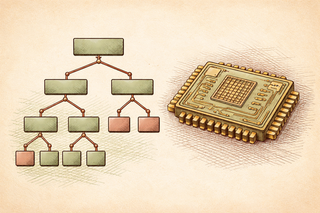
Normally, engineers treat that softness like a bug. Wen and colleagues treated it like the clue everyone else kept stepping over.
The reveal: let the hardware be gloriously imperfect
Traditional decision trees use hard splits: is a value above 7.3 or not? That is clean on paper and annoyingly fragile in real devices, where tiny shifts can send the decision down the wrong branch. The authors paired their analog CAM hardware with soft decision trees, which swap those cliff-edge yes-or-no splits for smooth probabilities. Instead of a bouncer checking IDs with military zeal, think of a velvet-rope host making judgment calls. Still selective, just less likely to melt down over a smudged barcode.
That match between model and hardware is the whole trick. The analog CAM naturally behaves in a sigmoid-like, gradual way, so the hardware can compute those soft probabilities in parallel, inside memory, without hauling data back and forth. On simulations, the setup cut soft-tree inference from a digital nightmare of checking many paths to effectively constant-time hardware evaluation. The paper reports 3 to 4 orders of magnitude faster inference than CPU and GPU baselines, plus 5 to 6 orders of magnitude lower energy use for deep trees (Wen et al., 2026).
That is not just fast. That is "your laptop looks offended" fast.
Why the fuzz helps when the world gets messy
The paper gets more interesting when things go wrong, because that is where trustworthy AI either earns its badge or drops it in a storm drain.
On MNIST, the authors found that with about 10% device threshold variation, a standard hard decision tree lost roughly 45% accuracy, while the soft version dropped by only 0.6%. Under adversarial attack, the soft model again held up better, with only a 1.7% accuracy drop versus 14.4% for the hard tree. On a fabricated 8x8 MoS2 flash memory array, the team reached 96% accuracy on the Wisconsin Diagnostic Breast Cancer dataset and 97% on Iris despite real device non-idealities (Wen et al., 2026).
That finding lines up with a broader theme in analog in-memory computing: a little physical randomness can sometimes make models harder to game, not easier (Lammie et al., 2025). It also fits a larger push toward hardware-software co-design, where you train models with the quirks of the destination hardware in mind instead of pretending physics will politely stay out of the way (Rasch et al., 2023).
Why you might actually care
If this line of work keeps holding up, it could matter anywhere people rely on tabular AI and also want explanations, speed, and power efficiency in the same room without a knife fight. Hospitals are an obvious example. A tree-based model running close to the sensor or device could help triage, screening, or decision support without shipping every calculation to a power-hungry server farm. Edge systems in labs, wearables, or portable diagnostics also benefit when "fast" and "low power" stop acting like divorced parents.
There is still a case file full of loose ends. The experimental hardware is small. Scaling, manufacturing consistency, and validation on real clinical workloads remain open questions. And no, one breast-cancer benchmark does not mean your future biopsy is being read by a noir detective trapped inside a flash memory chip. But the core idea is sharp: stop forcing analog hardware to impersonate digital perfection, and let biology's favorite truth sink in - soft edges can be surprisingly resilient.
Cancer biology is weird, but computer hardware has now entered the chat wearing a trench coat and muttering, "maybe the blur was the point."
References
-
Wen B, Gao G, Xu Z, et al. Trustworthy tree-based machine learning by MoS2 flash-based analog content-addressable memory with inherent soft boundaries. Nature Communications. 2026. DOI: 10.1038/s41467-026-72118-z
-
Pedretti G, Graves CE, Serebryakov S, et al. Tree-based machine learning performed in-memory with memristive analog CAM. Nature Communications. 2021;12:5806. DOI: 10.1038/s41467-021-25873-0
-
Lammie C, Büchel J, Vasilopoulos A, Le Gallo M, Sebastian A, et al. The inherent adversarial robustness of analog in-memory computing. Nature Communications. 2025;16:1756. DOI: 10.1038/s41467-025-56595-2
-
Rasch MJ, Mackin C, Le Gallo M, et al. Hardware-aware training for large-scale and diverse deep learning inference workloads using in-memory computing-based accelerators. Nature Communications. 2023;14:5282. DOI: 10.1038/s41467-023-40770-4
-
Huang Y, Ando T, Sebastian A, Chang MF, Yang JJ, Xia Q. Memristor-based hardware accelerators for artificial intelligence. Nature Reviews Electrical Engineering. 2024;1(5):286-299. DOI: 10.1038/s44287-024-00037-6
Disclaimer: The image accompanying this article is for illustrative purposes only and does not depict actual experimental results, data, or biological mechanisms.