For years, neurodegenerative diseases were sorted into tidy little boxes. Alzheimer's disease got amyloid-beta and tau. Parkinson's disease got alpha-synuclein. ALS and some dementias got TDP-43. Nice. Organized. Very satisfying to anyone who alphabetizes spices.
The problem is that real brains did not get the memo.
In this 2026 review, Shaik Basha and colleagues argue that age-related brain diseases often involve co-aggregation - meaning different misfolded proteins pile up together, influence each other, and generally behave like a toxic friend group that keeps making everyone's decisions worse (Basha et al., 2026). Instead of one rogue protein wrecking the neighborhood solo, you may have amyloid-beta, tau, alpha-synuclein, and TDP-43 all cross-seeding and amplifying each other's damage.
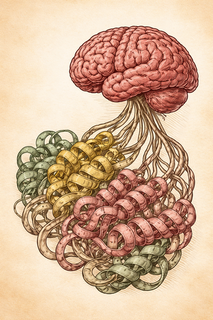
That phrase, cross-seeding, matters. Think of it like one bad crystal in a jar of rock candy kicking off more crystal formation. Except here the candy is your neurons, which is much less fun and significantly harder to explain at parties.
When One Protein Invites Three Friends
The review pulls together biophysical, cellular, animal, and human evidence showing that these proteins do not always stay in their lane. Tau can interact with alpha-synuclein. TDP-43 shows up in a substantial chunk of Alzheimer's cases. Mixed pathologies are common in older adults, which helps explain why real patients often look messier than textbook categories suggest (Meneses et al., 2021; Sofia et al., 2024).
This is a big deal because medicine loves a clean villain. But neurodegeneration may be less "single mastermind" and more "crime syndicate with terrible internal boundaries."
The review also lays out why aging makes this easier for the proteins. Membranes change. Redox balance gets shakier. Proteostasis - your cells' quality-control system for folding and clearing proteins - gets less sharp. Basically, the brain's housekeeping crew is still on the clock, but somebody gave them a mop, one paper towel, and a management seminar.
Why This Actually Changes the Plot
If these diseases are mixed proteinopathies, then diagnosis gets trickier and treatment probably needs to get smarter.
That helps explain why some patients do not fit neat labels and why symptoms can progress differently depending on which pathologies overlap. Recent work on mixed Alzheimer's and Lewy body pathology shows these combinations can alter risk patterns and clinical course, which is not great for doctors hoping for a simple checkbox exercise (Pillai et al., 2024).
It also matters for biomarkers. The review highlights cerebrospinal fluid and extracellular vesicles as possible ways to detect these overlapping protein signatures earlier. Extracellular vesicles are tiny membrane bubbles that cells release, sort of like encrypted gossip packets. They can carry disease-related proteins, which makes them attractive as liquid-biopsy-style clues, though the field still has major technical hurdles (Hagey and El Andaloussi, 2023).
And then there is treatment. If multiple proteins are teaming up, a single-target therapy may be showing up to a house fire with a water pistol and excellent self-esteem. The review points toward multi-target strategies such as immunotherapy, proteostasis-based approaches, and autophagy-boosting tools that might help cells clear more than one type of toxic aggregate.
The Annoying Part, Also Known as Reality
Before anyone starts printing "protein crossover solved" T-shirts, there are limits.
A lot of the evidence is strong but still incomplete when it comes to cause versus consequence. Are these proteins directly helping each other misfold in living human brains, or are they coexisting because the same aging environment makes everything go sideways at once? The answer may be "yes, inconveniently." Even recent experimental work showing that amyloid-beta, tau, and alpha-synuclein together can intensify inflammation and neuron loss is exciting, but it is still a step on the road, not the road itself (Tejera et al., 2026; Wu et al., 2024).
Still, the shift in thinking matters. A lot. This paper says we should stop pretending these disorders are isolated little kingdoms with one flag and one anthem. They look more like overlapping biological weather systems, colliding fronts of misfolded proteins, stressed cells, inflammation, and aging.
Which, honestly, feels rude. The brain already had plenty going on.
But if this review is right, the mess may also be the map. And once researchers stop treating Alzheimer's, Parkinson's, and related dementias like separate planets, they may get better at spotting the shared machinery underneath - and eventually, better at disrupting it.
References
Basha S, Nadkarni PP, Pai AR, Mahato KK. Co-Aggregation of Amyloidogenic Proteins in Age-Related Neurodegenerative Diseases. Ageing Res Rev. 2026. doi:10.1016/j.arr.2026.103148
Meneses A, Koga S, O'Leary J, Dickson DW, Bu G, Zhao N. TDP-43 Pathology in Alzheimer's Disease. Mol Neurodegener. 2021;16(1):84. doi:10.1186/s13024-021-00503-x. PMCID:PMC8691026
Wu YC, Bellucci A, Della Valle F, et al. The contribution of beta-amyloid, Tau and alpha-synuclein to blood-brain barrier damage in neurodegenerative disorders. Acta Neuropathol. 2024. doi:10.1007/s00401-024-02696-z. PMCID:PMC10861401
Hagey DW, El Andaloussi S. The promise and challenges of extracellular vesicles in the diagnosis of neurodegenerative diseases. Handb Clin Neurol. 2023;193:227-241. doi:10.1016/B978-0-323-85555-6.00014-X
Pillai JA, Koscik RL, Ghoshal N, et al. Lewy body pathology modifies risk factors for cerebral amyloid angiopathy when comorbid with Alzheimer's disease pathology. Alzheimers Dement. 2024;20(4):2564-2574. doi:10.1002/alz.13704
Sofia L, Massa F, Pardini M, Arnaldi D, Bauckneht M, Morbelli S. Alzheimer's disease co-pathology in dementia with Lewy bodies: implications in the disease modification era. Eur J Nucl Med Mol Imaging. 2024;51(7):2151-2153. doi:10.1007/s00259-024-06619-8. PMCID:PMC11139684
Tejera D, Scicluna BJ, Dalrymple-Alford J, et al. Tau, amyloid-beta and alpha-synuclein co-pathologies synergistically enhance neuroinflammation and hippocampal neuron loss. Neurobiol Dis. 2026; doi:10.1016/j.nbd.2026.107323
Disclaimer: The image accompanying this article is for illustrative purposes only and does not depict actual experimental results, data, or biological mechanisms.