Your immune system usually treats cancer like a suspicious guy trying to sneak backstage with a fake laminate. T cells are supposed to spot the fraud and toss him out. But some lung cancers, especially those with STK11 mutations, have a reputation for turning the venue into a fortress where the real security team never gets through the door.
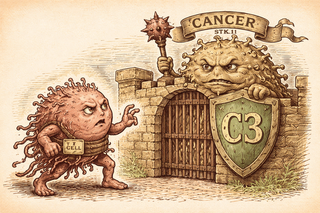
That is the setup in a new study by Suzuki and colleagues on STK11-mutant lung adenocarcinoma, a subtype already known for poor responses to immune checkpoint inhibitors like anti-PD-1 therapy (Suzuki et al.). The paper points the finger at an unexpected accomplice: complement C3.
If the word "complement" sounds like either grammar class or a polite remark about your jacket, fair. In immunology, complement is a protein network that helps the body tag microbes, stir up inflammation, and sometimes punch holes in bad actors. Useful system. Ancient system. Also, like many ancient systems, it can be manipulated by newer, ruder tenants. Cancer loves that.
Meet C3, the helpful chaos goblin
The researchers combined human tumor samples, lung cancer cell lines, public datasets, and mouse models. What they found was pretty blunt: STK11-mutant tumors made more C3 than STK11-wildtype tumors, and patients with high C3 expression in this setting had worse survival (Suzuki et al.).
Then came the more interesting twist. Knocking out STK11 in mouse lung tumors increased neutrophils and decreased T cells in the tumor. That is bad news for immunotherapy, because anti-PD-1 works best when T cells can actually enter the building and do their job. These STK11-deficient tumors were also resistant to anti-PD-1.
But deleting C3 inside the tumor cells themselves changed the script. Tumor growth dropped hard, and anti-PD-1 started working much better. Deleting C3 in the host animal did not have the same effect. Translation: the tumor was not just swimming in complement soup from the body. It was making its own local supply, like a criminal organization opening an in-house smoke machine to confuse the cameras.
That matters because it shifts the story from "complement is around tumors" to "tumor cells are actively weaponizing complement."
A sketchy neighborhood with hired bouncers
Mechanistically, the paper suggests STK11 loss pushes tumor cells to make C3, which then drives molecules including CXCL2 and complement factor H (CFH). CXCL2 helps recruit neutrophils. Neutrophils are not always villains in cancer, but in this context they seem to help create a cold, T-cell-poor microenvironment. CFH, meanwhile, is a complement regulator, which adds another layer of immune interference. Basically, the tumor is not just hiding. It is doing staffing.
This fits a bigger pattern people have been noticing across cancers and organ systems. Tumors often borrow old immune programs that evolved for wound repair, infection, or tissue stress, then run them in the worst possible context. Evolution is efficient like that. Stingrays reused fins, bats reused forelimbs, and tumors reuse inflammation. Nature loves a callback, even when the callback is deeply annoying.
Recent reviews have been building this broader case. Complement is increasingly viewed not just as a microbe-killing cascade, but as a regulator of the tumor microenvironment that can suppress antitumor immunity and support myeloid-heavy, T-cell-light conditions (Kolev et al., 2022; Kerdidani and Roumenina, 2024). On the lung cancer side, STK11 has been under suspicion for years as a marker of immune resistance and "cold" tumors (Gelsomino et al., 2021; Knetki-Wróblewska et al., 2024; Shiller et al., 2024).
Why you should care, even if complement sounds like a side quest
If these findings hold up, they point toward a practical idea: some STK11-mutant lung cancers may need more than PD-1 blockade alone. If the tumor has already locked out CD8 T cells and filled the place with the wrong inflammatory signals, simply yelling "go get 'em" at the immune system is not a strategy. It is a motivational poster.
A C3-centered pathway could offer new targets. Maybe you block complement signaling directly. Maybe you interfere downstream at neutrophil-recruiting chemokines. Maybe you use this biology to identify which patients need combination therapy upfront. That is why STK11 testing keeps showing up in biomarker conversations in lung cancer care, including patient-facing guidance and expert clinical discussions about treatment resistance and trial selection (American Lung Association; Shiller et al., 2024).
The big caveat is the usual one in cancer biology: mice are not people, pathways are messy, and tumors rarely rely on just one trick. Cancer is less a single mastermind and more a raccoon with twelve hands. Still, this study gives a sharper explanation for why STK11-mutant lung adenocarcinoma can be so frustrating in the immunotherapy era. The tumor is not merely invisible. It is rearranging the immune furniture.
References
Suzuki S, Kandar B, Ting C, et al. Tumor-derived complement C3 overexpression in STK11-mutant lung adenocarcinoma drives tumor growth and immune checkpoint inhibitor resistance. Cancer Immunol Res. 2025. DOI: https://doi.org/10.1158/2326-6066.CIR-25-0534
Gelsomino F, Lamberti G, Parisi C, et al. STK11/LKB1 modulation of the immune response in lung cancer: from biology to therapeutic impact. Cells. 2021;10(11):3129. DOI: https://doi.org/10.3390/cells10113129 PMCID: https://pmc.ncbi.nlm.nih.gov/articles/PMC8618117/
Kolev M, Das M, Gerber M, et al. Inside-Out of complement in cancer. Front Immunol. 2022;13:931273. DOI: https://doi.org/10.3389/fimmu.2022.931273 PMCID: https://pmc.ncbi.nlm.nih.gov/articles/PMC9291441/
Kerdidani D, Roumenina LT. Complement regulation in tumor immune evasion. Semin Immunol. 2024;74:101912. DOI: https://doi.org/10.1016/j.smim.2024.101912
Knetki-Wróblewska M, Wojas-Krawczyk K, Krawczyk P, Krzakowski M. Emerging insights into STK11, KEAP1 and KRAS mutations: implications for immunotherapy in patients with advanced non-small cell lung cancer. Transl Lung Cancer Res. 2024;13(12):3718-3730. DOI: https://doi.org/10.21037/tlcr-24-552
Shiller M, Johnson M, Auber R, Patel SP. Clinical perspectives on the value of testing for STK11 and KEAP1 mutations in advanced NSCLC. Front Oncol. 2024;14:1459737. DOI: https://doi.org/10.3389/fonc.2024.1459737 PMCID: https://pmc.ncbi.nlm.nih.gov/articles/PMC11655323/
Disclaimer: The image accompanying this article is for illustrative purposes only and does not depict actual experimental results, data, or biological mechanisms.