Inside your breast tissue, millions of tiny cellular factories are supposed to run like a disciplined manufacturing line: DNA as the instruction manual, proteins as the parts, and the internal scaffolding as the shock absorbers that keep every machine from rattling itself to pieces. This new paper asks a wonderfully weird question: what if some people’s cells start feeling old before the calendar says they should, and what if that mechanical wear-and-tear hints at future breast cancer risk?
That is the idea behind MechanoAge, a machine learning system described by Hinz and colleagues in EBioMedicine that reads the physical behavior of single breast cells like a mechanic listening to an engine knock before the check-engine light comes on (Hinz et al., 2026).
The usual risk models are smart, but not psychic
Breast cancer risk prediction already uses some solid tools: age, family history, inherited mutations like BRCA1/2, breast density, and increasingly polygenic risk scores. Those models help, but they still work mostly from population patterns. Useful? Yes. Personal in the "what are your cells doing right now?" sense? Not really.
That gap matters because plenty of women who develop breast cancer do not have a famous family tree full of ominous genetics. Meanwhile, some people get labeled high risk and never develop disease. Biology, as usual, refuses to stay in its lane.
Recent reviews on AI-based breast cancer risk prediction make the same point from a different angle: machine learning is getting better, but most models still lean on images, clinical history, or genomics rather than direct measurements from living tissue itself (Hussain et al., 2024; Ghasemi et al., 2024).
Cells have a feel, and that feel carries gossip
Here is where things get delightfully sci-fi. The researchers took human mammary epithelial cells from women with different ages and risk backgrounds and ran them through a microfluidic platform called mechano-node-pore sensing. In plain English: cells get pushed through tiny channels, and the device measures how big, squishy, and deformable they are. Basically, the cell gets an engineering stress test. Somewhere, a mechanical engineer and a cancer biologist high-fived.
From those measurements, the team trained MechanoAge to predict a cell’s chronological age. Then they built Mechano-RISQ, an index meant to capture something more interesting: whether a person’s breast cells look mechanically older than expected.
And that is where the plot thickens. Normal breast tissue from young BRCA1/2 mutation carriers, women with family history, and tissue from the breast opposite a tumor all showed higher Mechano-RISQ scores than age-matched controls. In other words, the cells looked like they had been aging in dog years.
That idea fits with earlier work from the same broader research space showing that histologically normal breast tissue from women with inherited susceptibility can already carry features of accelerated aging, including lineage weirdness in epithelial cells and higher expression of KRT14 where it usually does not belong (Shalabi et al., 2021). Cancer biology loves a prequel.
KRT14: not just a bystander with a clipboard
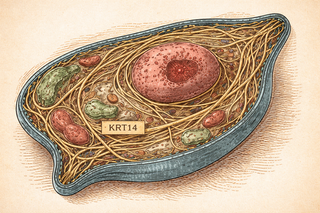
One of the more interesting characters here is keratin 14, or KRT14, a structural protein in the cell’s cytoskeleton. Think of the cytoskeleton as the steel framework inside a building, except the building is alive, moody, and occasionally decides to divide at the worst possible time. Keratins are part of the intermediate filament system that helps cells handle physical stress.
The researchers did not stop at correlation. They pushed KRT14 levels up in cells from younger women and those cells adopted a more biologically aged mechanical state. They knocked KRT14 down in older cells and partly reversed that state. That does not prove KRT14 is the whole story, but it strongly suggests it is not just standing around looking important in a lab coat.
This lines up with a growing mechanobiology literature arguing that cell mechanics are not cosmetic details. They shape how cells move, signal, survive stress, and interact with their neighborhood (Shakiba et al., 2023; Li et al., 2023). If the genome is the script, mechanics may be the stage direction that tells the cast whether to whisper, sprint, or set the theater on fire.
Why this matters in the real world
If this approach holds up in larger studies, it could become a new kind of risk biomarker: not just "Do you carry a mutation?" but "Do your breast cells already behave like tissue under higher risk?" That is a different level of personalization.
The catch is obvious, and the authors are pretty careful about it: this is proof of principle, not a ready-to-roll screening test. The high-risk subgroups were small. We do not yet know how Mechano-RISQ performs across large, diverse populations, or whether it predicts who actually develops cancer years later. Cancer prevention has been burned before by shiny biomarkers that looked great right up until reality arrived with a folding chair.
Still, the idea is sharp. Instead of waiting for a tumor to appear, this work looks for a tissue state that may make tumors more likely in the first place. That is less "find the burglar" and more "notice the locks have been getting weird for months."
And honestly, any paper that combines single-cell mechanics, machine learning, aging biology, and keratin remodeling deserves a little respect. It also deserves a moment of silence for every medical student who thought TP53 drama was already enough for one career.
References
-
Hinz S, Grøndal SM, Miyano M, et al. MechanoAge, a machine learning platform to identify individuals susceptible to breast cancer based on mechanical properties of single cells. EBioMedicine. 2026;127:106241. DOI: https://doi.org/10.1016/j.ebiom.2026.106241. PubMed: https://pubmed.ncbi.nlm.nih.gov/42031621/
-
Shalabi SF, Miyano M, Sayaman RW, et al. Evidence for accelerated aging in mammary epithelia of women carrying germline BRCA1 or BRCA2 mutations. Nature Aging. 2021;1:838-849. DOI: https://doi.org/10.1038/s43587-021-00104-9. PubMed: https://pubmed.ncbi.nlm.nih.gov/35187501/
-
Hussain S, Ali M, Naseem U, et al. Breast cancer risk prediction using machine learning: a systematic review. Front Oncol. 2024;14:1343627. DOI: https://doi.org/10.3389/fonc.2024.1343627. PMCID: https://pmc.ncbi.nlm.nih.gov/articles/PMC10987819/
-
Ghasemi A, Hashtarkhani S, Schwartz DL, Shaban-Nejad A. Explainable artificial intelligence in breast cancer detection and risk prediction: A systematic scoping review. Cancer Innovation. 2024;3(5):e136. DOI: https://doi.org/10.1002/cai2.136. PMCID: https://pmc.ncbi.nlm.nih.gov/articles/PMC11488119/
-
Shakiba D, Genin GM, Zustiak SP. Mechanobiology of cancer cell responsiveness to chemotherapy and immunotherapy: Mechanistic insights and biomaterial platforms. Adv Drug Deliv Rev. 2023;196:114771. DOI: https://doi.org/10.1016/j.addr.2023.114771. PMCID: https://pmc.ncbi.nlm.nih.gov/articles/PMC10133187/
-
Li SS, Xue CD, Li YJ, Chen XM, Zhao Y, Qin KR. Microfluidic characterization of single-cell biophysical properties and the applications in cancer diagnosis. Bioactive Materials. 2023;31:213-239. DOI: https://doi.org/10.1016/j.bioadv.2023.213503. PubMed: https://pubmed.ncbi.nlm.nih.gov/37909658/
Disclaimer: The image accompanying this article is for illustrative purposes only and does not depict actual experimental results, data, or biological mechanisms.