Fair enough - "we trained cell-made bubbles to find ovarian tumors" sounds like the sort of sentence that should come with either a Nobel Prize or a raised eyebrow. But this new study makes a serious case that extracellular vesicles, or EVs, could become something oncology has wanted for years: a delivery system that is both precise and scalable, which is a rare combo in cancer biology, a field that usually hands you one nice thing and three new problems.
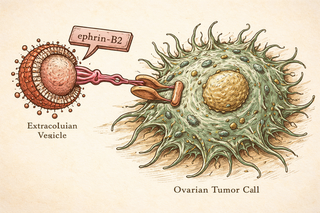
EVs are little membrane-wrapped parcels that cells naturally release. They ferry proteins, RNA, and other cargo between cells, which is useful in normal biology and deeply annoying in cancer, where tumors use them like shady couriers slipping messages across town. Researchers have been trying to hijack EVs for therapy because they are small, biologically compatible, and already know how to move through the body. The catch is that they can be hard to manufacture consistently, hard to load, and not especially obedient about where they end up (Kalita-de Croft et al., 2021; Yu et al., 2024).
The Wildlife Documentary Version
In this paper, Godbole and colleagues took EVs and tried to turn them from wandering drifters into trained falcons.
First, they looked for a better way to pack cargo into these vesicles. Then they tested five cell lines commonly used in biomanufacturing to see which one could serve as a reliable EV factory. Their winner was ExpiCHO cells, which are already familiar to large-scale biologics production. That matters because a clever delivery system is cute in a mouse study, but if you cannot make enough of it cleanly and reproducibly, it stays in the scientific petting zoo.
Next came the targeting trick. The team engineered the EV surface to display ephrin-B2, a ligand that binds tightly to EphB4, a receptor often overexpressed in advanced ovarian cancer. In plain English: they gave the vesicles a molecular name tag that helps them recognize a tumor with the right front-door handle. In mouse models built from patient-derived ovarian tumors, those engineered EVs showed selective accumulation in EphB4-positive tumors after systemic delivery. They also carried a bioluminescent reporter, letting the researchers track where the cargo went over time - which is delightfully nosy science and exactly what you want here (Godbole et al., 2026).
Why This Is More Than Fancy Bubble Decor
Ovarian cancer is notoriously difficult to treat well. It is often diagnosed late, tumors can vary wildly from patient to patient, and even when treatment works at first, resistance loves to stroll in later wearing sunglasses. That is why targeted delivery keeps showing up as the dream dinner guest in oncology - maybe you can hit the tumor harder without spraying the rest of the body with collateral damage.
This study addresses two of the biggest headaches in EV therapeutics at once. One is manufacturing. Reviews across the field keep circling the same complaint: EVs are promising, but scaling them up with consistent quality is hard, and storage, purification, and batch-to-batch reproducibility are still very real obstacles (Herrmann et al., 2023; Bhat et al., 2024). The other headache is targeting. Plenty of particles claim they will "home" to tumors. Some do. Some get distracted en route like a GPS with commitment issues. Here, the authors built around a specific ligand-receptor pair, ephrin-B2 and EphB4, and then tested that selectivity in patient-derived models rather than only tidy lab-grown cells.
That does not mean we should start planning ticker-tape parades for therapeutic vesicles just yet. The cargo in this study was a tracking payload, not an anti-cancer drug. So the paper shows that the delivery van can find the neighborhood and pull into the right driveway. The next question is whether it can drop off something clinically useful once it gets there.
What Could Come Next
If this approach holds up, the obvious next move is to load these EVs with actual therapeutic cargo - RNA drugs, proteins, gene-editing tools, maybe even combinations tailored to the tumor's biology. That is where things get interesting. Ovarian cancer is not one villain in a black hat. It is more like a whole cast of cunning escape artists, each with slightly different tricks. A modular EV platform that can be manufactured at scale and retargeted to specific receptors starts to look less like a science fair project and more like a precision medicine tool kit.
That idea fits with the broader direction of the field. Recent reviews describe EVs as attractive drug carriers precisely because they may cross biological barriers, reduce off-target exposure, and carry complex biological cargo more naturally than many synthetic nanoparticles. The same reviews also wave a large, responsible flag about heterogeneity, purity, loading efficiency, biodistribution, and regulatory standardization - all the thrilling administrative dragons that stand between a neat mouse paper and something your oncologist can prescribe (Kalita-de Croft et al., 2021; Yu et al., 2024; Kim et al., 2025).
For now, the headline is this: scientists took one of cancer biology's weird little communication devices and made it look a bit more like a guided delivery service. And in the sprawling ecosystem of ovarian cancer, where cells migrate, hide, bargain, and generally behave like highly motivated pests, that is a meaningful development.
References
-
Godbole N, Lai A, Quinn A, et al. Scalable Engineering of Bio-Manufactured Extracellular Vesicles for Selective Delivery in Ovarian Cancer Patient-Derived Models. Advanced Science. 2026:e75415. DOI: 10.1002/advs.75415
-
Kalita-de Croft P, Sharma S, Godbole N, Rice GE, Salomon C. Ovarian-Cancer-Associated Extracellular Vesicles: Microenvironmental Regulation and Potential Clinical Applications. Cells. 2021;10(9):2272. DOI: 10.3390/cells10092272
-
Herrmann IK, Wood MJA, Fuhrmann G. The importance of controlled clinical trials with extracellular vesicles. Journal of Extracellular Vesicles. 2023;12(7):e12332. DOI: 10.1002/jev2.12332
-
Yu J, Sane S, Kim JE, et al. Biogenesis and delivery of extracellular vesicles: harnessing the power of EVs for diagnostics and therapeutics. Frontiers in Molecular Biosciences. 2024;10:1330400. DOI: 10.3389/fmolb.2023.1330400
-
Kim S, Kim H, Lee D, et al. Harnessing Extracellular Vesicles for Targeted Drug Delivery in Ovarian Cancer. Pharmaceutics. 2025;17(4):528. DOI: 10.3390/pharmaceutics17040528
Disclaimer: The image accompanying this article is for illustrative purposes only and does not depict actual experimental results, data, or biological mechanisms.