Your peritoneum is a thin, slippery membrane that helps your abdominal organs move around without turning every lunch into a friction experiment. Unfortunately, colorectal cancer can treat that surface like a bonus expansion pack. Once tumor cells spread there, the disease gets harder to control, and the immune system often looks less like elite security and more like an IT ticket queue from 1998.
A new paper in Cancer Immunology Research looked at why that might be happening in peritoneal colorectal cancer, and the answer is a little sneaky: not raging inflammation, but the opposite. In a mouse model that mimics human metastatic colorectal cancer, researchers found that a relatively low-inflammatory environment allowed a specific group of long-term resident macrophages to multiply, move into the omentum, and help tumors grow. These cells carried markers called Tim4 and TREM1, which is the kind of naming scheme that makes biologists sound like they lost a bet with an acronym generator [1].
The quiet room where the wrong staff got promoted
Macrophages are immune cells that can act like cleanup crews, sensors, and emergency responders. Some arrive fresh from circulating monocytes. Others are tissue residents, meaning they already live on site and know the neighborhood better than your average visiting immune cell.
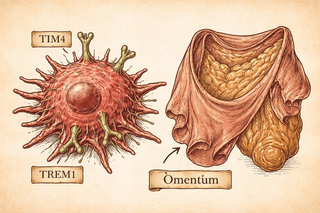
This study found that during peritoneal colorectal tumor growth, the cavity stayed surprisingly low on inflammatory alarms. That mattered because fewer alarms meant fewer incoming monocytes. So instead of getting a big wave of newly recruited macrophages, the resident Tim4-positive macrophages expanded mostly by local self-renewal, like middle management cloning itself during a system outage [1].
That shift seems important. The expanded resident macrophages were not neutral bystanders. They showed a gene-expression program linked to migration, immune suppression, and tumor support, including molecules such as ARG1, IDO, PD-L1/2, SPP1, TREM1, and VEGF-a [1]. In plain English: these cells were not there to break up the party. They were helping the tumor book the venue.
Why the omentum keeps showing up like a bad sequel
The omentum is a fatty apron-like fold inside the abdomen, and it is a common landing site for peritoneal metastases. It also contains immune-cell-rich structures sometimes called milky spots, which sounds adorable right up until cancer weaponizes them.
In the new study, Tim4+TREM1+ resident macrophages migrated to the omentum and promoted tumor progression there [1]. That fits with a growing body of work suggesting the peritoneal cavity has its own immune logic. It is not just "colon cancer, but in a different ZIP code." It is a distinct microenvironment with its own failure modes.
Human studies back that up. A 2025 Nature Communications paper found that peritoneal resident macrophages in patients with peritoneal metastatic colorectal cancer form an immunosuppressive niche, with higher IL-10 and VEGF and weaker antigen-presentation signals. In mouse experiments, combining macrophage depletion with anti-PD-1 reduced tumor burden and improved survival [2]. Another 2024 study reported that colorectal peritoneal metastases carry a strongly immunoregulatory environment, including PD-L1 and PD-L2 expression across several cell types [3].
The weirdly useful plot twist
The big twist here is that "less inflammation" does not automatically mean "less danger." In this setting, a quieter environment seems to reduce recruitment of outside immune reinforcements while giving resident macrophages room to expand into a tumor-friendly workforce [1]. It is a bit like a building with no fire alarm, no outside inspectors, and a maintenance crew that has quietly decided the electrical short is a design feature.
That matters because peritoneal metastases from colorectal cancer still have limited treatment options and generally worse outcomes than metastases in some other sites [2,4]. Surgery and intraperitoneal chemotherapy can help selected patients, but recurrence remains common, and the biology of the peritoneal niche may be part of the reason [4,5].
What this could mean in real life
If these findings hold up in human disease and across larger studies, they point toward a more targeted strategy: stop treating all macrophages like one blob and go after the specific resident populations that are helping tumors. Tim4, TREM1, CSF1R-related pathways, and other macrophage-associated signals could become part of combination immunotherapy approaches for peritoneal colorectal cancer [1,2].
That does not mean patients are about to get a Tim4-blocking miracle next Thursday. This paper is preclinical, and mouse immune systems, while useful, do occasionally behave like prototypes that passed unit tests and then exploded in production. Still, it sharpens the map. And in cancer biology, a better map is often the difference between wandering around the server room and actually fixing the outage.
References
-
Ferriz M, Alvarez-Ladrón N, Gutiérrez-González A, et al. Low inflammation correlates with protumor Tim4+TREM1+ resident macrophage expansion and limited monocyte-derived macrophage differentiation during peritoneal colorectal cancer. Cancer Immunology Research. 2026. DOI: https://doi.org/10.1158/2326-6066.CIR-25-0388
-
Logiantara A, Jongerius C, Garcia Vallejo JJ, et al. Peritoneal resident macrophages constitute an immunosuppressive environment in peritoneal metastasized colorectal cancer. Nature Communications. 2025;16:3669. DOI: https://doi.org/10.1038/s41467-025-58999-6
-
Sundström P, Hogg S, Quiding Järbrink M, Bexe Lindskog E. Immune cell infiltrates in peritoneal metastases from colorectal cancer. Frontiers in Immunology. 2024;15:1347900. DOI: https://doi.org/10.3389/fimmu.2024.1347900 PMCID: https://pmc.ncbi.nlm.nih.gov/articles/PMC10879551/
-
Sikora A, Sullivan KM, Dineen S, Raoof M, Karolak A. Emerging therapeutic approaches for peritoneal metastases from gastrointestinal cancers. Molecular Therapy Oncolytics. 2024;32:200767. DOI: https://doi.org/10.1016/j.omton.2024.200767 PMCID: https://pmc.ncbi.nlm.nih.gov/articles/PMC10873742/
-
Chow A, Schad S, Green MD, et al. Tim-4+ cavity-resident macrophages impair anti-tumor CD8+ T cell immunity. Cancer Cell. 2021;39(7):973-988.e9. DOI: https://doi.org/10.1016/j.ccell.2021.05.006
Disclaimer: The image accompanying this article is for illustrative purposes only and does not depict actual experimental results, data, or biological mechanisms.