Fair question: do we really need artificial intelligence to stare at prostate biopsy slides, or is this just a very expensive way to say, “that looks bad”?
In this study, the answer is: maybe we do. And not because the computer has mystical powers. It does not. It has math, pixels, clinical data, and the bedside manner of a toaster.
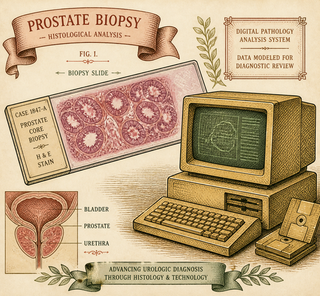
The paper looked at men with non-metastatic, very high-risk prostate cancer enrolled in two STAMPEDE phase 3 abiraterone trials. These were not tiny “we found three patients and a spreadsheet” studies. The analysis included 1,137 men treated with long-term androgen deprivation therapy, with or without abiraterone.
Abiraterone is a hormone-blocking drug. Prostate cancer often runs on androgen signaling, like a bad franchise that refuses to close. Standard hormone therapy cuts much of that fuel. Abiraterone cuts more.
That can help. It can also bring side effects, cost, and the general joy of adding another serious medication to life. So the real question is simple: who needs the extra firepower?
The Slide Had Opinions
The researchers used a locked multimodal artificial intelligence model. “Locked” means the model was not tuned after peeking at these results, which is good. Otherwise, the AI is just doing what many humans do after a bad prediction: quietly moving the goalposts.
The model used routine digital pathology images plus age, PSA, and tumor stage. It sorted patients into two groups: MMAI standard high-risk and MMAI very high-risk.
Then came the useful part.
In the MMAI very high-risk group, adding abiraterone improved metastasis-free survival. The hazard ratio was 0.47, and 5-year metastasis-free survival rose from 62% with long-term hormone therapy alone to 81% with abiraterone added.
That is not a rounding error. That is the kind of difference clinicians notice without needing extra coffee.
In the larger MMAI standard high-risk group, the benefit looked much smaller. Five-year metastasis-free survival was 82% without abiraterone and 84% with it. The interaction p-value was 0.02, suggesting the treatment effect really did differ between groups.
Translation: the AI may have spotted which tumors were likely to care about abiraterone.
Why This Matters
High-risk prostate cancer is already a sorting problem. Doctors use PSA, Gleason grade, tumor stage, imaging, lymph node status, and patient health. It is a lot. The tumor board table gets crowded.
But those clinical features can still lump together men whose cancers behave differently. Two tumors can wear the same clinical nametag and act like completely different roommates. One is quiet. One is setting off fireworks indoors.
A tool like this could help separate “needs intensification” from “may be spared extra toxicity.” That is the dream: more treatment for the people likely to benefit, less treatment for people unlikely to gain much.
The STAMPEDE trial platform has already helped change prostate cancer care. Prior work showed that adding abiraterone to standard therapy improves outcomes in high-risk non-metastatic prostate cancer, making it a serious option rather than a speculative side quest (Lancet, 2022; PMCID: PMC8811484).
This new analysis asks a sharper question: can we avoid treating everyone as if they have the same cancer wearing different hats?
The AI Is Not a Crystal Ball
This was a post-hoc analysis. That matters.
The patients came from randomized trials, which is strong. The AI model was locked, which is also strong. But the treatment-selection idea still needs prospective testing before everyone starts handing biopsy slides to algorithms like tiny paper offerings.
AI pathology also has ordinary problems with fancy names. Scanners differ. Tissue staining differs. Patient populations differ. Models can learn real biology, or they can learn weird shortcuts if nobody watches them closely. Computers are excellent at finding patterns. They are not always excellent at knowing whether the pattern is useful or nonsense in a lab coat.
Still, this fits a larger movement. Multimodal AI has been explored as a way to combine images and clinical data in medicine (Nature Medicine, 2022). In prostate cancer specifically, earlier work showed that deep learning can read pathology slides for diagnosis and grading (Nature Medicine, 2022) and that multimodal models may help personalize therapy decisions (npj Digital Medicine, 2022; PMCID: PMC9177850).
So this is not “AI replaces doctors.” Please retire that headline. It had a long shift.
This is closer to “AI may give doctors another lens.” A good lens does not make decisions. It helps you see.
The Clean Takeaway
If these results hold up, a routine prostate biopsy could do more than confirm cancer and grade it. It could help predict whether abiraterone is worth adding.
That would be a practical win. Same tissue. More information. Better aim.
For patients, that could mean fewer unnecessary side effects. For clinicians, it could mean less guessing. For cancer cells, frankly, it is rude. But they started it.
References
Parker CTA, Huang H-C, Grist E, et al. Multimodal Artificial Intelligence Prediction of Abiraterone Efficacy in Two STAMPEDE Phase 3 Trials of Non-Metastatic Very High-Risk Prostate Cancer. Annals of Oncology. 2026. https://doi.org/10.1016/j.annonc.2026.05.708
Attard G, Murphy L, Clarke NW, et al. Abiraterone acetate and prednisolone with or without enzalutamide for high-risk non-metastatic prostate cancer: a meta-analysis of two STAMPEDE phase 3 trials. Lancet. 2022. https://doi.org/10.1016/S0140-6736(21)02437-5
Esteva A, Feng J, van der Wal D, et al. Prostate cancer therapy personalization via multi-modal deep learning on randomized phase III clinical trials. npj Digital Medicine. 2022. https://doi.org/10.1038/s41746-022-00613-w
Bulten W, Kartasalo K, Chen P-HC, et al. Artificial intelligence for diagnosis and Gleason grading of prostate cancer: the PANDA challenge. Nature Medicine. 2022. https://doi.org/10.1038/s41591-021-01620-2
Acosta JN, Falcone GJ, Rajpurkar P, Topol EJ. Multimodal biomedical AI. Nature Medicine. 2022. https://doi.org/10.1038/s41591-022-01981-2
Disclaimer: The image accompanying this article is for illustrative purposes only and does not depict actual experimental results, data, or biological mechanisms.