In the video game version of pancreatic cancer, the tumor is the final boss, chemotherapy is your slightly underpowered sword, and the tumor microenvironment is that unfair level where the floor is lava, the doors lock behind you, and someone keeps stealing your health packs.
That “someone,” for years, has often been cancer-associated fibroblasts, or CAFs. These are support cells living around a tumor. In pancreatic ductal adenocarcinoma, the most common and notoriously stubborn form of pancreatic cancer, CAFs help build the thick, scar-like neighborhood around cancer cells. Think of them as construction workers in a sketchy part of town. Some build walls that protect the tumor. Some send inflammatory text messages. Some may even help immune cells lose the address.
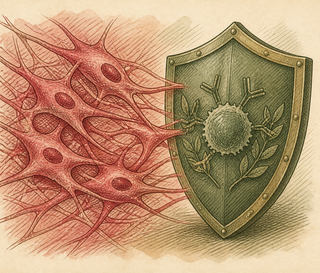
But a new study in Gut suggests the CAF story is not just “fibroblasts bad, smash fibroblasts.” Biology, because it enjoys making our lives complicated, has added a plot twist: one subtype of CAFs may be linked with better outcomes.
The Fibroblast Family Reunion Gets Awkward
Chen and colleagues used single-cell multiomics to study pancreatic cancer tissue in fine detail. That means they did not just ask, “Which genes are on?” They also looked at chromatin accessibility, spatial location, and how these cells seemed to communicate with nearby immune cells. Basically, they gave the tumor neighborhood a full census, zoning report, and group chat analysis.
Their focus was a CAF subtype called complement-secreting CAFs, or csCAFs. The complement system is part of your innate immune system, a fast-moving protein alarm system that helps mark threats, summon cleanup crews, and sometimes punch holes in suspicious cells. It is not subtle. It is more “hospital overhead page at 2 a.m.” than whisper.
The team found that csCAFs overlapped with inflammatory CAFs, or iCAFs, but were not identical. The data suggested csCAFs may represent an earlier state that can shift toward iCAFs as pancreatic cancer develops. In other words, these cells may start out wearing the “helpful-ish neighbor” badge and later get pulled into the tumor’s messier drama.
The Surprising Part: More csCAFs, Better Outcomes
Here is the bedside-relevant part: patients whose tumors had a higher proportion of csCAFs lived longer overall and had longer recurrence-free survival in the study’s analyses. That does not mean csCAFs cure cancer. Nobody should be handing these cells a tiny medal yet.
But it does mean the old idea of targeting CAFs as one big villainous blob looks too crude. Earlier work has already shown that pancreatic CAFs come in multiple flavors, including myofibroblastic CAFs, inflammatory CAFs, and antigen-presenting CAFs. Some may restrain cancer. Some may feed it snacks and hold the door open. If we treat all CAFs like the same bad guy, we risk flattening the body’s complicated, sometimes useful response to cancer.
That matters because pancreatic cancer already asks patients to fight uphill. It is often found late, resists many therapies, and surrounds itself with dense stroma that can block drugs and dampen immune attack. From the bedside, this is the part that feels so unfair: the tumor is not just a lump of bad cells. It builds a whole neighborhood watch program, except the neighborhood is watching out for the tumor.
What Was Happening Around These Cells?
Tumor areas richer in csCAFs had lower levels of TGF-beta ligands, fewer M2 tumor-associated macrophages, and more lipid mediators. Translation: the local environment looked less like an immune-suppressive swamp and more like a place where antitumor responses might have a fighting chance.
The researchers also saw CXCL12-CXCR4 signaling between csCAFs and T cells, with different patterns depending on metastatic site. That is a mouthful, but the idea is simple: cells talk using molecular signals, and this particular “come over here” signal may shape where immune cells go and what they do. Like any hospital hallway conversation, context matters. The same message can mean “urgent help needed” or “please wait outside exam room three forever.”
Could We Reprogram the Neighborhood?
The authors raise an intriguing possibility: instead of deleting CAFs, maybe we could reprogram tumor-promoting CAF states back toward more favorable ones like csCAFs. That would be a major shift. Less demolition crew, more renovation team.
There are plenty of caveats. This is not yet a treatment. These findings need validation in larger cohorts, functional experiments, and eventually therapy-focused studies. Single-cell maps are powerful, but a map is not the same as a working ambulance route. We still need to know whether pushing CAFs toward a csCAF-like state actually improves treatment response, helps immune cells work better, or changes outcomes in people.
Still, this study gives pancreatic cancer researchers a more humane kind of precision. Not just “kill the bad cells,” but “understand the whole room.” Anyone who has cared for patients through pancreatic cancer knows that details matter: which symptom changed, which scan shifted, which lab result stopped behaving itself. Tumors have details too. Some of them may be hiding in the cells we used to overlook.
References
-
Chen K, Ma Y, Huang L, et al. Complement-secreting CAFs are associated with better prognosis in pancreatic cancer: single-cell multiomics. Gut. 2026;75(7):1367-1382. https://doi.org/10.1136/gutjnl-2025-335683
-
Zhang T, Ren Y, Yang P, Wang J, Zhou H. Cancer-associated fibroblasts in pancreatic ductal adenocarcinoma. Cell Death & Disease. 2022;13:897. https://doi.org/10.1038/s41419-022-05351-1 PMCID: PMC9596464
-
Brichkina A, Polo P, Sharma SD, Visestamkul N, Lauth M. A quick guide to CAF subtypes in pancreatic cancer. Cancers. 2023;15(9):2614. https://doi.org/10.3390/cancers15092614 PMCID: PMC10177377
-
Elyada E, Bolisetty M, Laise P, et al. Cross-species single-cell analysis of pancreatic ductal adenocarcinoma reveals antigen-presenting cancer-associated fibroblasts. Cancer Discovery. 2019;9(8):1102-1123. https://doi.org/10.1158/2159-8290.CD-19-0094 PMCID: PMC6727976
-
Pan X, Zhou J, Xiao Q, et al. Cancer-associated fibroblast heterogeneity is associated with organ-specific metastasis in pancreatic ductal adenocarcinoma. Journal of Hematology & Oncology. 2021;14:184. https://doi.org/10.1186/s13045-021-01203-1
Disclaimer: The image accompanying this article is for illustrative purposes only and does not depict actual experimental results, data, or biological mechanisms.