Radiation beams, manganese ions, and a whiff of carbon monoxide are not the usual trio you expect to team up against cancer, but here we are.
The paper behind this odd little alliance tackles a real problem in radiotherapy. Radiation can do more than just blast tumor cells. It can also leave broken bits of DNA floating around inside cells, which sets off the cGAS-STING pathway - basically your body's internal burglar alarm for DNA that looks like it is in the wrong place. When that alarm works, immune cells get the memo, dendritic cells wake up, and T cells may finally stop acting like security guards locked outside the building [1,2].
The catch is that this immune jolt is often brief. Tumors are annoyingly good at surviving the first punch, then dragging the fight back into a swampy, immunosuppressive mess. That is the tactical problem this study tries to solve.
A Better Ambush
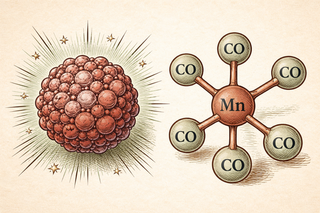
Kai Deng and colleagues built an X-ray-responsive nanoplatform called SCYS-P@MnCO [1]. The idea is sneaky in a way you almost have to respect. They paired scintillating nanoparticles, which glow when hit by X-rays, with photosensitive manganese carbonyl complexes. When radiation arrives, the particles act like tiny translators, converting X-ray energy into a signal that triggers the local release of manganese ions and carbon monoxide inside the tumor.
That matters because each payload brings a different weapon to the fight.
Manganese helps cGAS notice stray tumor DNA more strongly, which can amplify STING signaling and boost interferon-beta production, dendritic cell maturation, and downstream T-cell activity [1,3]. Carbon monoxide, which usually sounds like the villain in a homeowner's safety brochure, is used here in a very controlled way to make tumor cells more sensitive to radiation [1]. Cancer biology is weird. If you ever feel underqualified reading these papers, that is a healthy response.
So instead of radiation giving the immune system a quick tap on the shoulder, this setup tries to turn it into a coordinated counter-offensive.
Why Radiation Alone Sometimes Plays Small Ball
Radiotherapy already has a reputation as a local treatment, but researchers have spent years trying to get it to provoke a body-wide immune response too. That rare effect, where treating one tumor helps shrink tumors elsewhere, is called the abscopal effect. It is a great concept and a terrible thing to rely on casually, a bit like building your playoff strategy around half-court buzzer-beaters [2].
One reason is timing. Radiation can create the kind of DNA damage that activates cGAS-STING, but tumors often limit how long that signal lasts. Reviews over the past few years have pointed to the same broad problem: radiation can spark immunity, yet the tumor microenvironment quickly throws sand in the gears with immune suppression, poor antigen presentation, and not enough durable T-cell activation [2,4].
This is where manganese keeps showing up like a veteran utility player nobody wants to leave on the bench. Prior work has shown Mn2+ can strengthen cGAS-STING signaling and even improve antitumor immune responses in preclinical models, with early clinical interest in pairing manganese-related strategies with checkpoint blockade [3,5].
What Makes This Paper Interesting
The clever part is not just "nanoparticles plus radiation," because that sentence now describes roughly half of modern cancer nanomedicine. The interesting move is the choreography.
This platform uses X-rays, which are already part of standard cancer care, as the switch. That gives the system some spatial and temporal control. In plain English: the payload is supposed to go active where and when radiation is delivered, rather than wandering off like a lab intern sent to buy coffee. The released manganese then pushes harder on innate immune sensing, while carbon monoxide helps the radiation hit land more cleanly [1].
That combination fits with a larger trend in the field. Recent reviews and preclinical studies show growing interest in using nanoparticles not just as passive delivery trucks, but as tumor microenvironment remodelers and immune amplifiers during radiotherapy [2,4]. Researchers are increasingly trying to turn "cold" tumors into "hot" ones by coupling radiation damage with STING activation, better dendritic-cell priming, and stronger CD8+ T-cell infiltration [2,4,5].
The Real-World Promise, With Both Feet on the Ground
If this kind of result holds up in more models and eventually in people, the upside is pretty easy to see. You could imagine radiotherapy doing double duty: directly damaging the tumor while also sending a much louder immune distress signal. That might improve local control, help distant lesions become more visible to the immune system, and make combinations with checkpoint inhibitors more effective.
That said, nobody should confuse "promising preclinical strategy" with "next week in clinic." STING-targeted cancer therapy has had a bumpy road so far. Clinical experience with STING agonists has shown that immune activation is possible, but durable responses and clean delivery remain hard problems [5,6]. Nanoparticles add their own list of headaches too: manufacturing consistency, tumor delivery, off-target effects, and the eternal question of whether mouse tumors are telling us the truth or just freelancing again.
Still, this paper has a strong strategic logic. Radiation creates the opening. Carbon monoxide helps widen it. Manganese tells the immune system to stop admiring the opening and charge through it.
That is not a cure. It is a better battle plan.
References
-
Deng K, Zheng Y, Han Y, Xie Y, Luo Z, Li Y, Jiang J, Qin Z, Shi X, Yang H, Yang Y, Shi Q, Liu X, Du Z. X-Ray-Responsive Mn2+ Release via Scintillating Nanoparticles Drives cGAS-STING Activation for Enhanced Radio-Immunotherapy. Small. 2026. DOI: https://doi.org/10.1002/smll.73513 ; PubMed: https://pubmed.ncbi.nlm.nih.gov/42023514/
-
Colangelo NW, Gerber NK, Vatner RE, Cooper BT. Harnessing the cGAS-STING pathway to potentiate radiation therapy: current approaches and future directions. Front Pharmacol. 2024;15:1383000. DOI: https://doi.org/10.3389/fphar.2024.1383000 ; PMCID: https://pmc.ncbi.nlm.nih.gov/articles/PMC11039815/
-
He X, Wedn A, Wang J, Gu Y, Liu H, Zhang J, Lin Z, Zhou R, Pang X, Cui Y. IUPHAR ECR review: The cGAS-STING pathway: Novel functions beyond innate immune and emerging therapeutic opportunities. Pharmacol Res. 2024;201:107063. DOI: https://doi.org/10.1016/j.phrs.2024.107063
-
Zhen W, Weichselbaum RR, Lin W. Nanoparticle-Mediated Radiotherapy Remodels the Tumor Microenvironment to Enhance Antitumor Efficacy. Adv Mater. 2023;35(21):e2206370. DOI: https://doi.org/10.1002/adma.202206370 ; PMCID: https://pmc.ncbi.nlm.nih.gov/articles/PMC10213153/
-
Gehrcken L, Deben C, Smits E, Van Audenaerde JRM. STING Agonists and How to Reach Their Full Potential in Cancer Immunotherapy. Adv Sci (Weinh). 2025;12(17):e2500296. DOI: https://doi.org/10.1002/advs.202500296 ; PMCID: https://pmc.ncbi.nlm.nih.gov/articles/PMC12061341/
-
Meric-Bernstam F, Sweis RF, Hodi FS, Messersmith WA, Andtbacka RHI, Ingham M, Lewis KD, Chen EX, Hong DS, Hamilton EP, et al. Phase I Dose-Escalation Trial of MIW815 (ADU-S100), an Intratumoral STING Agonist, in Patients with Advanced/Metastatic Solid Tumors or Lymphomas. Clin Cancer Res. 2022;28(4):677-688. DOI: https://doi.org/10.1158/1078-0432.CCR-21-1963
Disclaimer: The image accompanying this article is for illustrative purposes only and does not depict actual experimental results, data, or biological mechanisms.