What if the difference between “chemo first” and “targeted pill first” came down to one tiny genetic typo hiding in exon 20, the molecular equivalent of someone wedging a sofa in a doorway?
That is basically the story of EGFR exon 20 insertion-mutated non-small-cell lung cancer, or NSCLC if you prefer your diseases with airport-code energy. EGFR is a growth-signal receptor. In normal cells, it helps regulate when cells should grow. In some lung cancers, EGFR gets jammed into the “go” position. The cell hears “grow, grow, grow,” like a toddler with a drum set and no bedtime.
Doctors have had good EGFR-targeted drugs for years, but exon 20 insertions have been the awkward cousin at the family reunion. Classic EGFR mutations often respond beautifully to EGFR pills. Exon 20 insertions? Not so much. The mutation changes the shape of the drug-binding pocket, so older drugs often bounce off like they forgot the password.
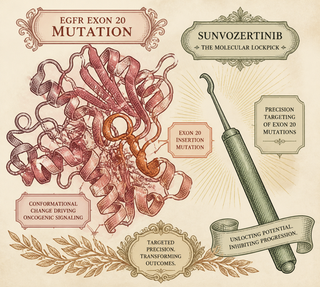
The Exon 20 Problem, Translated
Think of EGFR as a light switch. Many EGFR mutations flip the switch on, and targeted drugs can tape it back down. Exon 20 insertions also flip the switch on, but they slightly remodel the wall around the switch. So the usual tape, screwdriver, and stern talking-to do not work well.
That has left many patients with advanced nonsquamous NSCLC and EGFR exon 20 insertions starting with platinum-based chemotherapy. Chemo can help, but it is not exactly a precision instrument. It is more “spray the weeds” than “find the one suspicious weed wearing a name tag.”
Sunvozertinib is different. It is an oral EGFR tyrosine kinase inhibitor designed to hit these exon 20 insertion variants more directly. In other words, instead of yelling at the whole room, it tries to grab the right molecular troublemaker by the lapels.
The WU-KONG28 Trial: Pill vs Chemo
In this new phase 3 international trial, Zhou and colleagues randomly assigned 324 patients with advanced nonsquamous NSCLC and EGFR exon 20 insertion mutations to receive either first-line sunvozertinib or platinum-based chemotherapy. The headline result: sunvozertinib delayed cancer worsening better than chemotherapy.
Median progression-free survival was 10.3 months with sunvozertinib versus 7.5 months with chemotherapy. The hazard ratio for disease progression or death was 0.65, meaning the sunvozertinib group had a meaningfully lower risk of progression or death during the study period. At 12 months, 46.1% of patients on sunvozertinib had not had disease progression, compared with 26.7% on chemotherapy.
Tumors also shrank more often. The objective response rate was 58.9% with sunvozertinib and 31.1% with chemotherapy. That is not a cure, and nobody should pretend otherwise, but in metastatic lung cancer, extra months of disease control can mean more time feeling like a person instead of a calendar of appointments.
The Catch, Because Biology Never Lets Us Have a Clean Victory
Sunvozertinib was not a free lunch. Grade 3 or higher adverse events happened in 75.5% of patients receiving the drug versus 56.7% receiving chemotherapy. The notable severe side effects included increased creatine kinase, diarrhea, and anemia. That is the medical version of “the lockpick works, but it occasionally scratches the doorframe.”
Still, investigators reported no deaths attributed to sunvozertinib-related adverse events. Overall survival data were immature, so the big question remains: does starting with sunvozertinib help people live longer, not just go longer before the cancer grows? That answer needs more follow-up.
Why This Matters Beyond the Bar Napkin Diagram
This trial lands in a fast-moving treatment landscape. Amivantamab plus chemotherapy already showed first-line benefit in EGFR exon 20 insertion-mutated NSCLC in the PAPILLON trial. Sunvozertinib adds a different kind of option: an oral targeted pill that directly challenges chemotherapy as the starting move.
If these results hold up and expand across broader real-world groups, the impact could be practical and personal. More patients might begin treatment with a mutation-matched therapy. Fewer might need to rely on chemo alone as the opening act. And molecular testing becomes even more non-negotiable, because you cannot target a mutation you never looked for. That sounds obvious, but cancer care has a way of turning obvious things into paperwork, insurance calls, and three faxes to the wrong number.
The bigger lesson is that “lung cancer” is no longer one disease. It is a messy group chat of molecular subtypes, each with its own bad behavior. EGFR exon 20 insertion used to be one of the harder messages to answer. Sunvozertinib may not solve the whole conversation, but it gives clinicians a sharper reply.
References
-
Zhou C, Greillier L, Liu G, et al. First-Line Sunvozertinib in NSCLC with EGFR Exon 20 Insertion Mutations. New England Journal of Medicine. 2026. DOI: 10.1056/NEJMoa2604461
-
Zhou C, et al. Amivantamab plus Chemotherapy in NSCLC with EGFR Exon 20 Insertions. New England Journal of Medicine. 2023. DOI: 10.1056/NEJMoa2306441
-
Wang M, Yang JC, Mitchell PL, et al. Sunvozertinib, a Selective EGFR Inhibitor for Previously Treated Non-Small Cell Lung Cancer with EGFR Exon 20 Insertion Mutations. Cancer Discovery. 2022;12:1676-1689. DOI: 10.1158/2159-8290.CD-21-1615, PMCID: PMC9262839
-
Wang M, Fan Y, Sun M, et al. Sunvozertinib for patients in China with platinum-pretreated locally advanced or metastatic NSCLC and EGFR exon 20 insertion mutation (WU-KONG6). The Lancet Respiratory Medicine. 2024;12:217-224. DOI: 10.1016/S2213-2600(23)00379-X
-
Vyse S, Huang PH. EGFR and HER2 exon 20 insertions in solid tumours: from biology to treatment. Nature Reviews Clinical Oncology. 2022;19:51-69. DOI: 10.1038/s41571-021-00558-1
Disclaimer: The image accompanying this article is for illustrative purposes only and does not depict actual experimental results, data, or biological mechanisms.