In 1903, physicists briefly lost their minds over "N-rays" - an imaginary form of radiation that turned out to be less real than a reality TV promise. This PubMed entry has a similar whiff of scientific whiplash: PMID 42044351 is not the flashy pancreatic cancer study itself, but the 2026 retraction notice for it.
That distinction matters. A lot.
The original 2025 PNAS paper claimed something every pancreatic cancer researcher wants to hear and every tumor wants to pretend it didn't: a triple targeted therapy appeared to drive strong tumor regression in mouse and xenograft models of pancreatic ductal adenocarcinoma, or PDAC, while also holding off resistance for a surprisingly long stretch (Liaki et al., 2025). The combo went after KRAS, EGFR, and STAT3 - basically three major troublemakers in one extremely dysfunctional cellular group chat.
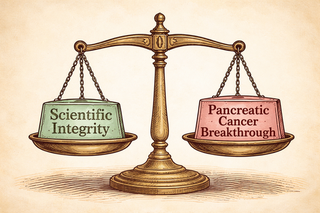
Then came the record scratch. In April 2026, PNAS retracted the paper because relevant competing financial interests were not disclosed at submission. The retraction notice specifically says authors held financial interests in Vega Oncotargets and that the paper should not have gone through the contributed-submission route under PNAS policy (Retraction notice). That is a research-integrity problem, not the same thing as a public finding of data fabrication. But if you're asking whether that still matters, yes - wildly. Science runs on methods, replication, and trust. Remove one leg of that stool and suddenly everyone's on the floor.
Pancreatic cancer is the worst roommate
PDAC is brutal. It usually shows up late, spreads early, and treats many therapies like spam email - ignored, filtered, gone. Reviews over the past few years keep hammering the same point: even when researchers find a promising angle, pancreatic tumors adapt fast through backup signaling routes, dense scar-like stroma, and an immune microenvironment that behaves like a nightclub bouncer who hates T cells on principle (Hu and O'Reilly, 2024; Arya et al., 2024).
And then there's KRAS, the gene that acts like the main breaker switch in most pancreatic cancers. Over 90% of PDACs carry KRAS mutations, which is one reason researchers have become borderline poetic about finally drugging it (Khan et al., 2023; Drizyte-Miller et al., 2025).
So the logic behind the original study was not ridiculous. It was actually pretty rational: if blocking KRAS alone leads tumors to sneak around the blockade, maybe you also shut down EGFR and STAT3, two routes cancer cells can use to keep the party going. It's the oncology version of not just locking the front door, but also the back door and that weird basement window your tumor absolutely knows about.
Why scientists got excited in the first place
The original paper reported that combining a pan-RAS inhibitor with afatinib and the STAT3 degrader SD36 caused deep regressions in preclinical PDAC models and seemed to prevent relapse for more than 200 days in some settings (Liaki et al., 2025). If that held up, it would be a big deal. Not "cancel-all-other-medicine" big, but real big.
Why? Because pancreatic cancer has an almost supernatural talent for evolving around single-agent therapy. Recent work in Cancer Discovery showed KRAS inhibition in pancreatic cancer runs into both genetic and non-genetic resistance mechanisms, which is science-speak for "the tumor keeps finding new ways to be annoying" (Dilly et al., 2024). Another 2025 study in Cancer Immunology Research found that even when you push immune cells into pancreatic tumors, the cancer can stack multiple checkpoint pathways like a bureaucrat building extra forms just to ruin your afternoon (Stone et al., 2025).
So yes, combination therapy is not some overcaffeinated fantasy. It is increasingly the whole game.
The annoying, necessary buzzkill
Here is the sober part with only a light seasoning of bar-stool honesty: a retracted paper should not be treated as established evidence. Not because every retracted result is automatically false, but because the scientific system has formally said, "Hold up - this record is not reliable enough to stand as published."
That means the real takeaway is not "pancreatic cancer cured in mice, drinks on the house." The real takeaway is that the idea - hitting multiple escape routes at once - fits where the field is going, but this particular paper no longer gets to serve as clean proof.
If future independent groups reproduce the same three-pathway strategy, or some cleaner cousin of it, then this line of attack could matter a lot for real patients. It could mean longer responses, fewer early relapses, and maybe one day a pancreatic tumor that cannot just shrug and reroute its wiring like an evil IT department.
For now, though, this story sits in a very modern scientific category: promising biology, messy human behavior, and a reminder that cancer research needs both bold experiments and boringly honest disclosure forms. Glamorous? No. Essential? Absolutely.
References
-
Liaki V, Barrambana S, Kostopoulou M, et al. A targeted combination therapy achieves effective pancreatic cancer regression and prevents tumor resistance. Proc Natl Acad Sci U S A. 2025;122(49):e2523039122. DOI: https://doi.org/10.1073/pnas.2523039122
-
Retraction for Liaki et al., A targeted combination therapy achieves effective pancreatic cancer regression and prevents tumor resistance. Proc Natl Acad Sci U S A. 2026;123(18):e2612385123. DOI: https://doi.org/10.1073/pnas.2612385123
-
Hu ZI, O'Reilly EM. Therapeutic developments in pancreatic cancer. Nat Rev Gastroenterol Hepatol. 2024;21:7-24. DOI: https://doi.org/10.1038/s41575-023-00840-w
-
Arya RK, Kumari S, Padmanabhan A, et al. Unveiling the resistance to therapies in pancreatic ductal adenocarcinoma. Drug Resist Updat. 2024;77:101146. DOI: https://doi.org/10.1016/j.drup.2024.101146
-
Dilly J, Hoffman MT, Abbassi L, et al. Mechanisms of Resistance to Oncogenic KRAS Inhibition in Pancreatic Cancer. Cancer Discov. 2024;14(11):2135-2161. DOI: https://doi.org/10.1158/2159-8290.CD-24-0177
-
Stone ML, Herrera V, Li Y, et al. Non-redundant immune checkpoints direct therapeutic resistance to chemoimmunotherapy in pancreatic ductal adenocarcinoma. Cancer Immunol Res. 2025;13(11):OF1-OF13. DOI: https://doi.org/10.1158/2326-6066.CIR-25-0575
-
Khan S, Budamagunta V, Zhou D. Targeting KRAS in pancreatic cancer: Emerging therapeutic strategies. Adv Cancer Res. 2023;159:145-184. DOI: https://doi.org/10.1016/bs.acr.2023.02.004
-
Drizyte-Miller K, Cox AD, Der CJ, et al. KRAS: the Achilles' heel of pancreas cancer biology. J Clin Invest. 2025;135(16):e191939. DOI: https://doi.org/10.1172/JCI191939
Disclaimer: The image accompanying this article is for illustrative purposes only and does not depict actual experimental results, data, or biological mechanisms.