Inside a cancer cell, the manufacturing floor is supposed to have a built-in shutdown switch for defective products. BCL-2 is the smug middle manager who keeps slapping "keep running" stickers on cells that absolutely should have been escorted out by security. Sonrotoclax shows up like the auditor nobody invited and starts asking why the broken machinery is still drawing a salary.
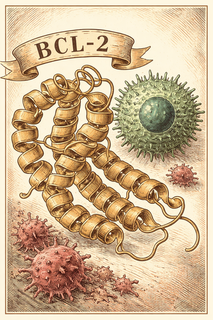
That is the basic drama behind sonrotoclax, a newly approved drug aimed at BCL-2, a protein that helps cancer cells dodge apoptosis - the tidy self-destruct program cells use when things go badly wrong. In the paper Sonrotoclax: First Approval, Hannah Blair summarizes the drug’s path to its first approval, which came in China on January 6, 2026 for adults with relapsed or refractory CLL/SLL after prior therapy including a BTK inhibitor, and for mantle cell lymphoma (MCL) after at least two prior systemic treatments including a BTK inhibitor [1]. Then, on May 13, 2026, the U.S. FDA granted accelerated approval for sonrotoclax in relapsed or refractory MCL [2].
Why cancer keeps cheating death
CLL and MCL are both cancers of B cells, a type of white blood cell. CLL usually behaves like that houseguest who never quite leaves, while MCL tends to be more aggressive and harder to pin down [3,4]. Both can lean heavily on BCL-2, which acts like a molecular bodyguard for damaged cells that really should not still be hanging around.
If BCL-2 gets blocked, those cancer cells can become vulnerable to apoptosis again. That is the whole appeal of this drug class. Venetoclax proved this strategy works. The problem is that cancer, being rude and adaptable, can evolve resistance. Some tumors pick up changes such as the BCL2 G101V mutation, which makes older BCL-2 blockers less effective [5,6]. Because apparently one villain origin story per protein was not enough.
What makes sonrotoclax different?
Sonrotoclax is a next-generation BCL-2 inhibitor. Preclinical work suggests it binds BCL-2 very tightly, stays selective, and may still work against some resistance mutations that trip up venetoclax, including G101V [5,6]. It also appears to have a shorter half-life, which matters because BCL-2 inhibitors can trigger tumor lysis syndrome - basically a biochemical traffic pileup that happens when too many cancer cells die at once and dump their contents into the bloodstream. Useful for killing cancer, less charming for kidneys.
That shorter half-life does not make the drug casual or cuddly. The FDA label still carries warnings for tumor lysis syndrome, infections, and neutropenia. But the dosing uses a 4-week ramp-up, which is part of the attempt to keep the demolition controlled rather than turning it into a fireworks mishap in a chemistry lab [2].
The part clinicians actually care about
The U.S. approval in MCL was based on the BGB-11417-201 trial in heavily pretreated patients. According to the FDA, the overall response rate was 52%, median time to response was 1.9 months, and median duration of response was 15.8 months [2]. In plain English: for patients with relapsed MCL who had already been through anti-CD20 therapy and a BTK inhibitor, sonrotoclax gave a meaningful number of them another shot.
That matters because the post-BTK-inhibitor setting in MCL is not exactly overflowing with easy wins. Reviews over the last few years keep making the same point in increasingly polite academic language: once patients relapse after key targeted therapies, treatment gets complicated fast [4,7]. Translation: the menu gets shorter, and none of the specials look relaxing.
CLL is a little different. It already has venetoclax and several BTK-based options, but resistance and sequencing remain real headaches [6,8]. That is why sonrotoclax is interesting beyond its first label. It is not just "another drug." It is a test of whether smarter BCL-2 targeting can widen the escape routes after current treatments stop working.
Why this is worth watching
The big promise here is not merely that sonrotoclax exists. It is that apoptosis reactivation may still have room to improve. If later studies confirm durable benefit, manageable safety, and activity in resistant disease, sonrotoclax could become a useful new building block in CLL, MCL, and perhaps other B-cell cancers.
That said, nobody should confuse "first approval" with "final answer." We still need longer follow-up, broader comparative data, and a clearer view of where sonrotoclax fits versus venetoclax, BTK inhibitors, CAR-T approaches, and combination regimens. Cancer therapy loves a plot twist, and usually not the fun kind.
Still, there is something satisfying about this mechanism. Cancer cells survive by refusing to follow the rules. Sonrotoclax works by reminding them the shutdown procedure was not optional. Awkward meeting for the middle manager. Excellent news for everyone else.
References
-
Blair HA. Sonrotoclax: First Approval. Drugs. 2026. DOI: https://doi.org/10.1007/s40265-026-02322-0. PubMed: https://pubmed.ncbi.nlm.nih.gov/42047966/
-
U.S. Food and Drug Administration. FDA grants accelerated approval to sonrotoclax for relapsed or refractory mantle cell lymphoma. May 13, 2026. https://www.fda.gov/drugs/resources-information-approved-drugs/fda-grants-accelerated-approval-sonrotoclax-relapsed-or-refractory-mantle-cell-lymphoma
-
Armitage JO, Longo DL. Mantle-Cell Lymphoma. N Engl J Med. 2022;386:2495-2506. DOI: https://doi.org/10.1056/NEJMra2202672
-
Silkenstedt E, Dreyling M. Treatment of relapsed/refractory MCL. Blood. 2025;145(7):673-682. DOI: https://doi.org/10.1182/blood.2025032315
-
Guo Y, et al. Discovery of the Clinical Candidate Sonrotoclax (BGB-11417), a Highly Potent and Selective Inhibitor for Both WT and G101V Mutant Bcl-2. J Med Chem. 2024;67(10):7836-7858. DOI: https://doi.org/10.1021/acs.jmedchem.4c00027
-
Bennett R, Seymour JF. Update on the management of relapsed/refractory chronic lymphocytic leukemia. Blood Cancer J. 2024;14:33. DOI: https://doi.org/10.1038/s41408-024-01001-1
-
Eyre TA, Cheah CY, Wang ML. Therapeutic options for relapsed/refractory mantle cell lymphoma. Blood. 2022;139(5):666-677. DOI: https://doi.org/10.1182/blood.2021013326. PMCID: https://pmc.ncbi.nlm.nih.gov/articles/PMC9710495/
-
Liu J, et al. Sonrotoclax overcomes BCL2 G101V mutation-induced venetoclax resistance in preclinical models of hematologic malignancy. Blood. 2024;143(18):1825-1836. DOI: https://doi.org/10.1182/blood.2023019706. PMCID: https://pmc.ncbi.nlm.nih.gov/articles/PMC11076911/
Disclaimer: The image accompanying this article is for illustrative purposes only and does not depict actual experimental results, data, or biological mechanisms.