What is a cell, really, if not a tiny employee trying to figure out whether today’s purpose is "file paperwork," "fight cancer," or "quietly panic in a lymph node"?
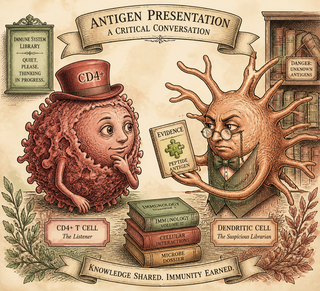
That is roughly the identity crisis at the center of a new Cancer Cell preview by Kruse, Leonhardt, and Böttcher, which discusses work from Kureshi and colleagues on pancreatic ductal adenocarcinoma, or PDAC - the pancreatic cancer subtype that behaves like it read the oncology textbook and underlined every section titled "How To Be A Problem" [1,2].
PDAC has a reputation for shrugging off immunotherapy. Checkpoint blockers, the drugs that can unleash T cells in melanoma and lung cancer, often walk into pancreatic tumors and find the immune equivalent of a locked nightclub, a fake guest list, and a bouncer named Fibrosis. The big question is: can we make the tumor neighborhood less hostile and get the right immune cells to show up?
Kureshi and colleagues suggest one answer: hit the STING pathway, combine it with checkpoint blockade, and let a lesser-celebrated immune crew do the job.
STING Is Not the Singer, Sadly
STING, in this case, is not the guy from The Police. It stands for stimulator of interferon genes, a DNA-sensing alarm system used by innate immunity. When cells detect DNA where DNA should not be - basically, cellular "why is there a sock in the refrigerator?" energy - the cGAS-STING pathway can trigger inflammatory signals and type I interferons [3].
Cancer researchers like STING because it may help turn "cold" tumors, where immune cells are scarce or sleepy, into "hot" tumors, where immune cells actually notice the problem. Recent reviews describe STING agonists as promising partners for checkpoint inhibitors, while also warning about the usual villains: toxicity, delivery, tumor heterogeneity, and the fact that biology enjoys adding extra steps like it is paid by the complication [4].
The Usual Hero Was Not the Hero
A lot of cancer immunotherapy focuses on CD8+ T cells, the immune system’s assassins. They get the posters. They get the dramatic music. They probably get better parking.
But in the Kureshi study, pancreatic tumor control in mouse models did not depend on CD8+ T cells or tumor MHC-I expression. Instead, the key players were IFN-gamma-producing CD4+ T cells, also called Th1 cells [2]. CD4+ T cells are often described as "helper" cells, which sounds like they bring snacks and organize the shared calendar. In reality, they can coordinate powerful immune attacks, reshape the tumor microenvironment, and in some settings directly contribute to tumor killing [5].
The twist gets better. The triple therapy - a local STING agonist plus anti-CTLA-4 and anti-PD-1 checkpoint blockade - increased activated cDC2 dendritic cells carrying tumor antigen into tumor-draining lymph nodes [2]. Dendritic cells are the immune system’s suspicious librarians: they collect weird molecular evidence, march it to T cells, and say, "Please identify this criminal."
Here, cDC2s helped prime the CD4+ T cells. In orthotopic pancreatic cancer models, meaning tumors growing in the pancreas rather than in a more convenient experimental parking lot, cDC2s were required for tumor clearance [2].
Why This Is More Than Immunology Trivia Night
This matters because pancreatic cancer creates a brutally suppressive tumor microenvironment. It has dense stroma, suppressive immune cells, abnormal signaling, exhausted T cells, and enough barriers to make a castle look under-zoned [6]. Reviews of PDAC immunotherapy keep circling the same challenge: checkpoint blockade alone usually does not work well because the immune system has not been properly recruited, trained, or allowed into the building [6].
The new work suggests a different route. Instead of trying only to revive CD8+ T cells that may be scarce or poorly primed, researchers may be able to activate cDC2s and CD4+ Th1 cells. That is especially interesting because Kureshi and colleagues reported that CD4+ T cells and cDC2s were still present in human PDAC samples, including after chemotherapy, and that cDC2s outnumbered cDC1s in chemotherapy-exposed patient blood [2].
Translation: the ingredients may already be in the kitchen. They just need a recipe that does not taste like despair.
The Catch, Because Biology Has Rent Due
This is still preclinical work, and mouse pancreatic tumors are not human pancreatic tumors wearing tiny lab coats. STING agonists also face real clinical hurdles. Local injection is not always practical. Systemic immune activation can cause inflammatory toxicity. Different tumors may respond differently, because cancer is less one disease than a chaotic group project where nobody read the instructions [4].
Still, the concept is exciting: combine innate immune alarm bells with checkpoint release, then let cDC2s teach CD4+ T cells what to attack. If reproducible and clinically expandable, this could help design immunotherapy combinations for PDAC that do more than press the gas pedal on an engine that was never started.
Pancreatic cancer has spent years being the tumor that immunotherapy could not sweet-talk, bribe, or guilt into responding. This study hints that maybe we were knocking on the wrong immune door. The CD8+ assassins are still important, sure. But the CD4+ coordinators and cDC2 evidence clerks may have been standing there the whole time, holding the keys, waiting for someone to stop calling them "helpers" like they only brought napkins.
References
-
Kruse B, Leonhardt BP, Böttcher JP. STING unlocks CD4+ T cell immunity in pancreatic cancer. Cancer Cell. 2026. DOI: 10.1016/j.ccell.2026.05.009
-
Kureshi CTS, Walsh MJ, Kureshi R, et al. Dendritic cell redundancy enables priming of anti-tumor CD4+ T cells in pancreatic cancer. Cancer Cell. 2026. DOI: 10.1016/j.ccell.2026.04.005
-
Wikipedia contributors. cGAS-STING cytosolic DNA sensing pathway. Wikipedia. https://en.wikipedia.org/wiki/CGAS-STING_cytosolic_DNA_sensing_pathway
-
Wang BW, Yu W, Jiang H, Meng X, Tang D, Liu D. Clinical applications of STING agonists in cancer immunotherapy: current progress and future prospects. Frontiers in Immunology. 2024. DOI: 10.3389/fimmu.2024.1485546
-
Tay RE, Richardson EK, Toh HC. Revisiting the role of CD4+ T cells in cancer immunotherapy: new insights into old paradigms. Cancer Gene Therapy. 2021. DOI: 10.1038/s41417-020-0183-x
-
Chen K, Wang Q, Li M, Guo H, Liu W, Wang F. Barriers and opportunities in pancreatic cancer immunotherapy. npj Precision Oncology. 2024. DOI: 10.1038/s41698-024-00681-z
Disclaimer: The image accompanying this article is for illustrative purposes only and does not depict actual experimental results, data, or biological mechanisms.