If you divide one tumor into a few dozen tiny neighborhoods, then count how many different T-cell receptor combinations show up in each block, you do not get a tidy average. You get a tactical map. Some blocks are crawling with one immune clone, some have a whole committee meeting, and some look like the security team never found parking.
That is basically the point of a new EBioMedicine paper by Magoulopoulou and colleagues, who asked a deceptively simple question: where exactly are different T cells sitting inside and around a tumor, and does that pattern change from place to place and over time? [1]
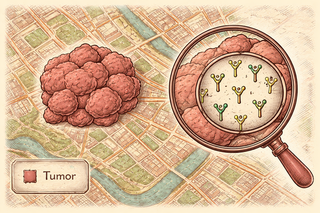
The Tumor Is Not One Place. It’s a Messy City Map.
T cells are immune cells that recognize threats using T cell receptors, or TCRs. Think of the TCR as a very fussy lock-pick. Each T cell carries its own version, which helps it recognize a specific target. In cancer, that matters because the T cells actually capable of spotting tumor-related targets are not sprinkled around like parmesan. They cluster, stall, disappear, or get boxed out by the local microenvironment.
And the local microenvironment is a huge deal. Tumors are not just piles of cancer cells. They are weird little ecosystems full of blood vessels, stromal cells, suppressive immune cells, signaling molecules, and enough mixed motives to qualify for a prestige TV drama. Reviews over the past two years have hammered home that spatial organization, not just cell type counts, shapes whether anti-tumor immunity gets traction or gets mugged in an alley [2-4].
What This Study Actually Did
The authors used in situ sequencing on the Xenium platform, then added a custom panel to detect TCR genes directly in tissue. Translation: instead of grinding up the sample and losing the map, they kept the cells in place and read out TCR-related signals where the cells were actually living.
That matters because conventional TCR sequencing is great at telling you which receptor sequences exist, but often terrible at telling you where those cells were standing when the biological drama happened. This study aimed to keep both the cast list and the seating chart.
They looked at non-small cell lung cancer samples plus matched lymph nodes, and they also studied longitudinal breast cancer biopsies taken during neoadjuvant treatment. They then built an analysis pipeline to infer putative clonotypes from paired alpha and beta variable chains at the single-cell level.
The key finding was not just “T cells are present.” We knew that already. The interesting part is that different regions of the same tissue could show different dominant TCR patterns, and those patterns could also shift over time during treatment. Same patient, same general disease, different local immune campaign. Cancer biology loves making one answer illegal.
Why That’s Interesting Outside a Pathology Lab
Here’s the chess-board version: if you sample one square and assume it represents the whole board, you can badly misread the position.
A tumor biopsy might catch an immune-hot patch and make things look encouraging, or land in an immune-desert patch and suggest the exact opposite. This paper argues that T-cell diversity and clonality are spatially uneven, which means location is part of the biology, not just background scenery. That fits with prior work showing spatial heterogeneity in TCR repertoires and local immune niches across cancers [5,6].
That also raises a very practical possibility. If these approaches keep working in larger studies, pathologists and oncologists may eventually get more than a generic “immune infiltrate present” note. They could get a map showing where potentially relevant T-cell clones are concentrated, whether they sit near tumor cells, whether they are hanging out in lymphoid-like niches, and how those patterns move during therapy. That is the difference between “there are troops somewhere in the region” and “the left flank is collapsing.”
The Bigger Clinical Play
The field is moving toward spatial methods because cancer treatment decisions increasingly depend on context. Not just what genes are expressed, but where, by whom, and next to what. Reviews in Nature Reviews Clinical Oncology and Nature Reviews Cancer make the same point from different angles: spatial profiling can reveal immune structure, migratory cues, and local niches that bulk assays flatten into statistical soup [2,4].
This paper adds something especially useful: it does targeted spatial TCR characterization without requiring prior sequencing, and it works on FFPE diagnostic material, which is the kind of archived tissue hospitals actually have lying around. That gives it a more realistic path toward clinical relevance than methods that only behave nicely on pristine research samples.
Of course, nobody should start acting like this instantly rewrites oncology practice by next Thursday. The study is a method-forward paper, not a final clinical answer. Larger cohorts, reproducibility, and clearer links to treatment outcomes still matter. But it addresses a real problem: tumors are patchy, immune responses are patchy, and our measurements have often pretended both were smoother than they are.
That pretense was always a little optimistic. Biology, as usual, prefers guerrilla warfare.
References
-
Magoulopoulou A, Chatzinikolaou M, Metousis A, et al. Spatially resolved T cell receptor diversity mapping uncovers variability of the cancer immune microenvironment. EBioMedicine. 2026;106264. DOI: https://doi.org/10.1016/j.ebiom.2026.106264
-
Chen J, Larsson L, Swarbrick A, Lundeberg J. Spatial landscapes of cancers: insights and opportunities. Nat Rev Clin Oncol. 2024;21(9):660-674. DOI: https://doi.org/10.1038/s41571-024-00926-7
-
Bareham B, Dibble M, Parsons M. Defining and modeling dynamic spatial heterogeneity within tumor microenvironments. Curr Opin Cell Biol. 2024;90:102422. DOI: https://doi.org/10.1016/j.ceb.2024.102422. PMCID: https://pmc.ncbi.nlm.nih.gov/articles/PMC11846781/
-
Mempel TR, Lill JK, Altenburger LM. How chemokines organize the tumour microenvironment. Nat Rev Cancer. 2024;24(1):28-50. DOI: https://doi.org/10.1038/s41568-023-00635-w. PMCID: https://pmc.ncbi.nlm.nih.gov/articles/PMC11480775/
-
Benotmane JK, Kueckelhaus J, Will P, et al. High-sensitive spatially resolved T cell receptor sequencing with SPTCR-seq. Nat Commun. 2023;14:7432. DOI: https://doi.org/10.1038/s41467-023-43201-6
-
Liu S, Vardhanabhuti S, Rungta P, et al. Spatial maps of T cell receptors and transcriptomes reveal distinct immune niches and interactions in the adaptive immune response. Immunity. 2022;55(10):1944-1958.e5. DOI: https://doi.org/10.1016/j.immuni.2022.09.002
Disclaimer: The image accompanying this article is for illustrative purposes only and does not depict actual experimental results, data, or biological mechanisms.