The study, published on April 28, 2026 in the British Journal of Cancer, zooms in on colorectal cancer and oxidative phosphorylation, usually shortened to OXPHOS because scientists also enjoy making things sound like IKEA furniture [1]. OXPHOS is the process mitochondria use to make ATP, the molecule cells spend the way the rest of us spend cash, too quickly and on everything.
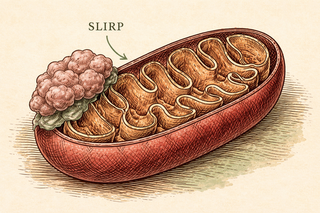
That matters because colorectal cancer is not one tidy disease with one tidy fuel source. Reviews over the last few years have made the same point from different angles: colorectal tumors can be metabolically flexible, switching between glycolysis, mitochondrial respiration, and other survival tricks depending on stress, oxygen, treatment, and plain old cellular opportunism [2-4]. Tumors are annoying like that. Show them one locked door and they start checking windows.
Meet SLIRP, the Tiny Bureaucrat Keeping the Lights On
SLIRP is an RNA-binding protein. Which sounds dull. It is not dull here.
Yang and colleagues found that SLIRP is elevated in colorectal cancer tissue compared with nearby normal tissue, and higher SLIRP levels track with worse patient survival [1]. Then they asked the more interesting question: what is this thing actually doing?
Answer: quite a lot, unfortunately.
SLIRP binds mitochondrial-encoded messenger RNAs and helps keep them stable [1]. Those RNAs are the instruction slips mitochondria need to build parts of the respiratory machinery. If SLIRP protects those messages from falling apart, the mitochondria keep making the parts they need, OXPHOS keeps rolling, ATP keeps flowing, and the cancer cell gets to continue its deeply unwanted career.
When the researchers knocked SLIRP down, the cancer cells hit what the paper basically describes as an ATP crisis. Energy dropped. Growth slowed. Apoptosis, meaning programmed cell death, went up [1]. In plain English: take away the mitochondria's note-keeper and the whole power plant starts coughing like an ancient radiator.
Why This Is Interesting, Beyond "Cells Are Weird"
This paper lands in a broader shift in how people think about colorectal cancer metabolism. Recent reviews have argued that mitochondria are not side characters here. They help drive growth, metastasis, drug resistance, and adaptation to stress [2-5]. There is also evidence that mitochondrial DNA changes and mitochondrial dynamics can reshape how colorectal tumors handle oxidative metabolism [3,4].
So the SLIRP story matters because it points to a very specific weak spot. Not just "mitochondria are important." We knew that. This is more like, "here is one protein helping preserve the mitochondrial instruction manual, and without it the tumor struggles to pay its electric bill."
That is cleaner. Cleaner is good. Oncology gets enough chaos already.
Could This Actually Matter for Patients?
Maybe. With the usual adult supervision clause attached.
If SLIRP really marks tumors that depend on OXPHOS, it could end up being useful in two ways. First, as a biomarker. High SLIRP might help identify patients whose tumors are especially reliant on mitochondrial respiration [1]. Second, as a target. If you can disrupt that dependency, you may be able to push those cancer cells into an energy collapse.
That idea is not science fiction. It is already drifting into the clinic. A phase 1b study tested the OXPHOS inhibitor ME-344 with bevacizumab in refractory metastatic colorectal cancer, which tells you the field is serious enough to stop merely making handsome pathway diagrams and start treating humans [5]. The hard part, as always, is getting enough tumor damage without unacceptable collateral damage to normal tissue, because your healthy cells also enjoy having mitochondria. Rude but true.
The Catch, Because There Is Always One
This is still early-stage translational work. Strong mechanism, promising biology, not a ready-made therapy.
Targeting cancer metabolism sounds elegant until you remember tumors are adaptable little goblins. Shut down one fuel line and some of them reroute. Reviews from 2025 and 2026 keep hammering that point: metabolic plasticity and treatment resistance are joined at the hip in colorectal cancer [4,6]. So if SLIRP ever becomes a therapeutic target, it will probably matter most as part of a combination strategy, not a solo act riding in on a white horse.
Still, the paper gives a useful answer to a question oncologists keep asking: why do some colorectal tumors stay so metabolically comfortable while everything around them is trying to kill them? Part of the answer may be that a small mitochondrial RNA chaperone is quietly preventing an energy meltdown.
Not glamorous. Very effective. Rather like the best clinic nurses, honestly.
References
-
Yang C, Ming Y, Wu Q, et al. SLIRP maintains energy metabolism homeostasis in colorectal cancer by stabilizing mitochondrial-encoded mRNAs. Br J Cancer. 2026. DOI: 10.1038/s41416-026-03453-7
-
Sedlak JC, Yilmaz OH, Roper J. Metabolism and Colorectal Cancer. Annu Rev Pathol. 2023;18:467-492. DOI: 10.1146/annurev-pathmechdis-031521-041113
-
Wu Z, Xiao C, Li F, et al. Mitochondrial fusion-fission dynamics and its involvement in colorectal cancer. Mol Oncol. 2024;18(5):1058-1075. DOI: 10.1002/1878-0261.13578 PMCID: PMC11076987
-
Guo W, Liu Y, Ji X, et al. Mutational signature of mtDNA confers mechanistic insight into oxidative metabolism remodeling in colorectal cancer. Theranostics. 2023;13(1):324-338. DOI: 10.7150/thno.78718 PMCID: PMC9800724
-
Boland PM, Lenz HJ, Ciombor KK, et al. A Phase 1b study of the OxPhos inhibitor ME-344 with bevacizumab in refractory metastatic colorectal cancer. Invest New Drugs. 2025;43(1):60-68. DOI: 10.1007/s10637-024-01489-1 PMCID: PMC11868331
-
Qiu X, Wang A, Wang J, et al. Mitochondrial metabolic reprogramming in colorectal cancer: mechanisms of resistance and future clinical interventions. Cell Death Discov. 2025;11(1):375. DOI: 10.1038/s41420-025-02670-y PMCID: PMC12335542
Disclaimer: The image accompanying this article is for illustrative purposes only and does not depict actual experimental results, data, or biological mechanisms.