Pancreatic cancer has long had a preferred trick: break the RAS switch, jam it in the “on” position, and keep yelling at cells to grow.
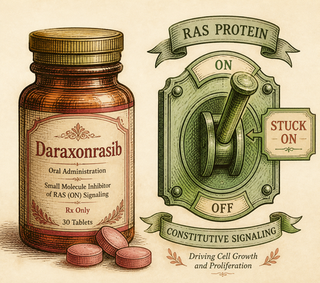
Subtle? No. Effective? Horribly.
A new phase 3 trial in The New England Journal of Medicine tested whether daraxonrasib, an oral RAS(ON) inhibitor, could do better than standard chemotherapy in people with previously treated metastatic pancreatic ductal adenocarcinoma. The short version: it did. By a lot.
The Switch That Would Not Shut Up
RAS proteins are tiny molecular switches. Off means calm. On means grow, divide, survive, move.
In pancreatic ductal adenocarcinoma, that switch is often broken. More than 90% of cases carry RAS-pathway driver mutations, most often in KRAS. The cancer cell is basically holding down the gas pedal while pretending this is normal traffic behavior.
For decades, RAS was called “undruggable.” That is science-speak for “we tried, we cried, the protein laughed.” RAS has a smooth surface, binds its fuel very tightly, and sits at the center of many vital cell signals. Blocking it without wrecking normal biology has been a nasty puzzle.
Daraxonrasib attacks a specific form: RAS in its active, GTP-bound “on” state. It is described as a multi-selective RAS(ON) inhibitor, meaning it aims at several common activated RAS variants rather than one rare mutation subtype.
That matters in pancreatic cancer, where KRAS G12D, G12V, and G12R dominate. One-size-fits-one drugs are elegant. They are also less helpful when the room is full of different villains wearing similar hats.
The Trial: Pill Versus Chemo
The RASolute 302 trial enrolled 500 patients with metastatic pancreatic cancer whose disease had already progressed after one prior treatment for metastatic disease. Patients received either daraxonrasib or the investigator’s choice of chemotherapy.
The study was open-label, so everyone knew what they were getting. Not ideal, but survival is a pretty hard endpoint to politely hallucinate.
In the overall population, median overall survival was 13.2 months with daraxonrasib versus 6.7 months with chemotherapy. Median progression-free survival was 7.2 months versus 3.6 months. Tumor responses also favored daraxonrasib: 31.6% versus 11.2%.
For patients with RAS G12 mutations, the pattern held: median overall survival was 13.2 months with daraxonrasib versus 6.6 months with chemotherapy, and median progression-free survival was 7.3 versus 3.5 months.
That is not a tiny nudge. That is the oncology equivalent of the printer finally working after years of blood sacrifice.
Why This Hit Different
Second-line metastatic pancreatic cancer has been a hard place to make progress. Chemotherapy can help, but the gains are often modest and the side effects are not exactly spa-adjacent.
Here, daraxonrasib did two useful things at once: people lived longer, and severe side effects were less common. Grade 3 or higher adverse events occurred in 43.6% of patients receiving daraxonrasib versus 57.5% receiving chemotherapy. Treatment-related side effects led to stopping therapy in 1.2% versus 11.2%.
Common daraxonrasib side effects included rash, mouth inflammation, nausea, and diarrhea. Not nothing. But compared with traditional cytotoxic chemotherapy, the tolerability signal looks meaningful.
This also builds on an earlier phase 1-2 NEJM study, where daraxonrasib showed activity in previously treated advanced RAS-mutated pancreatic cancer. The phase 3 trial is the bigger test. Bigger tests are where promising ideas either grow up or move back into the basement.
The Fine Print With Teeth
This is not a cure. It is not yet a magic pill. It was funded by Revolution Medicines, the company developing daraxonrasib. Several authors reported industry ties. That does not invalidate the results, but it means independent scrutiny matters.
Also, this trial studied patients after one prior metastatic treatment. We still need to know how daraxonrasib performs earlier, in combinations, over longer follow-up, and across different molecular subgroups. Resistance will come for it. Cancer biology is annoyingly persistent like that.
Still, this result is important because it targets the engine of the disease, not just the wreckage around it.
What It Could Mean
If these findings hold up and daraxonrasib is approved, second-line metastatic pancreatic cancer treatment could change fast.
A daily oral RAS-targeted therapy with better survival than chemotherapy would give patients and oncologists a new option where options have been thin. It could also open the door to smarter combinations: RAS inhibition plus chemotherapy, immunotherapy, stromal targeting, or next-generation pathway blockers.
Pancreatic cancer has spent years being the grim overachiever of oncology. Daraxonrasib does not erase that. But it does put a crack in one of the disease’s favorite defenses.
And after decades of calling RAS undruggable, watching it get drugged is satisfying.
Very satisfying.
References
-
O’Reilly EM, Wainberg ZA, Hendifar AE, et al. Daraxonrasib or Chemotherapy in Previously Treated Metastatic Pancreatic Cancer. N Engl J Med. 2026. DOI: 10.1056/NEJMoa2605555
-
Wolpin BM, Park W, Garrido-Laguna I, et al. Daraxonrasib in Previously Treated Advanced RAS-Mutated Pancreatic Cancer. N Engl J Med. 2026;394:1790-1802. DOI: 10.1056/NEJMoa2505783
-
Drizyte-Miller K, Cox AD, Der CJ. KRAS: the Achilles’ heel of pancreas cancer biology. J Clin Invest. 2025;135:e191939. DOI: 10.1172/JCI191939
-
Holderfield M, et al. Tumour-selective activity of RAS-GTP inhibition in pancreatic cancer. Nature. 2024. DOI: 10.1038/s41586-024-07379-z
Disclaimer: The image accompanying this article is for illustrative purposes only and does not depict actual experimental results, data, or biological mechanisms.