At 3 AM in a lab in Munich, someone was probably staring at pancreatic tumor data and having the sort of thought that either wins prizes or ruins sleep: what if a vitamin D-related drug could make chemotherapy work better in one of the stingiest cancers on earth?
That idea sits behind a new phase 1 study in Nature Cancer on paricalcitol plus chemotherapy for metastatic pancreatic cancer.1 And yes, phase 1 means early. Very early. This is the scientific equivalent of test-driving a prototype with the check engine light still on. But for pancreatic cancer - which has a talent for ignoring treatment like a billionaire ignoring parking tickets - even a plausible new angle gets attention fast.
Why pancreatic cancer is such a nightmare tenant
Pancreatic ductal adenocarcinoma, the usual form of pancreatic cancer, does not just grow. It builds a fortress.
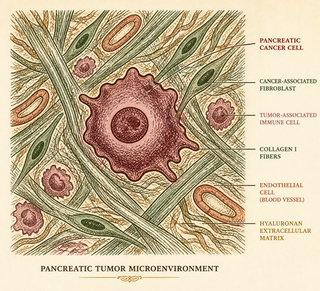
A big part of that fortress is the stroma - the dense mesh of connective tissue, fibroblasts, immune cells, and extracellular goo that surrounds the tumor.2 If the cancer cell is the criminal mastermind, the stroma is the private security detail, the walls, and the accountants laundering the money. It can physically block drugs, distort immune responses, and create a neighborhood where treatment struggles to do its job.
That is why researchers have spent years trying to target not just the cancer cells, but the ecosystem around them.3 The logic is simple: if you cannot storm the castle, maybe you can bribe the gatekeeper, soften the walls, or at least stop the drawbridge from slamming shut.
Enter paricalcitol, stage left
Paricalcitol is a vitamin D receptor agonist. It is already used in other medical settings, especially kidney disease, so this is not some mystery potion brewed from moonlight and postdoc tears. The interest in pancreatic cancer comes from work suggesting vitamin D signaling may reprogram stromal cells, particularly cancer-associated fibroblasts, into a less tumor-friendly state.4
In plain English: instead of attacking the tumor head-on, paricalcitol may try to make the tumor's weird little real-estate bubble less hospitable.
That idea has been floating around for a while. Preclinical studies helped build the case that activating the vitamin D receptor could change the pancreatic tumor microenvironment and possibly improve drug delivery.4 The new phase 1 paper moves that concept one step deeper into actual patients with metastatic disease, where the stakes are painfully real.
What this study was trying to do
Because this is a phase 1 trial, the main job was not to prove the combo definitely extends life. It was to figure out whether combining paricalcitol with chemotherapy is feasible and tolerable, and to look for early signs that the biology might be doing something useful.1
That matters more than it sounds. A lot of smart cancer ideas die here. The spreadsheet of “promising mechanisms” is a graveyard.
The headline is cautious but encouraging: the combination showed promise. In oncology language, that usually means “we saw enough to justify not throwing this into the bin yet.” It is not a cure. It is not a standard of care. It is a signal - and in metastatic pancreatic cancer, a signal is worth more than the usual biotech confetti.
The bigger idea: fix the neighborhood, not just the house
This study plugs into a broader shift in cancer research. For years, treatment focused mostly on the malignant cells themselves. Now the field spends much more time asking how the surrounding environment props up the disease.5
That is especially relevant in pancreatic cancer, where the microenvironment often behaves like a rigged market. Drugs enter, but the transaction costs are absurd. Immune cells show up, but half of them seem to have been given the wrong address. Chemotherapy works, but often less than anyone would like because the tumor has already cornered the market on resistance.
If paricalcitol can reliably loosen that stromal chokehold, it could become the kind of addition oncologists like: not necessarily a flashy solo act, but a useful amplifier for existing therapies.
The part where we stay adults about this
Now for the obligatory cold shower.
Phase 1 studies are small, and small studies can flatter bad ideas. Results that look hopeful at this stage often shrink under the harsh fluorescent lighting of larger trials. Pancreatic cancer has a long history of making researchers look overconfident in public.
There is also the issue of value. If this strategy advances, the question will not just be “does it work?” but “how much benefit does it add, for whom, and at what cost?” In cancer care, we are experts at inventing therapies with luxury-car price tags and compact-sedan survival gains. No one should pretend that scientific promise automatically translates into equitable access.
Still, there is a practical upside here. Because paricalcitol is not an entirely new molecular stranger, combining it with standard chemotherapy may offer a more realistic path than building a bespoke moonshot from scratch. “Realistic,” of course, is doing a lot of work in that sentence - this is oncology, where realism often arrives carrying invoices.
Why this is worth watching
What makes this paper interesting is not just the drug. It is the strategy.
Pancreatic cancer keeps beating treatments by acting less like a lone target and more like a whole hostile economy. So researchers are trying to disrupt supply chains, zoning laws, and local governance - biologically speaking. Paricalcitol fits that approach. It treats the tumor not as an isolated clump of bad cells, but as a system with enablers.
That does not make the outcome certain. It makes the hypothesis sharper.
For patients, the near-term message is modest: this is not practice-changing yet, but it is a credible step in a direction that has made biological sense for years. If later trials confirm benefit, the real payoff could be a regimen that helps standard chemotherapy hit harder in a cancer that rarely gives discounts.
References
Disclaimer: The image accompanying this article is for illustrative purposes only and does not depict actual experimental results, data, or biological mechanisms.
-
Combination of paricalcitol with chemotherapy shows promise in phase 1 study of metastatic pancreatic cancer. Nature Cancer. 2026. doi:10.1038/s43018-026-01164-9 ↩↩
-
Whatcott CJ, Han H, Posner RG, et al. Desmoplasia in primary tumors and metastatic lesions of pancreatic cancer. Clin Cancer Res. 2015;21(15):3561-3568. doi:10.1158/1078-0432.CCR-14-1051 PMCID: PMC4511255 ↩
-
Hosein AN, Brekken RA, Maitra A. Pancreatic cancer stroma: an update on therapeutic targeting strategies. Nat Rev Gastroenterol Hepatol. 2020;17(8):487-505. doi:10.1038/s41575-020-0300-1 ↩
-
Sherman MH, Yu RT, Engle DD, et al. Vitamin D receptor-mediated stromal reprogramming suppresses pancreatitis and enhances pancreatic cancer therapy. Cell. 2014;159(1):80-93. doi:10.1016/j.cell.2014.08.007 PMCID: PMC4192089 ↩↩
-
Principe DR, Park A, Dorman MJ, et al. The pancreatic cancer microenvironment: evolving biology and therapeutic strategies. Cancer Lett. 2021;498:293-301. doi:10.1016/j.canlet.2020.10.035 ↩