Cancer was supposed to pass Metastasis 101 late in the semester, after it had caused enough local chaos to earn extra credit. This new Nature paper suggests some early colorectal cancers may start auditing the class almost immediately, which is frankly rude behavior from a disease already failing group projects.
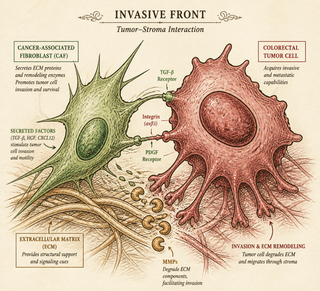
Researchers studying early colorectal cancer found that cells with “oncofetal” features - basically adult cancer cells dusting off fetal-development programs - show up right at the invasive front, the place where a tumor first pushes into deeper tissue. That matters because those fetal-like states have been linked to metastatic potential, the ability to spread and set up shop elsewhere like a terrible franchise model.
The Tumor Finds Its Old Baby Photos
“Oncofetal” sounds like a sci-fi villain with a medical degree, but the idea is simple enough: fetal development uses flexible, fast-moving, highly adaptable cell programs. Normally, adults pack those programs away. Cancer, being cancer, sometimes opens the forbidden storage closet and says, “What if we tried the embryo settings again?”
A 2022 Nature Reviews Cancer perspective described oncofetal reprogramming as a recurring theme across cancer, inflammation, immune escape, and tissue repair. In other words, tumors may borrow from early-life biology not because they are nostalgic, but because plasticity is useful when you need to invade, survive, and dodge security Sharma et al., 2022.
This new study by Buissant des Amorie and colleagues asks a sharper question: when does this happen in colorectal cancer? Late, after years of evolution? Or early, when the tumor has barely unpacked its villainous furniture?
Their answer: early. Very early.
The Sketchy Neighborhood Matters
The team studied early colorectal cancers using spatial transcriptomics, single-cell analyses, organoids, genome sequencing, and co-culture experiments. Translation: they did not just ask what genes were turned on. They asked where the cells were sitting, who their neighbors were, and whether those neighbors were whispering bad advice.
The suspicious neighbor turned out to be a fibroblast.
Fibroblasts are usually the body’s construction crew. They help maintain tissue structure, patch wounds, and manage the extracellular matrix, which is basically the building material around cells. In tumors, some become cancer-associated fibroblasts, or CAFs. At that point, the construction crew may start “renovating” in ways that help the tumor add a suspicious basement.
In this paper, the first CAFs appearing as early colorectal cancers invaded the submucosa resembled normal submucosal trophocytes. These trophocyte-like CAFs sat near oncofetal tumor cells at invasive fronts. When researchers put fibroblasts and tumor organoids together, the fibroblasts helped push tumor cells into these oncofetal states Buissant des Amorie et al., 2026.
So the tumor’s dangerous behavior was not explained by a shiny new mutation. Whole-genome sequencing and growth-factor tests argued against a simple cancer-cell-intrinsic switch. Instead, the local microenvironment seemed to help decide where and when plasticity appeared. Cancer biology, once again, refuses to be a one-person drama. It is an ensemble cast, and several actors are overacting.
Early Does Not Mean Inevitable
A key twist: these oncofetal states appeared widely in early non-metastatic cancers too. That is a big deal. If fetal-like plasticity were the whole metastatic recipe, every tumor showing it would be packing bags for the liver.
But biology enjoys making us earn our conclusions.
The authors argue that oncofetal plasticity may be necessary for metastasis, but not sufficient. Other barriers still matter, such as immune evasion. Your immune system is running a 24/7 security service, and apparently some early tumor cells are already wearing fake employee badges. Whether they get past the lobby is another question.
This fits with recent work showing that colorectal cancer metastases can become increasingly plastic over time. Moorman and colleagues reported that metastases shift away from normal intestinal identities toward fetal progenitor-like states and other unusual lineages, with chemotherapy sometimes intensifying that plasticity Moorman et al., 2025. The new paper pushes the timeline backward: the first hints of that flexibility may appear near the moment invasion begins.
Why This Could Change the Exam
Colorectal cancer remains a major health problem, and the American Cancer Society reports that rates in people under 50 have been rising in recent years. Early detection already saves lives, but doctors still need better ways to tell which early cancers are likely to behave badly and which are mostly making theatrical threats.
If these findings hold up in larger cohorts, oncofetal cell states and trophocyte-like CAF patterns could help refine risk prediction for early colorectal cancers. That could matter for decisions after removing a T1 lesion: who needs closer surveillance, more aggressive treatment, or new therapies aimed at the tumor microenvironment?
It also points researchers toward an appealingly annoying target: the conversation between tumor cells and nearby fibroblasts. Interrupt that conversation, and maybe some cancer cells lose access to their fetal-behavior cheat sheet.
Of course, this is not tomorrow morning’s clinic protocol. The study is mechanistic and discovery-driven, and the field still needs validation, clinical-grade biomarkers, and proof that blocking these signals improves outcomes. Science remains a long group assignment, graded harshly by reality.
Still, the message is hard to ignore: early colorectal cancers may learn dangerous tricks sooner than expected, and the local tissue neighborhood may be teaching the class.
References
-
Buissant des Amorie JR, Hageman JH, Brunner SR, et al. Emergence of oncofetal plasticity is ubiquitous in early colorectal cancers. Nature. 2026. DOI: 10.1038/s41586-026-10344-7
-
Sharma A, Blériot C, Currenti J, Ginhoux F. Oncofetal reprogramming in tumour development and progression. Nature Reviews Cancer. 2022;22:593-602. DOI: 10.1038/s41568-022-00497-8
-
Moorman A, Benitez EK, Cambulli F, et al. Progressive plasticity during colorectal cancer metastasis. Nature. 2025;637:947-954. DOI: 10.1038/s41586-024-08150-0
-
Qi J, Sun H, Zhang Y, et al. Single-cell and spatial analysis reveal interaction of FAP+ fibroblasts and SPP1+ macrophages in colorectal cancer. Nature Communications. 2022;13:1742. DOI: 10.1038/s41467-022-29366-6
Disclaimer: The image accompanying this article is for illustrative purposes only and does not depict actual experimental results, data, or biological mechanisms.