Parenting rogue cells is basically your body saying, “We do not draw on the walls, we do not ignore growth signals, and we absolutely do not start a tumor in the stomach,” while cancer cells stare back with marker on their face and deny everything.
That is the vibe behind HER2-positive gastric cancer: a subset of stomach and gastroesophageal junction cancers where tumor cells make too much HER2, a growth-signaling receptor that behaves like someone taped the accelerator down. HER2 is famous in breast cancer, but it also shows up in gastric cancer, where it can make the disease more targetable and, unfortunately, sneakier.
For years, trastuzumab helped by grabbing HER2 and slowing the party down. But tumors are not known for respecting the group chat. After trastuzumab stops working, treatment options can get frustrating fast: chemo, antibody-drug conjugates like trastuzumab deruxtecan, clinical trials, and a lot of “please let this next scan be boring” energy.
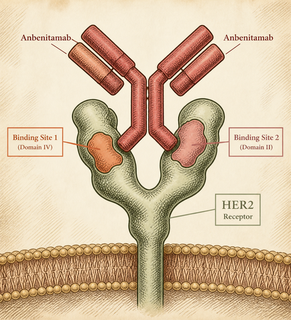
Enter anbenitamab, also known as KN026, which is not content to shake HER2’s hand politely. It grabs two different parts of the HER2 receptor at once.
The Antibody With Two Hands
Anbenitamab is a bispecific antibody. Translation: instead of binding one target spot like a regular antibody, it binds two non-overlapping HER2 sites, roughly the same territory targeted by trastuzumab and pertuzumab [1]. Think of HER2 as a suspiciously overconfident nightclub bouncer letting cancer-growth signals through the velvet rope. Trastuzumab taps one shoulder. Anbenitamab taps both shoulders and says, “We need to talk.”
In the KC-WISE phase III trial, researchers tested anbenitamab plus chemotherapy against chemotherapy alone in 188 patients in China with previously treated HER2-positive gastric or gastroesophageal junction adenocarcinoma whose trastuzumab-containing treatment had failed [1].
The results were not subtle. Median progression-free survival was 7.1 months with anbenitamab plus chemotherapy versus 2.7 months with chemotherapy alone. Overall survival was 19.6 months versus 11.5 months. The hazard ratios were 0.25 for disease progression and 0.29 for death, which is oncology-statistics language for “the curve did not just wiggle, it packed a suitcase and moved.”
Why This Has People Leaning Forward
Second-line HER2-positive gastric cancer has been a tough room. Trastuzumab changed first-line therapy years ago, and trastuzumab deruxtecan later gave doctors a powerful antibody-drug conjugate option after prior HER2 therapy, with meaningful survival gains in DESTINY-Gastric01 and further data in later studies [2,3]. More recently, combinations with immunotherapy have pushed the first-line field forward, including pembrolizumab plus trastuzumab and chemotherapy in KEYNOTE-811 [4].
But not every patient can receive every drug, tumors may lose HER2 expression, toxicities matter, and access varies by country. Cancer treatment is not a tidy restaurant menu. It is more like trying to order from a food truck during a thunderstorm while the menu keeps mutating.
That is why KC-WISE is intriguing: anbenitamab is not an antibody-drug conjugate carrying a chemo payload. It is a dual HER2 blocker paired with standard chemotherapy. If the final analysis confirms the interim results, this could add another serious option after trastuzumab failure, especially for patients whose tumors remain HER2-driven.
The Fine Print, Because Biology Always Brings Paperwork
The trial was randomized, double-blind, and multicenter, which gives the findings more weight than a small single-arm “we saw some activity” study. Still, this was a prespecified interim analysis, not the final word. The study enrolled patients at 51 sites in China, so doctors will want to know how well the results carry across broader populations, different treatment sequences, and current global standards that may include trastuzumab deruxtecan or immunotherapy.
Side effects also showed up, because the immune-oncology fairy does not hand out free lunches. Grade 3 or higher treatment-related adverse events occurred in 60% of patients receiving anbenitamab plus chemotherapy and 45% receiving chemotherapy alone. Neutropenia and leukopenia were common. Interestingly, treatment-related deaths occurred in 0 patients in the anbenitamab group and 5 in the control group, but that detail still needs cautious interpretation in a trial of this size [1].
The Real-World Hope
If these results hold up, anbenitamab could help fill a nasty gap: what to do when HER2-positive gastric cancer shrugs off trastuzumab. Longer disease control can mean more time with symptoms held back, more chances to reach another therapy, more ordinary Tuesdays. In cancer care, ordinary Tuesdays are wildly underrated.
The bigger story is that HER2 targeting in gastric cancer is maturing. We are no longer just asking, “Is HER2 present?” We are asking how strongly it is expressed, whether it persists after treatment, whether the tumor has become patchy and evasive, and which HER2 strategy fits the moment: blockade, payload delivery, immune activation, or some clever combination cooked up by scientists who clearly looked at cancer and said, “Fine, we’ll build a weirder wrench.”
Anbenitamab may be one of those wrenches. Two-handed, targeted, and, if future data cooperate, potentially very useful.
References
-
Liu R, Zhao J, Zhang R, et al. Anbenitamab in previously treated HER2-positive gastric cancer (KC-WISE): prespecified interim analysis of a randomized, phase III clinical trial. Annals of Oncology. 2026;37(6):777-786. doi: 10.1016/j.annonc.2026.01.006
-
Shitara K, Bang YJ, Iwasa S, et al. Trastuzumab deruxtecan in previously treated HER2-positive gastric cancer. New England Journal of Medicine. 2020;382:2419-2430. doi: 10.1056/NEJMoa2004413
-
Van Cutsem E, Di Bartolomeo M, Smyth E, et al. Trastuzumab deruxtecan in patients in the USA and Europe with HER2-positive advanced gastric or gastroesophageal junction cancer with disease progression on or after a trastuzumab-containing regimen: DESTINY-Gastric02. The Lancet Oncology. 2023. PMID: 37329891
-
Janjigian YY, Kawazoe A, Yañez P, et al. The KEYNOTE-811 trial of dual PD-1 and HER2 blockade in HER2-positive gastric cancer. Nature. 2021;600:727-730. doi: 10.1038/s41586-021-04161-3
-
Yang Y, et al. Targeted and immunotherapy approaches in HER2-positive gastric and gastroesophageal junction adenocarcinoma: a new era. Cancers. 2023. PMCID: PMC10448730
Disclaimer: The image accompanying this article is for illustrative purposes only and does not depict actual experimental results, data, or biological mechanisms.