The moment the survival curves split and stayed split, the researchers had a problem with the usual story: these gastric tumors looked epithelial enough to pass inspection, yet clinically they behaved like they had already kicked over the furniture. In this new British Journal of Cancer study, the culprit was CCNE1 gain - meaning amplification of the CCNE1 gene or overexpression of its protein, Cyclin E1 - and it marked a group of stomach cancers that were unusually aggressive, therapy-resistant, and eerily short on helpful immune cells [1].
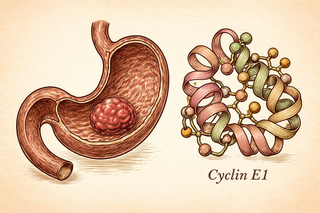
That matters because gastric cancer has spent years being sorted into broad buckets like "epithelial" and "mesenchymal." Useful buckets, sure. But also a bit like sorting your house fire into "kitchen" or "living room" while ignoring the guy with the flamethrower. This paper argues that CCNE1 gain is its own clinically meaningful subtype, not just background molecular trivia [1].
Cyclin E: the cell-cycle bouncer who let everyone in
CCNE1 encodes Cyclin E1, a protein that helps push cells from the G1 phase into DNA replication. In normal tissue, that process is tightly controlled. In cancer, extra CCNE1 can behave like a broken gas pedal - more proliferation, more chromosomal instability, more chances for things to go spectacularly wrong [2].
The authors analyzed 1,273 patients across six cohorts and found that tumors with CCNE1 gain kept E-cadherin positivity, so under the microscope they did not look like classic fully mesenchymal escape artists. But biologically, they were trouble: more proliferation, more nerve and venous invasion, worse survival, and weaker responses to adjuvant chemotherapy, HER2-targeted therapy, anti-angiogenic treatment, and PD-1 blockade [1].
That last part is the eyebrow-raiser. When a biomarker predicts resistance to multiple treatment classes at once, it is no longer a decorative genomic accessory. It is starting to look like the tumor’s entire business model.
The real twist: an immune desert with bad management
The study’s most interesting finding was not just that these tumors grew fast. It was that they lived in an immune desert. In plain English, the cancer neighborhood had very few lymphocytes wandering around to do anything useful, reduced signs of cytotoxic anti-tumor activity, more M2-polarized macrophages - the immune cells that often act less like bodyguards and more like corrupt mall security - and higher TGF-beta, a molecule well known for helping tumors build a hostile, suppressive microenvironment [1,3].
That fits a broader pattern in gastric cancer. Reviews and translational studies over the past few years have shown that response to immunotherapy depends on far more than a single marker like PD-L1. The architecture of the tumor immune microenvironment matters: who is present, where they are standing, and whether they are active or just loitering uselessly near the exits [3,4]. One 2022 Nature Communications study showed that multi-dimensional immune-cell patterns predicted anti-PD-1/PD-L1 response better than any one biomarker alone [4].
So the contrarian take here is not "immunotherapy failed." It is "we keep acting surprised when an empty battlefield produces no heroic battle scene." If the T cells are not there, or cannot function, PD-1 blockade is less magic key and more extremely expensive keychain.
Why this could matter in the clinic
The practical appeal of this paper is that CCNE1 gain may be clinically testable and actionable. The authors frame it as a "clinic-ready" subtype affecting more than 1 in 10 patients with gastric cancer [1]. That is not a boutique oddity. That is a real slice of patients.
Other recent work supports the idea that CCNE1-amplified upper GI cancers carry a distinct molecular profile and poor therapeutic behavior, including associations with chromosomal instability, TP53 alterations, and metastasis patterns [2,5]. There is also early preclinical momentum around PKMYT1 inhibition as a synthetic-lethal strategy for CCNE1-amplified gastroesophageal cancers, with lab data suggesting it might even help pull some of these cold tumors toward a more inflamed state [6]. Translation to patients is still very much pending, so nobody should start popping champagne in the infusion room. But at least there is a rational next move.
The bigger lesson is simple: a tumor can look polite and still be planning a felony. Gastric cancer biology is annoying like that. If these findings hold up, testing for CCNE1 gain could help flag patients whose cancers are less likely to respond to the usual menu and more likely to need a different strategy from the jump.
That is not a cure. It is not a miracle. It is something better than hype, actually: a sharper map of where the landmines are.
References
-
Gu Y, Wang J, Ling Z, et al. Lethal clinical outcome and immune desert contexture in refractory gastric cancer harboring CCNE1 amplification and overexpression. Br J Cancer. 2026. doi:10.1038/s41416-026-03461-7. PubMed: https://pubmed.ncbi.nlm.nih.gov/42045542/
-
Rustgi N, Wu S, Samec T, et al. Molecular Landscape and Clinical Implication of CCNE1-amplified Esophagogastric Cancer. Cancer Res Commun. 2024;4(6):1399-1409. doi:10.1158/2767-9764.CRC-23-0496. PMCID: PMC11146286
-
Zavros Y, Merchant JL. The immune microenvironment in gastric adenocarcinoma. Nat Rev Gastroenterol Hepatol. 2022;19(7):451-467. doi:10.1038/s41575-022-00591-0. PMCID: PMC9809534
-
Chen Y, Jia K, Sun Y, et al. Predicting response to immunotherapy in gastric cancer via multi-dimensional analyses of the tumour immune microenvironment. Nat Commun. 2022;13(1):4851. doi:10.1038/s41467-022-32570-z. PMCID: PMC9388563
-
Skubleny D, Purich K, McLean DR, et al. The Tumor Immune Microenvironment Drives Survival Outcomes and Therapeutic Response in an Integrated Molecular Analysis of Gastric Adenocarcinoma. Clin Cancer Res. 2024;30(23):5385-5398. doi:10.1158/1078-0432.CCR-23-3523. PubMed: https://pubmed.ncbi.nlm.nih.gov/39325010/
-
Jang S, Wu LW, Park J, et al. PKMYT1 inhibition induces DNA damage and synergizes with immune checkpoint blockade in CCNE1-amplified gastroesophageal adenocarcinoma. bioRxiv preprint posted December 19, 2025. doi:10.64898/2025.12.17.694745. PMCID: PMC12724593
Disclaimer: The image accompanying this article is for illustrative purposes only and does not depict actual experimental results, data, or biological mechanisms.