Today’s forecast inside the leukemia microenvironment: low clouds over the bone marrow, scattered genetic squalls, and a suspicious little FLT3-ITD drizzle that may later remodel the whole neighborhood.
Acute myeloid leukemia, or AML, is a fast-moving blood cancer where immature white blood cells crowd the marrow like an illegal high-rise built without permits, plumbing, or basic respect for zoning laws. One of the most notorious design flaws is FLT3-ITD, a mutation that keeps growth signals switched on. FLT3 is supposed to help blood cells develop. FLT3-ITD turns that signal into a stuck elevator button: up, up, up, why are we still going up?
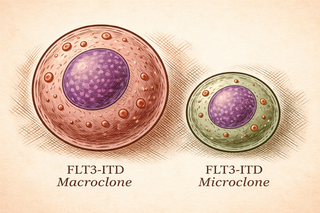
Doctors already know that large FLT3-ITD clones are bad news. The question in this new Blood paper was sharper: what about the tiny ones? The microclones. The little architectural cracks in the foundation that the old inspection report might wave through with a shrug.
The Small Print In The Blueprint
Duployez and colleagues looked back at 1,733 young adults with newly diagnosed AML treated in the BIG-1 trial. They used next-generation sequencing, which is basically a molecular building inspector with a flashlight powerful enough to find a loose screw behind the drywall.
They defined FLT3-ITD microclones as low-level mutations with an allelic ratio between 0.0004 and 0.05. That means the FLT3-ITD signal was present, but at levels below the traditional “macroclone” threshold that has usually driven risk decisions.
Here is the eyebrow-raising part: among patients who did not have a standard detectable FLT3-ITD macroclone, 17.4% had microclones. That is not a rounding error. That is an entire secret basement.
And these tiny clones behaved badly. After adjusting for age, white blood cell count, other mutations, midostaurin treatment, and stem cell transplant, microclones were independently linked with higher relapse risk. At two years, relapse occurred in about 45.1% of patients with microclones, compared with 29.4% of patients without FLT3-ITD. The macroclone group was similar, at 42.5%.
In plain English: some “tiny” FLT3-ITD populations did not stay tiny in any clinically comforting way.
When A Closet Becomes A Condo Tower
The study gets especially interesting at relapse. In paired samples, 41.8% of relapses in patients who had FLT3-ITD microclones at diagnosis involved a FLT3-ITD macroclone at relapse.
That suggests the microclone may sometimes act like a quiet developer buying up lots in the background. At diagnosis, it owns one awkward corner parcel. After chemotherapy clears out the competition, it returns with permits, investors, and a deeply concerning taste for aggressive expansion.
This matters because current AML risk systems have not fully incorporated ultra-sensitive FLT3-ITD detection. The 2022 European LeukemiaNet recommendations already changed how FLT3-ITD risk is handled, moving away from older allelic-ratio categories in some contexts, but this paper asks whether the diagnostic net still has holes in it Dohner et al., 2022.
MRD: The Dust After Demolition
The authors also looked at NPM1-mutated AML, a subtype where measurable residual disease, or MRD, is especially useful. MRD means leukemia cells remain after treatment at levels too low for routine microscopy. Think of it as dust left after demolition. You may not see the building anymore, but if the dust contains active blueprints, you keep watching.
In NPM1-mutated AML, both FLT3-ITD microclones and macroclones were linked with higher MRD levels and higher relapse risk. But once MRD was included in the analysis, FLT3-ITD microclones did not independently predict overall survival. That is a subtle but useful distinction: the microclone may help identify patients at risk, while MRD may show who actually has dangerous leftovers after treatment.
Recent MRD guidance has been moving in this direction, emphasizing sensitive molecular monitoring and careful interpretation rather than one-size-fits-all crystal-ball medicine Heuser et al., 2025. Crystal balls, regrettably, remain poorly validated in hematology.
Why This Could Change The Inspection Code
FLT3 inhibitors such as midostaurin, gilteritinib, and quizartinib have changed AML treatment, but relapse remains a stubbornly bad tenant. Reviews of FLT3-targeted therapy keep circling the same issue: AML evolves, resists, hides, and reappears with the persistence of a renovation project that somehow always costs 40% more than quoted Short et al., 2021; Daver et al., 2023.
This study does not prove that every patient with a FLT3-ITD microclone needs a different treatment plan tomorrow morning. It was post-hoc, and the authors rightly call for prospective trials. But it does make a strong case that “too small to count” may be the wrong attitude. In AML, a tiny clone can be less like a harmless garden shed and more like the first pilings of a very unpleasant skyscraper.
If future trials confirm these findings, NGS-based FLT3-ITD testing could become part of routine diagnostic and prognostic planning. That might affect monitoring, risk discussions, trial eligibility, FLT3 inhibitor strategies, and transplant decisions. Not because every microclone is destiny, but because ignoring hidden structural damage has rarely improved a building.
References
Duployez N, Joudinaud R, Boudry A, et al. Prognostic impact of FLT3-ITD microclones in young adults with acute myeloid leukemia treated with intensive chemotherapy. Blood. 2026. doi: 10.1182/blood.2025032829
Dohner H, Wei AH, Appelbaum FR, et al. Diagnosis and management of AML in adults: 2022 recommendations from an international expert panel on behalf of the ELN. Blood. 2022. doi: 10.1182/blood.2022016867
Heuser M, Freeman SD, Ossenkoppele GJ, et al. 2025 update on MRD in acute myeloid leukemia: a consensus document from the ELN-DAVID MRD Working Party. Blood. 2025. doi: 10.1182/blood.2025031480
Short NJ, Kantarjian H, Ravandi F, Daver N. A review of FLT3 inhibitors in acute myeloid leukemia. Blood Reviews. 2021. doi: 10.1016/j.blre.2021.100905
Daver N, Schlenk RF, Russell NH, Levis MJ. A review of FLT3 kinase inhibitors in AML. Cancers. 2023. doi: 10.3390/cancers15082312
Disclaimer: The image accompanying this article is for illustrative purposes only and does not depict actual experimental results, data, or biological mechanisms.