Breaking news from the cellular panic desk: glioblastoma stem cells, already famous for ignoring radiation and temozolomide like unread emails from HR, may be surviving by stuffing ferritin into tiny stress bunkers.
That is the central plot of a new Nature Cell Biology paper: stress granules restrain ferroptosis by sequestering ferritin. Translation from Cell Biology-ese: when glioblastoma stem cells get hit with standard treatment, they build emergency protein-RNA blobs called stress granules. Those blobs grab ferritin, the cell’s iron-storage protein, and hide it away. By doing that, the tumor cells keep iron chemistry from spiraling into ferroptosis, a messy iron-driven cell death that cancer researchers would very much like tumors to experience more often.
Cancer cells: somehow both chaotic and weirdly good at filing paperwork.
The Genome Starts the Drama, as Usual
Glioblastoma is not one bad actor. It is a genomic neighborhood full of clones, subclones, transcriptional mood swings, and cells that can change their identity when therapy shows up with a clipboard. Glioblastoma stem cells are especially annoying because they can self-renew, resist treatment, and help rebuild the tumor after therapy. If TP53 is the genome’s copy editor, glioblastoma often behaves like somebody fired the editor, spilled coffee on the manuscript, and then published version 37 anyway.
The standard first-line combo, radiation plus temozolomide, damages DNA. That should be a problem for a cancer cell. But glioblastoma stem cells are not merely sitting there taking notes. They activate survival programs, adjust gene expression volume knobs, and remodel metabolism to ride out the storm.
This new study adds a sharp detail: one survival program may involve stress granules acting like emergency storage lockers for ferritin.
Ferroptosis: Death by Rusty Lipids
Ferroptosis is a form of regulated cell death powered by iron and lipid peroxidation. Picture a cell membrane as a carefully maintained oily fence. Now add reactive iron chemistry, oxidative sparks, and not enough antioxidant cleanup. The fence starts chemically fraying. Eventually, the cell cannot keep its boundary intact. Cellular dignity exits stage left.
This matters because some therapy-resistant cancer states seem especially vulnerable to ferroptosis. Reviews over the past few years have framed ferroptosis as a tempting cancer target, especially when apoptosis, the more famous “orderly cell suicide” pathway, has been dodged by tumor cells with the grace of a tax lawyer in a loophole convention [2,3].
Glioblastoma researchers have been circling this idea too. Prior work showed that ferroptosis-related programs are deeply tied to glioma biology and may shape immunosuppression and treatment resistance [4]. Another study found that EGFR signaling can protect glioblastoma stem cells from ferroptosis by rewiring RNA methylation and glutathione biology [5]. In other words, glioblastoma does not just have one anti-ferroptosis umbrella. It has a whole patio set.
Stress Granules: Tiny Cellular Bunkers
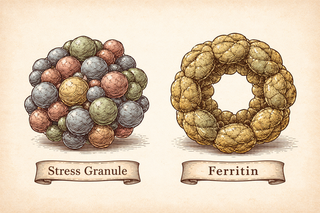
Stress granules are membrane-free assemblies of RNA and proteins that appear when cells are under pressure. No membrane, no walls, just molecules clustering like panicked interns around the last working printer. They usually help cells pause translation, protect RNAs, and survive stress.
The new paper reports that after radiation and temozolomide, glioblastoma stem cells recruit iron-related proteins into stress granules, including ferritin. Ferritin normally stores iron safely. But ferritin can also be degraded through ferritinophagy, releasing iron into the labile iron pool. More labile iron can help trigger ferroptosis.
Here is the clever bit: the stress granule core protein G3BP1 directly interacts with ferritin light chain, and the interaction depends on oxidation of G3BP1 at methionine-333 after treatment stress [1]. That molecular detail is deliciously specific. It is the kind of detail that makes a genomics nerd whisper, “Okay, but what regulates that residue?” into a perfectly normal dinner conversation.
By sequestering ferritin inside stress granules, the cells limit available ferrous iron and reduce ferritinophagy. Less loose iron means less ferroptotic pressure. The tumor cell survives another day, probably updating its LinkedIn skills section to include “adaptive stress management.”
The Small Molecule Plot Twist
The researchers also screened for a way to interfere with the G3BP1-ferritin light chain interaction. They identified ciwujianoside C3, which disrupted that binding, loosened the stress granule brake on ferroptosis, and made glioblastoma stem cells more sensitive to radiation and temozolomide in cell and animal models [1].
That does not mean ciwujianoside C3 is ready to stroll into clinic tomorrow wearing a superhero cape. Many things kill cancer cells in models and then face-plant in humans because of delivery, toxicity, dosing, blood-brain barrier problems, tumor heterogeneity, or the general fact that biology enjoys plot holes. But the concept is strong: instead of only hitting DNA damage harder, maybe therapy could also remove the tumor’s ferroptosis shield.
For glioblastoma, that is especially appealing. Brain cancer stem cells thrive through plasticity and heterogeneity, reshuffling cellular states like a genome-powered shell game [6]. A treatment strategy that exposes a shared metabolic weakness could give current therapy a better shot.
Why This One Is Worth Watching
This paper connects three worlds that usually get discussed in separate conference rooms: stress granules, iron storage, and ferroptosis. The finding suggests that glioblastoma stem cells may survive standard therapy by physically reorganizing iron-handling machinery inside the cell.
If future studies reproduce and extend this work, the impact could be practical. Clinicians already use radiation and temozolomide. A drug that sensitizes resistant glioblastoma stem cells to those treatments could, in principle, improve the effect of an existing backbone rather than replacing the whole treatment playbook.
The big questions now are very real: Can this be done safely in normal brain tissue? Do patient tumors show the same stress granule-ferritin behavior? Which genomic backgrounds depend most on this pathway? And can a drug reach the right cells at the right concentration without causing collateral chaos?
Cancer biology rarely hands us a clean villain. But sometimes it points to a suspiciously well-organized survival trick. In this case, the trick looks like ferritin hiding inside stress granules while ferroptosis waits outside with a clipboard and a tiny iron hammer.
References
-
Ge Z, Wang Z, Zhao E, et al. Stress granules restrain ferroptosis by sequestering ferritin. Nature Cell Biology. 2026. DOI: 10.1038/s41556-026-01953-5
-
Zhou Q, Meng Y, Li D, et al. Ferroptosis in cancer: from molecular mechanisms to therapeutic strategies. Signal Transduction and Targeted Therapy. 2024;9:55. DOI: 10.1038/s41392-024-01769-5
-
Diao J, Jia Y, Dai E, et al. Ferroptotic therapy in cancer: benefits, side effects, and risks. Molecular Cancer. 2024;23:89. DOI: 10.1186/s12943-024-01999-9. PMCID: PMC11067110
-
Liu T, Zhu C, Chen X, et al. Ferroptosis, as the most enriched programmed cell death process in glioma, induces immunosuppression and immunotherapy resistance. Neuro-Oncology. 2022;24(7):1113-1125. DOI: 10.1093/neuonc/noac033. PMCID: PMC9248406
-
Lv D, Zhong C, Dixit D, et al. EGFR promotes ALKBH5 nuclear retention to attenuate N6-methyladenosine and protect against ferroptosis in glioblastoma. Molecular Cell. 2023;83(23):4334-4351.e7. DOI: 10.1016/j.molcel.2023.10.025. PMCID: PMC10842222
-
Gimple RC, Yang K, Halbert ME, Agnihotri S, Rich JN. Brain cancer stem cells: resilience through adaptive plasticity and hierarchical heterogeneity. Nature Reviews Cancer. 2022;22:497-514. DOI: 10.1038/s41568-022-00486-x
Disclaimer: The image accompanying this article is for illustrative purposes only and does not depict actual experimental results, data, or biological mechanisms.