Most cancer stories focus on the usual stars - big-name genes, flashy mutations, the molecular celebrities who hog the spotlight. This paper goes hunting for an underdog instead: UFL1, a protein most non-cell-biologists have never had to lose sleep over, which is frankly healthy behavior.
In prostate cancer, the authors found that UFL1 is often reduced, and that drop tracks with chromosomal instability, or CIN for short - the tendency of cells to gain, lose, or badly shuffle chromosomes during division (Li et al., 2026). That matters because chromosomes are not decorative shelving. They hold the instruction manual. If a cancer cell keeps photocopying that manual with pages missing, duplicated, or taped in upside down, you get a tumor that evolves faster, acts meaner, and becomes harder to treat.
This fits a broader picture in prostate cancer. Recent reviews argue that CIN is not some side quest - it is tangled up with progression, metastasis, and treatment resistance (Fraile-Bethencourt et al., 2024; Al-Rawi et al., 2024). In other words, the tumor is not just growing. It is remixing itself.
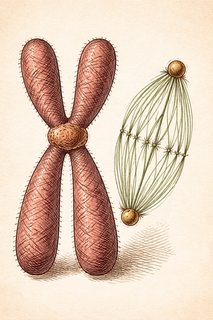
Mitosis: the world’s least forgiving group project
To understand why UFL1 matters, you need a quick trip into mitosis, which is the part of the cell cycle where one cell becomes two. Ideally, this is a clean handoff. In reality, it is a tiny circus involving spindle fibers, centrosomes, checkpoints, and proteins with names that sound like Wi-Fi passwords.
The new study says UFL1 helps keep that circus from catching fire.
Mechanistically, UFL1 modifies RNF20 through a process called UFMylation, a lesser-known cousin of ubiquitination that acts like a molecular tag system (Zhou et al., 2024). That modification helps RNF20 bind CEP192, a key centrosome-associated protein needed for proper spindle assembly. If UFL1 is missing, RNF20 does not get where it needs to go, the spindle apparatus gets messy, chromosomes mis-segregate, and the cell starts handing out the wrong genetic cargo like a baggage claim disaster run by raccoons (Li et al., 2026).
The paper also links this to MITF, a transcription factor that appears to help maintain UFL1 expression. Lower MITF means lower UFL1, which means even more room for prostate cancer to go full chaos goblin.
Why this is more than molecular trivia
Here is the part that earns a raised eyebrow over your second drink: this is not just a neat mechanism. It points to a possible weak point.
If prostate cancers with low UFL1 are especially prone to chromosome-level mistakes, that could help in at least two ways. First, biomarker potential: tumors with this kind of instability might be identifiable earlier or classified more accurately. Second, treatment strategy: cancers surviving on a shaky mitotic scaffold may be vulnerable if you push that instability past what they can tolerate. Researchers are already trying to exploit CIN more broadly in cancer, and reviews in 2024 called it a serious therapeutic opportunity rather than a biological curiosity (Al-Rawi et al., 2024).
There are hints this could matter clinically in prostate cancer. DNA ploidy and PTEN status are already being studied as ways to flag patients whose disease may behave more aggressively (Cyll et al., 2024). And CIN-based signatures are now being explored to predict resistance to chemotherapy across cancers, including prostate cancer (Crespo et al., 2025; Longoria et al., 2025).
That is the real-world hook. Not “wow, cells are weird,” though they absolutely are. It is that a neglected protein in the cell division machinery might help explain why some prostate cancers stay relatively manageable while others start behaving like they are trying to speedrun villainy.
The fine print, because biology always has fine print
Before anyone starts printing “Team UFL1” shirts, this is still early-stage work. The study is strong mechanistically, but moving from cell lines and mouse models to patient care is a long hike with bad weather. Prostate cancer is also wildly heterogeneous, which is a polite scientific way of saying it loves being inconvenient.
So the near-term value is clarity. This paper gives us a sharper explanation for how chromosomal instability can arise in prostate cancer, and it elevates an overlooked pathway that now deserves a lot more attention.
Not bad for a molecular bench player.
References
-
Li J, Yang F, Zhang X, et al. Loss of UFL1 drives chromosome instability and tumorigenesis of prostate cancer. Proc Natl Acad Sci U S A. 2026;123(17):e2523965123. https://doi.org/10.1073/pnas.2523965123
-
Fraile-Bethencourt E, Christensen WN, Iniguez AB, Knudsen ES. The yin and yang of chromosomal instability in prostate cancer. Nat Rev Urol. 2024;21(6):357-372. https://doi.org/10.1038/s41585-023-00845-9
-
Al-Rawi DH, Lettera E, Li J, et al. Targeting chromosomal instability in patients with cancer. Nat Rev Clin Oncol. 2024;21:645-659. https://doi.org/10.1038/s41571-024-00923-w
-
Zhou X, Mahdizadeh SJ, Le Gallo M, Eriksson LA, Chevet E, Lafont E. UFMylation: a ubiquitin-like modification. Trends Biochem Sci. 2024;49(1):52-67. https://doi.org/10.1016/j.tibs.2023.10.004
-
Cyll K, Haug ES, Pradhan M, et al. DNA ploidy and PTEN as biomarkers for predicting aggressive disease in prostate cancer patients under active surveillance. Br J Cancer. 2024;131(5):895-904. https://doi.org/10.1038/s41416-024-02780-x
-
Crespo M, Rinaldi G, Macintyre G, et al. Predicting resistance to chemotherapy using chromosomal instability signatures. Nat Genet. 2025;57(7):1708-1717. https://doi.org/10.1038/s41588-025-02233-y
-
Longoria O, Rekowski J, Gupta S, et al. Chromosomal instability in circulating tumor cells and cabazitaxel resistance in metastatic castration-resistant prostate cancer. JCI Insight. 2025;10(24):e196505. https://doi.org/10.1172/jci.insight.196505
Disclaimer: The image accompanying this article is for illustrative purposes only and does not depict actual experimental results, data, or biological mechanisms.