The case opens with suspicious clues scattered across the cellular crime scene: a tumor burning sugar like it has a midnight deadline, mitochondria changing shape in the corner, immune cells looking oddly exhausted, and somewhere in the evidence locker, Otto Warburg’s ghost muttering, “I told you metabolism mattered.”
That, roughly, is the premise of MacVicar and colleagues’ new review in Cell Metabolism, “Cancer as a window into mitochondrial biology” (DOI: 10.1016/j.cmet.2026.05.003). The paper is not reporting one big new experiment. Instead, it makes a broader and, frankly, very satisfying argument: cancer has taught us that mitochondria are not little bean-shaped batteries sitting politely in the cytoplasm, waiting for someone to call them “the powerhouse of the cell” for the 900 millionth time.
Mitochondria are alive with decisions. They fuse, split, travel, signal, panic, adapt, and sometimes help cancer cells survive in ways that feel less like biochemistry and more like office politics with enzymes.
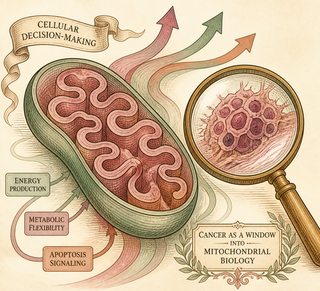
The Organelle Formerly Known as a Battery
For decades, mitochondria were mostly introduced as ATP factories. ATP is the cell’s energy currency, which makes mitochondria sound like tiny accountants in sensible shoes. But modern cancer biology has made that description look painfully underdressed.
Mitochondria also help decide whether a damaged cell should die through apoptosis, manage reactive oxygen species, shape immune signaling, process nutrients, influence gene expression, and maintain the metabolic flexibility cells need when life becomes unpleasant. Tumors, being unpleasantness with a blood supply, are excellent stress tests.
Cancer cells face low oxygen, scarce nutrients, immune attack, therapy pressure, and the general existential awkwardness of being cells that have defected from the cooperative project of the body. As Camus did not say, but perhaps should have: one must imagine the mitochondrion adapting.
Warburg Was Right, But Not Finished
The old Warburg effect says many cancer cells ferment glucose into lactate even when oxygen is available. This once encouraged the idea that tumor mitochondria were broken. That view was too simple, like assuming a person is unemployed because they are wearing sweatpants at noon.
Many cancers keep functional mitochondria and use them aggressively. Reviews over the past few years have emphasized that tumor cells can depend on oxidative phosphorylation, glutamine metabolism, fatty acid oxidation, redox control, and mitochondrial signaling, depending on tumor type and context (Sainero-Alcolado et al., 2022; Du et al., 2025). The real story is not “glycolysis versus mitochondria.” It is “cells are opportunists, and cancer cells brought a buffet plate.”
This matters because metabolic plasticity is one reason cancers resist treatment. Block one pathway and the tumor may reroute through another, like a commuter with no moral objections to side streets.
Shape Is Not Decoration
Mitochondria are not static raisins floating in cellular pudding. They form networks. They break apart. They merge. These behaviors, called mitochondrial dynamics, help cells respond to stress and changing energy demands. A 2025 review in Nature Reviews Molecular Cell Biology describes fission and fusion as core machinery for mitochondrial adaptation, not cellular interior design (Tábara et al., 2025).
In cancer, those shapes may carry information. Work mapping mitochondrial networks in lung cancer found spatial and structural differences linked to bioenergetic states, suggesting that where mitochondria sit and how they connect can reveal how tumor cells are living, scheming, and paying rent (Han et al., 2023).
A mitochondrion’s form, in other words, can be a confession.
The Tumor Neighborhood Is Weird
The tumor microenvironment is not just cancer cells. It is immune cells, fibroblasts, blood vessels, metabolites, oxygen gradients, and biochemical gossip. Mitochondria participate in that social drama. They can influence T-cell survival and function, macrophage behavior, inflammation, and the ability of tumors to hide from immune attack.
Some studies even suggest mitochondria can move between cells through tunneling nanotubes, which sounds like science fiction until you remember that biology has never once cared about sounding reasonable. Cancer cells may gain or dump mitochondrial material in ways that alter immune function and survival (Saha et al., 2022; Ikeda et al., 2025).
If the immune system is a security team, mitochondria are not just powering the flashlights. They may be rewriting the access badges.
Why This Could Matter
If these mitochondrial behaviors can be measured reliably, they could help classify tumors by how they actually live, not just by where they started or which mutations they carry. That could improve biomarkers, identify metabolic vulnerabilities, and guide combination therapies that hit cancer when it tries to switch fuel sources.
But the challenges are serious. Mitochondria are essential in normal tissues too, so targeting them is like trying to sabotage a getaway car while your own ambulance uses the same engine. Tumors are heterogeneous, patients vary, and mitochondrial biology shifts with oxygen, nutrients, therapy, and time. The target moves because life moves.
That is why this review is intriguing. It suggests cancer is not only a disease to be treated, but also a distorted mirror in which we see basic cell biology more clearly. The tragedy of cancer is betrayal: cells abandoning the body’s ancient cooperative treaty. The opportunity is that betrayal leaves tracks.
Follow the mitochondria, and the clues may lead somewhere useful.
References
MacVicar T, Greaves LC, Gammage PA, Tait SWG, Fisher-Wellman KH, Freedman G. Cancer as a window into mitochondrial biology. Cell Metabolism. 2026;38(6):1085-1088. https://doi.org/10.1016/j.cmet.2026.05.003
Sainero-Alcolado L, Liaño-Pons J, Ruiz-Pérez MV, Arsenian-Henriksson M. Targeting mitochondrial metabolism for precision medicine in cancer. Cell Death & Differentiation. 2022;29:1304-1317. https://doi.org/10.1038/s41418-022-01022-y
Kopinski PK, Singh LN, Zhang S, et al. Mitochondrial DNA variation and cancer. Nature Reviews Cancer. 2021;21:431-445. https://doi.org/10.1038/s41568-021-00358-w
Tábara LC, Segawa M, Prudent J. Molecular mechanisms of mitochondrial dynamics. Nature Reviews Molecular Cell Biology. 2025;26:123-146. https://doi.org/10.1038/s41580-024-00785-1
Du H, Xu T, Yu S, et al. Mitochondrial metabolism and cancer therapeutic innovation. Signal Transduction and Targeted Therapy. 2025;10:245. https://doi.org/10.1038/s41392-025-02311-x
Disclaimer: The image accompanying this article is for illustrative purposes only and does not depict actual experimental results, data, or biological mechanisms.