Molecular modifications are the cell’s makeover montage: a tiny chemical accessory here, a protein wardrobe change there, and suddenly biology is walking into the room acting like it has a new stylist. In lung cancer prevention, though, the makeover question is more blunt: after years of cigarette smoke redecorating your airways with DNA damage, inflammation, and general biochemical vandalism, does switching to e-cigarettes help the lungs recover, or just swap the ashtray for a sleeker accessory?
A new Nature Medicine study says we should raise an eyebrow. Possibly both.
The Consensus Everyone Likes
The standard harm-reduction argument goes like this: cigarettes are combustion machines. They burn tobacco, produce a chemical soup, and deliver carcinogens with the subtlety of a marching band in a library. E-cigarettes do not burn tobacco, so they usually expose users to fewer toxicants than cigarettes. That part matters. If the comparison is “keep smoking” versus “completely switch,” vaping may be less harmful.
But that is not the question this study asked.
The sharper question was: among people who already quit cigarettes, what happens if they keep using e-cigarettes instead of stopping nicotine products altogether?
That is where the story gets less tidy.
Four And A Half Million People Is Not A Vibes-Based Study
Kim and colleagues analyzed 4,524,895 adults in South Korea with a history of conventional cigarette smoking. Everyone had participated in the Korean National Health Screening Program in 2018, with earlier records from 2012 to 2014. Researchers grouped people as current smokers, short-term quitters, or long-term quitters, then followed them through December 2023 [1].
Over more than 24 million person-years, the study recorded 35,887 lung cancer cases and 12,807 lung cancer-specific deaths. Compared with people who quit smoking and did not use e-cigarettes, those who used e-cigarettes daily after quitting had higher risks of lung cancer incidence and lung cancer-specific death.
The adjusted hazard ratio for lung cancer was 1.56. For lung cancer-specific death, it was 2.00 [1].
Translation from statistics goblin dialect: within this study, daily post-cessation e-cigarette users had about 56% higher lung cancer hazard and about twice the hazard of dying from lung cancer compared with complete quitters. A hazard ratio is not a crystal ball for your personal future, but it is a serious flare in the data.
The Uncomfortable Question
The obvious retort is: “Maybe the vapers were different to begin with.” Correct. Gold star. Observational studies are always haunted by confounding, the scientific term for “people are messy and refuse to behave like randomized lab mice.”
Maybe people who used e-cigarettes had smoked more heavily. Maybe they had stronger nicotine dependence. Maybe they differed in diet, occupational exposures, screening behavior, or the thousand other life variables that make epidemiologists stare into the middle distance. The researchers adjusted for many factors, but adjustment is not magic. It is more like trying to clean glitter out of carpet.
Still, the pattern matters because it pokes at a popular assumption: once cigarettes are gone, vaping is harmless enough to ignore. The study does not prove vaping caused the cancers. It does suggest that “quit smoking, but vape daily forever” may not give the same cancer-prevention benefit as “quit smoking, full stop.”
Why The Lungs Might Care
E-cigarette aerosol is not just enchanted water vapor. It can contain nicotine, volatile organic compounds, carbonyls, metals, flavoring chemicals, and tiny particles that reach deep lung tissue. Reviews have repeatedly found that e-cigarettes likely reduce exposure to many cigarette toxins, while also raising concerns about inflammation, oxidative stress, respiratory effects, and the lack of long-term cancer data [2].
That nuance is annoying, which is how you know it is probably closer to reality. Cigarettes are worse. Vapes are not air. The lungs did not sign up to beta-test mango-flavored industrial chemistry.
The Clinical Catch
There is another twist. E-cigarettes may help some adults stop smoking, and evidence syntheses have found nicotine e-cigarettes can improve quit rates compared with some other approaches [3]. So the contrarian position is not “vapes are useless” or “everyone panic.”
The more defensible position is: if e-cigarettes are used as a bridge away from cigarettes, the bridge should probably lead somewhere. Ideally not to a permanent fog machine subscription.
That matters especially for people already at high lung cancer risk. Current guidelines recommend low-dose CT screening for many adults aged 50 to 80 with a 20 pack-year smoking history, depending on the guideline and local criteria [4,5]. In the new study, the higher-risk subgroup also showed elevated lung cancer incidence and lung cancer-specific death among post-cessation e-cigarette users [1]. That is not a footnote. That is the part where your doctor leans forward.
What This Changes
This study gives clinicians a better sentence than “vaping is probably better than smoking.” Better questions now sound like:
Are you using e-cigarettes to get off cigarettes, or did the exit ramp become the destination? Are you still getting lung cancer screening if you qualify? Do you have a plan to taper nicotine or stop vaping? Has anyone actually helped you with that, or did they just hand you a pamphlet and vanish like a low-budget magician?
The current challenge is not just getting people to stop cigarettes. It is helping them finish the job without pretending every non-cigarette product is benign.
Complete cessation still looks like the cleanest win. Not glamorous. Not TikTok-friendly. But lungs are old-fashioned like that.
References
-
Kim YW, Park EJ, Kwak KI, et al. Electronic cigarette use after smoking cessation and lung cancer risk. Nature Medicine. 2026. https://doi.org/10.1038/s41591-026-04469-5
-
Marques P, Piqueras L, Sanz MJ. An updated overview of e-cigarette impact on human health. Respiratory Research. 2021;22:151. https://doi.org/10.1186/s12931-021-01737-5. PMCID: PMC8129966
-
Lindson N, Theodoulou A, Ordóñez-Mena JM, et al. Pharmacological and electronic cigarette interventions for smoking cessation in adults: component network meta-analyses. Cochrane Database of Systematic Reviews. 2023;9:CD015226. https://doi.org/10.1002/14651858.CD015226.pub2. PMCID: PMC10495240
-
US Preventive Services Task Force. Screening for lung cancer: US Preventive Services Task Force recommendation statement. JAMA. 2021;325(10):962-970. https://doi.org/10.1001/jama.2021.1117
-
Wolf AMD, Oeffinger KC, Shih TY, et al. Screening for lung cancer: 2023 guideline update from the American Cancer Society. CA: A Cancer Journal for Clinicians. 2024;74(1):50-81. https://doi.org/10.3322/caac.21811
-
Zawertailo L, et al. Clinical guidance for e-cigarette cessation: results from a modified Delphi panel approach. Preventive Medicine Reports. 2023;35:102372. https://doi.org/10.1016/j.pmedr.2023.102372. PMCID: PMC10466900
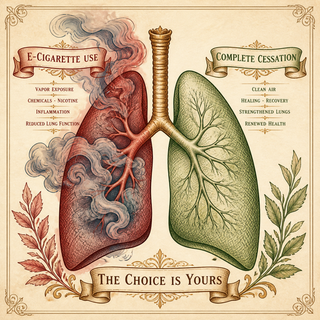
Disclaimer: The image accompanying this article is for illustrative purposes only and does not depict actual experimental results, data, or biological mechanisms.