Level one of pancreatic cancer immunology looks simple: find the tumor boss, send in the immune warriors, collect victory loot. Then level two loads, the lights flicker, and you realize the boss arena is packed with suspicious support characters quietly locking doors, moving walls, and hiding all the power-ups.
Those support characters are fibroblasts.
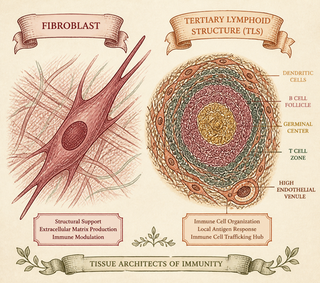
A new Immunity commentary by Théo Bouloudani and Catherine Sautès-Fridman highlights work from Kirschstein and colleagues in Cancer Cell showing that some fibroblasts may decide whether pancreatic tumors can build tertiary lymphoid structures, or TLSs. TLSs are little immune command centers that form inside or near inflamed tissue. In cancer, they can look like pop-up lymph nodes: T cells, B cells, and other immune operatives gathering close to the action instead of commuting from distant immune suburbs.
That matters because pancreatic ductal adenocarcinoma is famously hostile to immunotherapy. It is less "open battlefield" and more "fortress with bad lighting, terrible parking, and a moat made of scar tissue."
The Tumor Neighborhood Has Zoning Laws
Fibroblasts usually help build and maintain tissue structure. They make scaffolding, patch wounds, and generally act like the body’s construction crew. In tumors, though, cancer-associated fibroblasts can become deeply weird, because of course cancer biology looked at construction workers and said, "What if they also ran espionage?"
Kirschstein et al. focused on two fibroblast flavors in pancreatic cancer. One was myofibroblastic CAFs, or myCAFs, which are linked to stiff, fibrotic, immune-hostile tumor stroma. The other was reticular CAFs, or rCAFs, which resemble fibroblastic reticular cells that help organize immune cell traffic in lymphoid tissues.
The big plot twist: tumors rich in rCAFs were more permissive to TLS formation. Tumors dominated by myCAFs resisted it. The difference was not just architectural wallpaper. MyCAF programming blocked fibroblasts from turning on chemokines, the molecular distress flares that help recruit lymphocytes into the tumor zone.
In other words, the immune cells may have been ready for battle, but the map marker was missing.
TGF-Beta: The Villain With a Clipboard
The signal pushing fibroblasts toward the myCAF state was TGF-beta. TGF-beta is a shape-shifting cytokine involved in wound healing, immune regulation, fibrosis, and cancer. In normal biology, it can be useful. In tumors, it often becomes the bureaucrat of doom, stamping "access denied" on immune responses.
The Cancer Cell study found that TGF-beta-driven myCAF programming prevented fibroblasts from adopting the TLS-organizing rCAF state. But when researchers inhibited TGF-beta receptor 1 and added a lymphotoxin beta receptor agonist, pancreatic tumor models that previously resisted TLS formation started recruiting T and B cells and forming TLS-like structures. Tumor control improved in a T cell-dependent way.
That is not a cure. It is not even close to a "throw this into everyone’s pancreas tomorrow" situation. Biology still has 900 side quests, and most of them involve toxicity, timing, patient selection, and the humbling fact that mice do not read clinical trial protocols.
But it is a very interesting control panel.
Why TLSs Are Having a Moment
TLSs have become a hot topic because several studies connect mature TLSs with stronger anti-tumor immunity and better responses to immune checkpoint blockade. In melanoma, TLSs have been linked to improved immunotherapy outcomes. Across solid tumors, mature TLSs may predict checkpoint inhibitor benefit independently of PD-L1, which is helpful because PD-L1 sometimes behaves like a biomarker written by a committee during a fire drill.
In pancreatic cancer, the TLS story is especially tempting. This disease often resists immunotherapy, partly because immune cells struggle to enter and function inside the dense tumor microenvironment. If researchers can learn how to build or restore local immune hubs, they may be able to turn some "cold" tumors into warmer, more attackable neighborhoods.
Recent pancreatic cancer work has also pointed to other TLS-related switches, including IL-33-activated innate lymphoid cells that can induce TLS formation. Put together, the field is starting to look less like "TLSs randomly appear if the tumor feels generous" and more like a programmable immune architecture problem.
Which sounds absurdly sci-fi, until you remember we are talking about engineering microscopic fortresses inside tumors. Oncology has no chill.
The Catch, Because There Is Always a Catch
TLSs are not automatically good in every setting. Their location, maturity, cell composition, and surrounding stroma all matter. A well-organized immune basecamp may help anti-tumor responses. A poorly organized or suppressive structure could be less useful, or even counterproductive.
The fibroblast angle helps explain that complexity. The same broad cell category, "fibroblast," can include pro-immune builders and immune-blocking wall-makers. Targeting all fibroblasts would be like demolishing an entire city because one department lost your permit. The smarter goal is reprogramming the bad zoning rules.
If future studies reproduce and expand these findings, clinicians might someday use fibroblast states or TLS signatures to identify patients more likely to benefit from immunotherapy combinations. Therapies that combine TGF-beta pathway inhibition with immune-organizing signals could help create the local conditions immune cells need to do their jobs.
Not magic. More like finally giving the tiny bodyguards a working elevator key.
References
-
Bouloudani T, Sautès-Fridman C. Fibroblasts hold the key to TLS formation. Immunity. 2026;59(6):1490-1492. doi:10.1016/j.immuni.2026.05.009
-
Kirschstein E, Harder O, Krull J, et al. Myofibroblast programming blocks differentiation of TLS-organizing fibroblastic reticular cells in pancreatic cancer. Cancer Cell. 2026;44(5):1080-1096.e11. doi:10.1016/j.ccell.2026.03.004
-
Vanhersecke L, Brunet M, Guégan JP, et al. Mature tertiary lymphoid structures predict immune checkpoint inhibitor efficacy in solid tumors independently of PD-L1 expression. Nature Cancer. 2021;2:794-802. doi:10.1038/s43018-021-00232-6
-
Kinker GS, Vitiello GAF, Diniz AB, et al. Mature tertiary lymphoid structures are key niches of tumour-specific immune responses in pancreatic ductal adenocarcinomas. Gut. 2023;72:1927-1941. doi:10.1136/gutjnl-2022-328697
-
Amisaki M, Zebboudj A, Yano H, et al. IL-33-activated ILC2s induce tertiary lymphoid structures in pancreatic cancer. Nature. 2025;638:1076-1084. doi:10.1038/s41586-024-08426-5
Disclaimer: The image accompanying this article is for illustrative purposes only and does not depict actual experimental results, data, or biological mechanisms.