At some point today, you probably turned sugar into energy without sending a single thank-you note to your mitochondria. Rude, honestly. But inside lung tumors, sugar handling is not just housekeeping. It is logistics, construction, security, and occasionally a getaway driver.
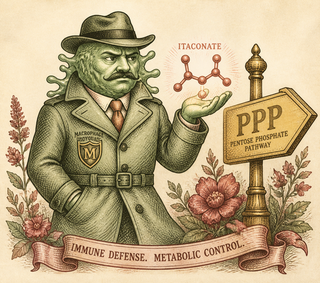
A new Cell Metabolism study asks a wonderfully specific question: what happens when tumor-associated macrophages, the immune cells hanging around tumors like confused bodyguards at a suspicious nightclub, make a small molecule called itaconate? The answer: they may help jam one of cancer’s favorite metabolic side roads.
The Tumor Neighborhood Has Weird Zoning Laws
Macrophages are immune cells that normally clean up messes, fight invaders, and help tissues heal. Near tumors, though, they can get reprogrammed. Some become helpful anti-cancer scouts. Others become the tumor’s weirdly loyal maintenance crew, patching roads, calming immune attacks, and generally making the neighborhood more comfortable for cellular rebels.
Researchers already know tumor-associated macrophages are not one simple “good guy/bad guy” population. A 2022 review in Nature Reviews Clinical Oncology stressed that macrophage states are diverse, clinically relevant, and increasingly targetable in cancer therapy (doi:10.1038/s41571-022-00620-6). Translation: the macrophage section of the tumor map has many alleys, and some of them are poorly lit.
This new study focuses on one alley named IRG1, also called ACOD1, a gene that helps macrophages make itaconate. Itaconate is a metabolite, which means it is one of those small chemical widgets cells use to run their internal economy. Recent reviews have described itaconate as a major immunometabolic messenger, especially in macrophages (doi:10.1038/s42255-024-01092-x, doi:10.1016/j.tem.2024.02.004). Tiny molecule, big group chat energy.
The Missing Molecule in the Tumor Zone
Mansouri and colleagues looked at lung tumors using spatial metabolomics, which is basically chemical cartography. Instead of asking “what molecules are in this tissue smoothie?” they ask “where are the molecules located?” Much better. Nobody wants a map made in a blender.
They found that itaconate was depleted inside lung tumor regions compared with nearby non-tumor lung tissue. Single-cell RNA sequencing then pointed to macrophages as the main IRG1-expressing cells in human and mouse lung tumors.
Then came the stress test. When mice lacked IRG1, or received bone marrow missing IRG1, lung tumors grew more. That suggests IRG1 and its itaconate product were not just decorative throw pillows in the tumor microenvironment. They were doing anti-tumor work.
The team also tested 4-octyl itaconate, a cell-permeable itaconate derivative. In lung cancer cells, mouse models, and precision-cut slices of human lung tumors, it reduced tumor growth. That last model matters because human tumor slices preserve more of the messy tissue architecture. Cancer biology loves a clean petri dish, then immediately betrays it in real tissue, because apparently biology went to drama school.
The Sugar Side Road: PPP and G6PD
Now for the metabolic diagram. Imagine glucose entering a cell like a delivery truck at a city intersection. One road goes toward glycolysis, where cells harvest energy. Another road branches into the pentose phosphate pathway, or PPP. The PPP makes two very useful things: NADPH, which helps cells manage oxidative stress and build molecules, and ribose sugars, which help make DNA and RNA.
Cancer cells, being overachieving little rebels, often love this route because fast growth needs building materials. The key gatekeeper near the entrance is G6PD, short for glucose-6-phosphate dehydrogenase.
This study found that IRG1/itaconate inhibits G6PD activity and reduces PPP flux. In plain English: itaconate appears to put a traffic cone in front of a metabolic shortcut tumors like to use. Not a glamorous traffic cone. A biochemical traffic cone. Still satisfying.
The effect was not limited to cancer cells. Itaconate also shifted pro-tumor macrophages toward a more anti-tumor state. So the molecule may hit both the rebellious cells and parts of the neighborhood support staff.
Why This Is Worth Watching
The most interesting part is not “itaconate kills cancer, everyone go home.” Please do not go home. Science has paperwork.
The interesting part is that a macrophage-made metabolite may suppress lung tumor growth by rewiring metabolism across multiple cell types. That fits a broader trend: cancer treatment is no longer only about attacking tumor cells directly. It is also about changing the ecosystem they live in. A tumor is less like a marble and more like a bad city council meeting with blood vessels, immune cells, nutrients, waste, and too many people voting in favor of chaos.
There are also reasons to stay careful. Itaconate can behave differently depending on cancer type and context. For example, a 2024 Cancer Cell study found that tumor uptake of itaconate through SLC13A3 could impair tumor immunity by promoting ferroptosis resistance (doi:10.1016/j.ccell.2024.10.010, PMCID:PMC11631639). In another 2024 paper, tumor-intrinsic itaconate promoted tumor immunogenicity (doi:10.1038/s44318-024-00217-y, PMCID:PMC11574104). Biology, as usual, refuses to be a tidy infographic.
The Takeaway
If these findings hold up, the IRG1/itaconate axis could become a new way to think about lung cancer therapy: not just “block a growth signal,” but “reroute the tumor’s fuel economy and retrain nearby immune cells.” That is a more architectural view of cancer treatment. Less whack-a-mole, more urban planning with lab coats.
For now, 4-octyl itaconate is not a lung cancer treatment in the clinic. But this study gives researchers a sharp new map: macrophages make itaconate, tumors seem to lose it, and restoring that signal may jam a metabolic pathway cancer depends on. Somewhere inside that tiny chemical detour, there may be a useful therapeutic road sign.
References
-
Mansouri S, Hesami G, Ambikan A, et al. IRG1/itaconate rewires macrophage and lung tumor metabolism through G6PD inhibition. Cell Metabolism. 2026. doi:10.1016/j.cmet.2026.05.005
-
Pittet MJ, Michielin O, Migliorini D. Clinical relevance of tumour-associated macrophages. Nature Reviews Clinical Oncology. 2022;19:402-421. doi:10.1038/s41571-022-00620-6
-
McGettrick AF, Bourner LA, Dorsey FC, et al. Metabolic Messengers: itaconate. Nature Metabolism. 2024;6:1661-1667. doi:10.1038/s42255-024-01092-x
-
Ye D, Wang P, Chen LL, Guan KL, Xiong Y. Itaconate in host inflammation and defense. Trends in Endocrinology & Metabolism. 2024;35:586-606. doi:10.1016/j.tem.2024.02.004
-
Lin H, Tison K, Du Y, et al. Itaconate transporter SLC13A3 impairs tumor immunity via endowing ferroptosis resistance. Cancer Cell. 2024;42:2032-2044.e6. doi:10.1016/j.ccell.2024.10.010, PMCID:PMC11631639
Disclaimer: The image accompanying this article is for illustrative purposes only and does not depict actual experimental results, data, or biological mechanisms.