39 trillion is roughly the number of microbial cells hanging out in and on a human body, which means you are less a lone individual and more a very opinionated apartment building with legs.
Most days, this arrangement works beautifully. Your gut microbes help process food, train the immune system, and manufacture small molecules that drift through the body like tiny biochemical text messages. But in the plot Fang, Lau, and Yu lay out in Gut, some of those messages may reach one of cancer’s most annoying characters: the cancer stem cell.
And cancer stem cells are not regular villains. They are the sequel villains. The ones you thought were gone after chemotherapy, only to pop up in the final scene wearing a darker coat.
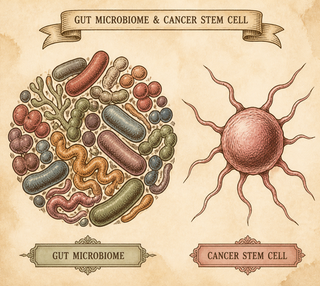
The Tiny Survivors in the Basement
Cancer stem cells, or CSCs, are a small population of tumor cells with a very inconvenient talent: they can self-renew, seed new tumor growth, help metastasis, and survive treatment better than many of their tumor neighbors. If a tumor were a chaotic medieval castle, CSCs would be the smug little heirs hidden in the cellar, waiting to reclaim the throne after the siege.
Chemotherapy often works by damaging fast-growing cells. That can shrink tumors, sometimes dramatically. But CSCs can hunker down, shift their metabolism, repair damage, pump drugs out, and take cues from the tumor microenvironment - the sketchy neighborhood around the tumor where immune cells, fibroblasts, blood vessels, extracellular matrix, and soluble factors all keep gossiping.
Fang and colleagues reviewed evidence that microbes and their metabolites may influence that neighborhood, changing whether CSCs stay dangerous, become more vulnerable, or get help from the wrong crowd.
The Gut Sends Plot Twists
The microbiota does not need to march into a tumor wearing a tiny helmet to affect cancer biology. Often, microbes work through metabolites - small chemicals produced when bacteria digest nutrients or modify host molecules.
Short-chain fatty acids such as butyrate, acetate, and propionate come from microbial fermentation of fiber. Bile acids start in the liver but get remodeled by gut microbes. Tryptophan metabolites, including indole derivatives, can act like molecular mood lighting for immune and cancer cells. Some of these compounds influence inflammation, cell signaling, gene expression, metabolism, and immune behavior.
That is not a simple “good bacteria good, bad bacteria bad” story. Biology looked at our desire for clean categories and laughed into a pipette. The same class of metabolite can help or hurt depending on dose, tissue, tumor type, and which receptor answers the door.
Chemotherapy Meets the Microbial Writers’ Room
One of the clearest examples comes from pancreatic cancer. In a 2023 Nature study, researchers found that patients with metastatic pancreatic ductal adenocarcinoma who responded better to chemotherapy had higher levels of a microbial tryptophan metabolite called indole-3-acetic acid, or 3-IAA. In mouse models, 3-IAA improved chemotherapy response. Mechanistically, it worked with neutrophil-derived myeloperoxidase to increase oxidative stress in tumor cells and interfere with their stress-survival machinery.
Translation: a gut-derived molecule may help chemotherapy make cancer cells worse at taking a punch. Not exactly a superhero cape, but in pancreatic cancer, even a well-aimed biochemical shove matters.
Other reviews show the broader cast. Gut microbes can alter drug availability, drug toxicity, immune activation, tumor metabolism, and treatment resistance. Some bacteria may even help tumors resist chemotherapy through pathways like autophagy, which is basically the cell’s emergency recycling program. Cancer cells, because they are rude, can use that program to survive.
Why This Review Matters
The Gut review pulls several threads together: CSCs, microbiota, metabolites, chemotherapy resistance, and possible interventions. That combination matters because resistance remains one of oncology’s most maddening problems. A treatment can look promising, the tumor can shrink, everyone exhales - and then the hidden cell population starts writing Chapter Two.
If the CSC-microbiota-metabolite network proves reproducible in larger human studies, it could open practical strategies. Doctors might one day use microbial or metabolite signatures to predict who will respond to chemotherapy. Researchers might design probiotics, prebiotics, metabolite formulations, targeted antibiotics, engineered bacteria, or nanomedicine approaches to weaken CSC defenses. The goal would not be “drink yogurt, defeat cancer,” which would be both absurd and legally haunted. The goal would be precision: identify which microbial pathways matter, in which patients, with which treatment, at which moment.
The Cliffhanger: Helpful Tool or Chaos Button?
The hard part is that the microbiome is wildly personal. Diet, antibiotics, cancer type, geography, immune status, and prior treatment all shape it. Changing microbes without understanding the setting could help, do nothing, or cause problems. This is not a kitchen-spice situation where more oregano fixes the stew.
Still, the idea is compelling: chemotherapy may not act alone. It may arrive with backup or interference from an invisible microbial ensemble, whose metabolites can tug on the behavior of cancer stem cells and the neighborhoods they hide in.
The next chapter needs careful human trials, better biomarkers, and a lot of mechanistic detective work. But the story has a deliciously strange premise: some of the smallest residents in your body may influence whether some of cancer’s most stubborn cells keep their crown.
References
-
Fang F, Lau HCH, Yu J. Microbiota and metabolites modulation of cancer stem cells and chemotherapy sensitivity. Gut. 2026. DOI: 10.1136/gutjnl-2026-338801
-
Tintelnot J, Xu Y, Lesker TR, et al. Microbiota-derived 3-IAA influences chemotherapy efficacy in pancreatic cancer. Nature. 2023;615:168-174. DOI: 10.1038/s41586-023-05728-y
-
Li S, Zhu S, Yu J. The role of gut microbiota and metabolites in cancer chemotherapy. Journal of Advanced Research. 2024;64:223-235. DOI: 10.1016/j.jare.2023.11.027. PMCID: PMC11464465
-
Yang Q, Zhang H, Wei T, et al. A Review of Gut Microbiota-Derived Metabolites in Tumor Progression and Cancer Therapy. Advanced Science. 2023;10:e2207366. DOI: 10.1002/advs.202207366. PMCID: PMC10214247
-
Deng J, Deng D, Wang B, Donati V, Frampton AE, Giovannetti E. Metabolites derived from gut microbiota mitigate chemoresistance in pancreatic cancer. Expert Review of Gastroenterology & Hepatology. 2024;18:597-604. DOI: 10.1080/17474124.2024.2412045
Disclaimer: The image accompanying this article is for illustrative purposes only and does not depict actual experimental results, data, or biological mechanisms.