The mystery of cancer coming back after surgery is a little like the mystery of D.B. Cooper: we know something disappeared, we know there were clues, and everyone has a theory that sounds confident until you ask for receipts.
In colorectal cancer, the disappearing act goes like this: a surgeon removes the tumor, scans look clean, everyone exhales, and then months later the cancer sometimes reappears like a villain who definitely should have stayed in Act II. The big question is whether tiny traces of tumor DNA in the blood can warn doctors early enough to do something useful.
That tiny trace is called circulating tumor DNA, or ctDNA. Think of it as shredded paperwork from cancer cells drifting through the bloodstream. Not a tumor you can see on a scan. Not a lump. More like biological confetti from a party nobody wanted to attend.
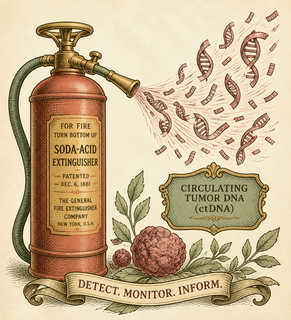
The ALTAIR trial asked a sharp, practical question: if patients have ctDNA after standard treatment but no visible cancer on scans, should doctors start treatment right away?
A Very Fancy Smoke Alarm
ctDNA has become one of oncology's most tempting tools because it can spot molecular residual disease, or MRD. That means cancer may still be hiding after surgery and chemotherapy, even when imaging says, "Nothing to see here, please move along."
Earlier studies made ctDNA look like a powerful risk signal. In the GALAXY study from CIRCULATE-Japan, patients with ctDNA after surgery had much worse disease-free survival and overall survival than ctDNA-negative patients. In the updated analysis, ctDNA positivity during the MRD window was linked with sharply worse outcomes, with a disease-free survival hazard ratio of 11.99 and overall survival hazard ratio of 9.68. That is not a subtle signal. That is the smoke alarm screaming while the toaster is on fire and your cat is judging you from the hallway (Kotani et al., 2023; Nakamura et al., 2024).
But oncology has a recurring problem: finding danger is not the same as knowing how to fix it. A positive ctDNA test may tell us cancer is likely lurking. The next question is nastier: what treatment actually helps?
ALTAIR Enters, Wearing Sensible Shoes
ALTAIR was a randomized, double-blind phase 3 trial inside the CIRCULATE-Japan platform. The researchers enrolled 243 patients with resected colorectal cancer, ranging from stage 0 to IV, who became ctDNA-positive after completing standard therapy but had no radiologic evidence of disease.
Half received trifluridine/tipiracil, also called FTD/TPI. The other half received placebo. Treatment lasted 6 months. The main goal was disease-free survival.
The result: median disease-free survival was 9.30 months with FTD/TPI versus 5.55 months with placebo. That sounds encouraging at first glance, the kind of number that makes a press release start stretching before a sprint. But the hazard ratio was 0.79, with a 95% confidence interval of 0.60 to 1.05, and the P value was 0.107. Translation: the trial did not meet its primary endpoint (Bando et al., 2026).
And the side effects were not exactly a spa weekend. Grade 3 or higher hematologic adverse events happened in 73.0% of patients receiving FTD/TPI, compared with 3.3% on placebo. No new safety signals showed up, but "known bad blood count problems" still counts as bad blood count problems.
The Annoying but Useful Lesson
This is where the skeptic in the room clears their throat.
ALTAIR does not mean ctDNA is useless. Far from it. It means ctDNA may be excellent at identifying risk, but risk detection does not magically turn any available drug into the right drug. A smoke alarm can save your life, but only if the thing you grab next is an extinguisher and not, say, a decorative throw pillow.
That distinction matters. The DYNAMIC trial showed that ctDNA-guided adjuvant therapy in stage II colon cancer could reduce chemotherapy use without compromising recurrence-free survival, and its 5-year follow-up supported ctDNA-guided management in that setting (Tie et al., 2022; Tie et al., 2025). Meanwhile, reviews of ctDNA-based MRD in colorectal cancer keep pointing to the same promise and the same headache: testing is getting better, but clinical action still needs proof (Wang et al., 2025).
Why This Still Matters
For patients, this research is not an abstract biomarker puzzle. It is the difference between waiting for cancer to become visible and catching warning signs while the enemy is still trying to sneak through the side door.
If future trials find treatments that clear ctDNA and improve survival, the impact could be huge. Doctors might intensify therapy for patients at highest risk, spare low-risk patients unnecessary chemotherapy, and use blood tests to track whether treatment is actually working. That would be oncology with fewer blindfolds, which feels like a reasonable upgrade.
But ALTAIR gives the field a needed reality check. ctDNA can tell us who is in trouble. It does not yet tell us that FTD/TPI, given after adjuvant therapy to ctDNA-positive patients with clean scans, solves the problem.
That is not a failure of the whole idea. It is the scientific process doing its least glamorous but most useful job: separating "this is promising" from "this actually helps people live longer or stay cancer-free." Less fireworks, more receipts. Honestly, oncology could use more of that.
References
-
Bando H, Watanabe J, Takahashi Y, et al. Post-adjuvant chemotherapy in ctDNA-positive patients with resected colorectal cancer: a randomized phase 3 trial. Nature Medicine. 2026. https://doi.org/10.1038/s41591-026-04428-0
-
Nakamura Y, et al. ctDNA-based molecular residual disease and survival in resectable colorectal cancer. Nature Medicine. 2024. https://doi.org/10.1038/s41591-024-03254-6
-
Kotani D, et al. Molecular residual disease and efficacy of adjuvant chemotherapy in patients with colorectal cancer. Nature Medicine. 2023;29:127-134. https://doi.org/10.1038/s41591-022-02115-4
-
Tie J, et al. Circulating tumor DNA analysis guiding adjuvant therapy in stage II colon cancer. New England Journal of Medicine. 2022. https://doi.org/10.1056/NEJMoa2200075
-
Tie J, et al. Circulating tumor DNA analysis guiding adjuvant therapy in stage II colon cancer: 5-year outcomes of the randomized DYNAMIC trial. Nature Medicine. 2025;31:1509-1518. https://doi.org/10.1038/s41591-025-03579-w
-
Wang X, et al. Circulating tumor DNA for MRD detection in colorectal cancer: recent advances and clinical implications. Biomarker Research. 2025. https://doi.org/10.1186/s40364-025-00796-w
Disclaimer: The image accompanying this article is for illustrative purposes only and does not depict actual experimental results, data, or biological mechanisms.