Most cancer drugs arrive like a SWAT team with a blurry address. They mean well, but healthy cells can get caught in the commotion. That has been one of the oldest headaches in metastatic cancer - especially ovarian cancer, where the disease often spreads widely and likes to come back like a villain who refuses to stay off screen.
This new paper from Nature Biomedical Engineering takes a different approach. Instead of telling a drug to attack any cell wearing a certain badge, the researchers rewired a virus so it only replicates inside cells broadcasting a very particular kind of internal chaos - hyperactive ErbB signaling, the pathway family that includes EGFR and HER2. In detective terms, this is less "round up everyone in the neighborhood" and more "wait for the suspect to use his very distinctive burner phone."
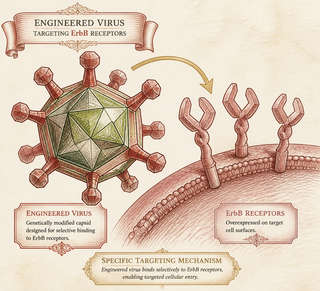
Their engineered agent is called ErbB-OSV - an ErbB oncogene-selective virus. The idea is sneaky in the best way. The virus can only fully do its grim little job if it detects the signaling state associated with cancer cells driven by ErbB family receptors. If the signal is absent, replication gets shut down. No signal, no mayhem. That is the theory, anyway. Biology, as usual, likes to act like a witness who keeps changing the story.
Why ErbB matters in the first place
EGFR and HER2 are part of the ErbB receptor family, a set of cell-surface proteins that help control growth and survival. In many cancers, including subsets of ovarian, breast, lung, and gastric cancers, these pathways get jammed in the "go, go, go" position. That can make tumors aggressive and hard to treat.
We already have targeted drugs against EGFR and HER2. Some work very well in the right setting. The problem is that tumors adapt, side effects pile up, and metastatic disease does not exactly fold under pressure. Immunotherapy has also transformed some cancers, but ovarian cancer has generally been a tougher neighborhood for it. T cells often show up like underpaid security guards and discover the building has no doors.
So the researchers asked a sharper question: what if you could target not just a surface marker, but the active signaling behavior of the cancer cell itself?
A virus with better taste in victims
Oncolytic viruses are designed to infect and kill cancer cells, sometimes while stirring up an immune response too. A few are already approved or in development, but specificity is the whole ballgame. If the virus replicates too freely, healthy tissue can pay the bill.
Here, the team used synthetic signaling-responsive proteins to make viral replication depend on aberrant ErbB activity. In plain English: they gave the virus a molecular bouncer. No suspicious signaling pattern, no entry to the after-party.
According to the paper, ErbB-OSV showed better safety than a benchmark oncolytic virus built on the same viral family backbone. That matters because "it kills tumors" sounds a lot less charming when the fine print reads "and maybe other things too."
In HER2-positive ovarian cancer xenografts, the virus also showed better efficacy than the comparator. Then came the stronger test - a syngeneic model of advanced ovarian cancer, which keeps the immune system in the picture and makes life more realistic, which is scientist code for "more annoying but more useful."
The reveal: good alone, even better with backup
The results got interesting fast.
As a single agent, ErbB-OSV reportedly cured most early cases in the model. That is the kind of line that makes you sit up straighter and read the methods twice.
In advanced disease, the team combined the virus with chemotherapy and used B cell depletion to allow repeated dosing. Why bother with B cells? Because your immune system, bless its paranoid heart, tends to make neutralizing antibodies against viruses, which can shut down repeat treatments. Depleting B cells is a way of giving the virus another pass at the suspect before the neighborhood watch catches on.
That combination delivered a 180% larger survival benefit than chemotherapy alone. Not a subtle nudge - more like kicking the door open.
What this could mean outside the lab
If these findings hold up, this strategy could point toward a new class of cancer therapy: signal-state-targeted biologics. Not just drugs that bind a protein. Not just viruses that prefer tumors. Agents engineered to respond to the tumor's internal wiring diagram.
That could matter a lot in metastatic disease, where precision is everything. A treatment that selectively expands inside cancer cells with aberrant ErbB signaling might reduce off-tumor toxicity while still hitting disseminated lesions. For patients with HER2- or EGFR-driven cancers, that is a tantalizing possibility.
But let's keep the trench coat on and the champagne corked. These are preclinical results. Mouse models are useful, but they are not tiny people with excellent whiskers. Questions remain about durability, resistance, manufacturing, delivery, and how well this approach translates across different human tumors and immune settings.
The bigger mystery
The real intrigue here is not just one virus. It is the broader trick: rewiring therapies to detect cancer-specific signaling states rather than relying only on tissue location or a single marker. Tumors are slippery operators. They change costumes. They forge papers. Catching them by behavior instead of outfit may be the smarter play.
This paper reads like a careful sting operation. The researchers found a molecular tell, wired it into a viral weapon, and sent it after metastatic cancer with stricter instructions than most therapies get. Whether that strategy becomes a clinical star is still an open case. But for once, the suspect may have left fingerprints everywhere.
References
-
Zou X, Palafox E, Zhao C, Beier KT, Kang CY, Lin MZ. Rewiring oncogenic signalling to precision ablation of metastatic cancer. Nat Biomed Eng. 2026. doi:10.1038/s41551-026-01704-9
-
Wee P, Wang Z. Epidermal growth factor receptor cell proliferation signaling pathways. Cancers (Basel). 2017;9(5):52. doi:10.3390/cancers9050052 PMCID:PMC5446472
-
Oh DY, Bang YJ. HER2-targeted therapies - a role beyond breast cancer. Nat Rev Clin Oncol. 2020;17(1):33-48. doi:10.1038/s41571-019-0268-3
-
Russell SJ, Barber GN. Oncolytic viruses as antigen-agnostic cancer vaccines. Cancer Cell. 2025;43(3):359-375. doi:10.1016/j.ccell.2025.01.002
-
Lheureux S, Braunstein M, Oza AM. Epithelial ovarian cancer: evolution of management in the era of precision medicine. CA Cancer J Clin. 2019;69(4):280-304. doi:10.3322/caac.21559
Disclaimer: The image accompanying this article is for illustrative purposes only and does not depict actual experimental results, data, or biological mechanisms.