What makes a tissue itself: the cells it contains, the job it performs, or the physical mood it keeps under the surface?
That sounds like something a philosopher would ask after staring too long at a biopsy slide, but it is basically the question behind a new Cancer Cell paper on breast cancer risk, inflammation, and tissue stiffness. The short version: when breast tissue becomes fibrotic and tense, it may not just sit there like biological packing material. It may actively help create a more dangerous neighborhood, recruiting macrophages and pushing them toward chemistry that can damage DNA.
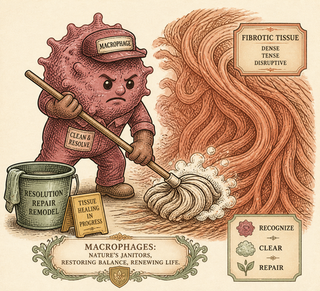
Cancer biology, once again, has chosen “haunted construction site” as its aesthetic.
The Tumor Neighborhood Has Bad Zoning Laws
Your tissues are not just blobs of cells floating in soup. They live in a scaffold called the extracellular matrix, a mesh of proteins like collagen that gives organs their shape and texture. A liver, a breast, a pancreas, and a squid mantle all solve the same basic problem - how do you hold cells together without turning the place into cement?
The answer matters because cells can feel stiffness. They tug on their surroundings and read the mechanical feedback, like tiny contractors testing whether the floorboards are solid. In cancer, that scaffold often gets remodeled into something denser, stiffer, and more fibrotic. That stiffening has already been linked to invasion, immune exclusion, drug resistance, and tumor progression.
Hayward and colleagues add a sharper twist: stiffness may also help create DNA damage before or during malignant progression, not just make existing cancer cells nastier Hayward et al., 2026.
Enter the Macrophage, Nature’s Extremely Confident Janitor
Macrophages are immune cells that clean up debris, eat suspicious material, and coordinate inflammation. They are useful. They are ancient. Versions of this job show up across animal life, because apparently every multicellular organism eventually needs a cellular bouncer with a mop.
But in tumors, macrophages can get recruited into the wrong crowd. Instead of fighting the tumor, they may help remodel tissue, suppress anti-tumor immune responses, and generally act like the security guard who got offered stock options by the villain.
In this study, stiff tissue increased epithelial STAT3 signaling, which helped trigger chemokine signals that pulled macrophages into the area. Once there, the macrophages experienced the tense, fibrotic environment and generated reactive oxygen species. Those reactive molecules kicked off lipid peroxidation, a chain reaction where fats in membranes get chemically roughed up.
The nasty leftovers include lipid aldehydes such as malondialdehyde and 4-hydroxynonenal. These are not polite molecules. They can react with DNA, forming damage and mutations - tiny typos in the cellular instruction manual. Enough typos in the wrong genes, and the cell starts treating “normal tissue citizen” as more of a loose suggestion.
Dense Breasts, Stiff Tissue, and the Risk Question
The authors also connect this mechanism to mammographically dense breast tissue. Dense breasts are common and already clinically relevant because they both raise breast cancer risk and make tumors harder to see on mammograms. The FDA’s national breast density notification requirement began in the United States on September 10, 2024, which means this is not just molecular trivia hiding in a lab freezer FDA.
What this paper suggests is that density may not be only a visibility problem or a vague risk marker. Dense, stiff breast tissue may come with inflammation, lipid aldehydes, and DNA damage. That is a much more specific story. It turns “dense tissue is associated with risk” into “here is a plausible biochemical path from mechanics to mutation.”
Nature loves this kind of cross-system echo. In pancreatic cancer, dense stroma can wall off drugs and immune cells. In breast cancer, stiff collagen can influence epithelial behavior and immune composition. Even elephants, with their famously low cancer rates despite massive bodies, remind us that cancer risk is not just about having lots of cells. It is about how tissues police damage, repair mistakes, and keep cellular rebels from becoming a franchise.
Why This Is a Big Deal If It Holds Up
The exciting part is not that stiff tissue is bad. We knew stiffness had villain potential. The exciting part is the proposed chain of custody:
stiff matrix -> epithelial STAT3 -> chemokines -> macrophage recruitment -> reactive oxygen species -> lipid peroxidation -> aldehydes -> DNA damage -> higher mutational burden.
That is the kind of pathway researchers can test, interrupt, and measure. Could future prevention strategies target fibrosis, mechanosignaling, macrophage recruitment, lipid peroxidation, or aldehyde-driven DNA damage? Maybe. Nobody should sprint to the supplement aisle yelling “antioxidants!” because biology is rude and context-dependent. Lipid oxidation can harm normal tissue, but oxidative stress is also how some cancer therapies kill tumor cells. It is less like flipping a switch and more like tuning an orchestra where the trombones may be armed.
Still, this work gives researchers a better map. It ties together breast density, inflammation, fibrosis, macrophages, and mutational burden into one mechanical-immune-chemical storyline. If reproduced and expanded, it could help explain why some “at-risk” tissues are not merely unlucky but physically primed for trouble.
Cancer cells may be the headline criminals, but this paper reminds us to check the neighborhood, the architecture, and the overly enthusiastic cleanup crew.
References
-
Hayward MK, Northey JJ, Opazo-Mellado V, et al. Tissue tension fosters macrophage-driven lipid peroxidation-induced DNA damage. Cancer Cell. 2026. DOI: 10.1016/j.ccell.2026.03.022
-
Tharp KM, Kersten K, Maller O, et al. Tumor-associated macrophages restrict CD8+ T cell function through collagen deposition and metabolic reprogramming of the breast cancer microenvironment. Nature Cancer. 2024;5:1045-1062. DOI: 10.1038/s43018-024-00775-4. PMCID: PMC12204312
-
Northey JJ, Hayward M-K, Yui Y, et al. Mechanosensitive hormone signaling promotes mammary progenitor expansion and breast cancer risk. Cell Stem Cell. 2024;31:106-126.e13. DOI: 10.1016/j.stem.2023.12.002. PMCID: PMC11050720
-
Stashko C, Hayward M-K, Northey JJ, et al. A convolutional neural network STIFMap reveals associations between stromal stiffness and EMT in breast cancer. Nature Communications. 2023;14:3561. DOI: 10.1038/s41467-023-39085-1. PMCID: PMC10272194
-
Yu KX, Yuan WJ, Wang HZ, et al. Extracellular matrix stiffness and tumor-associated macrophage polarization: new fields affecting immune exclusion. Cancer Immunology, Immunotherapy. 2024;73:115. DOI: 10.1007/s00262-024-03675-9
Disclaimer: The image accompanying this article is for illustrative purposes only and does not depict actual experimental results, data, or biological mechanisms.