Cancer treatment has a very annoying software problem: the first version often works beautifully, then the tumor files a bug report called "resistance" and keeps running anyway.
That is the recurring drama in EGFR-mutated non-small-cell lung cancer, or NSCLC. EGFR is a growth-signal receptor that can get stuck in the "go, go, go" position. Drugs called EGFR tyrosine kinase inhibitors, especially osimertinib, can shut that signal down for many patients. For a while, the system behaves. Then cancer, being the worst product manager alive, pivots.
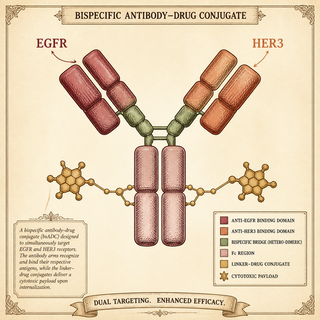
The new study in Annals of Oncology looks at izalontamab brengitecan, mercifully shortened to Iza-bren, also known as BL-B01D1. It is a bispecific antibody-drug conjugate, which sounds like something a biotech company would name after three whiteboards and one panic meeting. But the concept is pretty elegant: use an antibody that grabs two tumor-associated targets, EGFR and HER3, then deliver a chemotherapy payload straight to cells carrying those targets.
In startup terms, Iza-bren is not just knocking on one door. It is badge-accessing two doors, finding the conference room, and leaving a very serious calendar invite.
Why EGFR Plus HER3 Is a Sneaky Combo
EGFR and HER3 are part of the ErbB receptor family, a network of proteins that helps cells respond to growth signals. In cancer, this network can become less "organized infrastructure" and more "group chat with no moderation."
HER3 is especially interesting because it often hangs around in EGFR-mutated lung cancers, including after EGFR inhibitors stop working. It may not be the main villain in every case, but it can be a useful address label for drug delivery. Earlier HER3-directed antibody-drug conjugates, such as patritumab deruxtecan, already showed that this strategy can hit EGFR-mutated NSCLC after prior targeted therapy and chemotherapy.
Iza-bren adds a second targeting arm. By binding EGFR and HER3, it may improve tumor-cell recognition across a messy and heterogeneous cancer landscape. Tumors are not neat little app icons. They are more like a folder named "final_final_REAL_v7" with 400 hidden files.
What The Trial Found
Hong and colleagues pooled individual patient data from a phase Ia/Ib trial and a phase II multicohort trial. The analysis included 171 patients with advanced EGFR-mutated NSCLC whose cancer had progressed after EGFR TKI therapy. The recommended phase II dose was 2.5 mg/kg on days 1 and 8 every 3 weeks.
The headline number: confirmed objective response rate was 47.4%. That means nearly half of patients had measurable tumor shrinkage confirmed on follow-up scans. Disease control rate was 81.3%, median duration of response was 8.5 months, median progression-free survival was 6.9 months, and median overall survival was 24.8 months.
The most eye-catching subgroup was patients who had not yet received chemotherapy after TKI failure and were treated at the recommended dose. In those 50 patients, response rate was 56.0%, disease control was 90.0%, median progression-free survival reached 12.5 months, and median overall survival had not been reached at the data cutoff.
That is not a cure. It is not a victory lap. It is a promising signal in a tough setting, and oncology has learned to respect promising signals while keeping one hand firmly on the brakes.
The Payload Comes With Baggage
Antibody-drug conjugates are often described as "smart chemotherapy," which is fair, as long as we remember that "smart" does not mean "polite." Iza-bren still carries a cancer-killing payload, and payloads have opinions.
Treatment-related adverse events occurred in 98.8% of patients. Grade 3 or higher events occurred in 70.2%, mostly blood-related problems such as low counts. That matters because patients are not spreadsheets with lungs. Fatigue, infection risk, transfusions, dose delays, and clinic visits are real quality-of-life issues.
The study did report low treatment discontinuation from treatment-related adverse events, at 1.2%, and no treatment-related deaths. Interstitial lung disease was rare, at 0.6%, and all cases were grade 1. That last point stands out because lung inflammation has been a serious concern with some other ADCs. Still, rare toxicities can look different once larger randomized trials roll in, so nobody should uninstall caution yet.
Why This Could Matter
After EGFR TKIs fail, treatment choices can get frustrating fast. Chemotherapy remains a major option. Amivantamab-based regimens and other targeted approaches have expanded the menu, but resistance keeps finding side doors. The field needs treatments that work across different resistance mechanisms, especially when the tumor has become genetically messy.
That is where ADCs have appeal. They do not always need to decode every resistance mutation. If the cancer cell displays the right target, the drug can deliver its payload. It is less "solve the whole conspiracy board" and more "track the package to the correct address."
Iza-bren's results are hypothesis-generating, not practice-changing by themselves. The pooled analysis was exploratory and post hoc, which is science-speak for "interesting, but please do not build the entire skyscraper on this foundation yet." Randomized trials will need to show whether Iza-bren beats existing options, which patients benefit most, and how clinicians should sequence it with chemotherapy, amivantamab, HER3-directed ADCs, and future combinations.
Still, the idea is compelling: a dual-targeting ADC for tumors that have learned to route around EGFR blockade. Cancer may keep shipping resistance updates, but drug developers are clearly getting better at pushing patches.
References
-
Hong S-D, Wang Y-S, Zhao H-Y, et al. Izalontamab brengitecan (Iza-bren; BL-B01D1), a first-in-class EGFR-HER3 bispecific antibody-drug conjugate, for patients with EGFR-mutated NSCLC: pooled analysis of phase I and phase II trials. Annals of Oncology. 2026. https://doi.org/10.1016/j.annonc.2026.01.009
-
Ma Y, Huang Y, Zhao Y, et al. BL-B01D1, a first-in-class EGFR-HER3 bispecific antibody-drug conjugate, in patients with locally advanced or metastatic solid tumours: a first-in-human, open-label, multicentre, phase 1 study. The Lancet Oncology. 2024. https://doi.org/10.1016/S1470-2045(24)00159-1
-
Yu HA, Goto K, Hayashi H, et al. HERTHENA-Lung01, a phase II trial of patritumab deruxtecan in EGFR-mutated NSCLC after EGFR TKI therapy and platinum-based chemotherapy. Journal of Clinical Oncology. 2023. https://doi.org/10.1200/JCO.23.01476
-
Liao BC, Lin CC, Yang JC-H. A narrative review of antibody-drug conjugates in EGFR-mutated non-small cell lung cancer. NPJ Precision Oncology. 2023. https://doi.org/10.1038/s41698-022-00338-9 PMCID: PMC10722249
-
National Cancer Institute. Izalontamab brengitecan definition. NCI Drug Dictionary. https://www.cancer.gov/publications/dictionaries/cancer-drug/def/izalontamab-brengitecan
Disclaimer: The image accompanying this article is for illustrative purposes only and does not depict actual experimental results, data, or biological mechanisms.