At the end of this trial, men who got the two-drug combo were much more likely to still have no visible cancer progression at 3 years: 77% versus 56%. Now rewind, because cancer science loves making us watch the finale first and then explain the plot like a Christopher Nolan movie.
The study, published in The New England Journal of Medicine, tested whether adding the PARP inhibitor talazoparib to enzalutamide plus ongoing androgen deprivation therapy could slow metastatic prostate cancer in men whose tumors had defects in homologous recombination repair, or HRR. That phrase sounds like a villainous government agency from the Marvel Cinematic Universe, but it simply means the tumor has trouble repairing certain kinds of DNA damage.
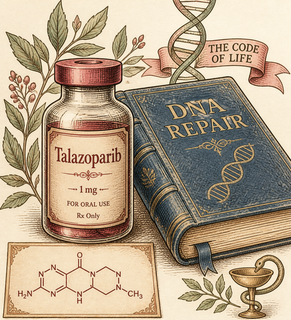
And tumors with bad DNA repair? They can be vulnerable. Not always. Not magically. But vulnerable enough that researchers keep poking this pathway with very expensive molecular sticks.
The Tumor’s Wi-Fi Password Is Testosterone
Prostate cancer often runs on androgen signaling, especially testosterone-driven signals. Think of androgen signaling as the tumor’s Wi-Fi. Cut the signal with androgen deprivation therapy, then block the router with drugs like enzalutamide, and you can slow the whole operation down.
That strategy already changed metastatic prostate cancer care. But cancer cells are not exactly known for respecting boundaries. They adapt, reroute, and eventually may become resistant. They are the streaming service that asks “Are you still watching?” and then charges you anyway.
This trial asked: what if doctors block the androgen signal and attack the tumor’s DNA repair backup system at the same time?
PARP Inhibitors: The “No More Fix-It Crew” Strategy
PARP enzymes help cells patch DNA damage. Normal cells have several repair crews. Some tumors, especially those with BRCA1, BRCA2, or other HRR gene alterations, already have one repair crew out sick. A PARP inhibitor like talazoparib can disable another repair route.
That creates a setup called synthetic lethality, which is science-speak for “the tumor can survive one broken system, but not two.” It is less John Wick and more Home Alone: the cancer cell keeps stepping on rakes until the house wins.
Talazoparib also “traps” PARP on damaged DNA, which may make it especially punishing for cells already struggling to repair their genome. That is the biological logic behind using PARP inhibitors in HRR-altered prostate cancer, a theme supported by earlier trials and reviews of PARP inhibitor treatment in metastatic disease.
What TALAPRO-3 Actually Did
TALAPRO-3 enrolled 599 men with metastatic androgen pathway modulation-sensitive prostate cancer, also called metastatic hormone-sensitive or castration-sensitive prostate cancer. All had HRR gene alterations. Half received talazoparib plus enzalutamide, and half received placebo plus enzalutamide. Everyone continued androgen deprivation therapy.
At 3 years, imaging-based progression-free survival was 77% with talazoparib plus enzalutamide versus 56% with placebo plus enzalutamide. The hazard ratio for progression or death was 0.48, meaning the combination cut that risk by about half during the study period.
Overall survival was not yet a clean win at this interim analysis: 78% versus 72% alive at 3 years, with a hazard ratio of 0.77 and a confidence interval that crossed 1. Translation: promising signal, but not yet the kind of courtroom evidence where the judge bangs the gavel.
The Catch, Because Biology Never Lets Us Have a Free Burrito
The combination came with more toxicity. Serious adverse events occurred in 42% of patients receiving talazoparib versus 32% in the control group. The big offender was anemia. Grade 3 or higher anemia showed up in 51% of patients receiving talazoparib. Fatigue and low neutrophil counts also made appearances, like unwelcome recurring characters in season six.
Two treatment-related deaths occurred in the talazoparib group. That matters. A longer delay before progression can be meaningful, especially in metastatic prostate cancer, but the price is not abstract when side effects affect blood counts, energy, transfusion needs, clinic visits, and daily life.
Why This Could Matter
If these results hold up with longer follow-up, TALAPRO-3 supports a more precise version of early intensification: do not just throw every weapon at every tumor, Avengers-style. Test the tumor’s repair genes, identify HRR alterations, and consider whether a PARP-and-androgen double hit makes sense.
That is the big clinical idea here. Metastatic prostate cancer treatment keeps moving earlier, smarter, and more molecularly tailored. The challenge is choosing who benefits enough to justify extra toxicity. HRR testing becomes less like bonus trivia and more like the casting director for treatment strategy.
This study does not mean every man with metastatic prostate cancer should receive talazoparib. It means that for men with HRR-altered disease, adding a PARP inhibitor to strong androgen blockade may delay visible progression in a major way. The sequel we need is longer survival follow-up, better toxicity management, and sharper answers about which HRR mutations benefit most.
Cancer biology remains a messy franchise with too many spin-offs. But this chapter has a clear plot: hit the tumor’s growth signal, hit its repair machinery, and some cancers may have a much harder time writing their comeback episode.
References
-
Agarwal N, Matsubara N, Azad AA, et al. PARP and Androgen-Signaling Inhibition plus ADT in Metastatic Prostate Cancer. New England Journal of Medicine. 2026. DOI: 10.1056/NEJMoa2604126
-
Messina C, Giunta EF, Signori A, et al. Combining PARP Inhibitors and Androgen Receptor Signalling Inhibitors in Metastatic Prostate Cancer: A Quantitative Synthesis and Meta-analysis. European Urology Oncology. 2024;7(2):179-188. DOI: 10.1016/j.euo.2023.07.013
-
Iannantuono GM, Chandran E, Floudas CS, et al. Efficacy and safety of PARP inhibitors in metastatic castration-resistant prostate cancer: A systematic review and meta-analysis of clinical trials. Cancer Treatment Reviews. 2023;120:102623. DOI: 10.1016/j.ctrv.2023.102623
-
Bieńkowski M, Tomasik B, Braun M, Jassem J. PARP inhibitors for metastatic castration-resistant prostate cancer: Biological rationale and current evidence. Cancer Treatment Reviews. 2022;104:102359. DOI: 10.1016/j.ctrv.2022.102359
-
Clarke NW, Armstrong AJ, Thiery-Vuillemin A, et al. Abiraterone and Olaparib for Metastatic Castration-Resistant Prostate Cancer. NEJM Evidence. 2022;1(9). DOI: 10.1056/EVIDoa2200043
Disclaimer: The image accompanying this article is for illustrative purposes only and does not depict actual experimental results, data, or biological mechanisms.