Cellular engineering can look a lot like a home remodel gone feral - walls knocked out, wiring exposed, nobody filed permits, and somehow the whole structure is still standing. This paper asks a sneaky question: while a tumor is busy turning the house into an illegal open-concept disaster, is your immune system quietly showing up as the building inspector and forcing the worst design choices off the blueprint?
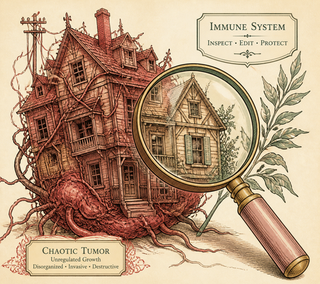
According to a new Immunity study, yes. At least in untreated human skin tumors, the immune system seems to do more than just wave a flashlight around and mutter darkly. It may actually trim out some of the most visible cancer targets before the tumor fully expands them into its main army. That process is called immunoediting, which sounds like a modest copy-editing job but is really more like deleting enemy battle plans before they reach the front line.
The battlefield: clonal neoantigens
The stars of this paper are neoantigens - strange little protein fragments made from tumor mutations. These are the flags cancer cells accidentally hang out the window. If a neoantigen gets displayed on MHC class I, T cells can spot it and attack. In theory, that makes neoantigens one of cancer’s biggest tactical mistakes.
But tumors are slippery. Some mutations are clonal, meaning nearly all tumor cells carry them. Others are subclonal, meaning only a subset does. If you are designing an immune attack, clonal neoantigens are the dream target. Hit that, and you are not just swatting a scout car - you are bombing the central command.
This study looked at cutaneous squamous cell carcinoma, a skin cancer with plenty of mutations, and compared tumors from immunocompetent patients with those from immunosuppressed patients. That setup matters because it lets researchers ask whether a working immune system changes which mutations survive in the tumor.
What the researchers found - and why it’s spicy
The short version: tumors with lots of immune infiltration in immunocompetent patients had lower overall mutational burden and, more notably, lower clonal mutational burden than low-infiltrate tumors or tumors from immunosuppressed patients.
That is a pretty big clue. It suggests the immune system is not just reacting to the tumor after it appears. It may be shaping which cancer cell clones get to dominate. Think of it as survival of the sneakiest. The loud, obvious clones - especially the ones carrying more immunogenic neoantigens - get knocked back before they can become the tumor’s starting lineup.
The authors also found that predicted neoantigens with stronger MHC class I binding were less likely to persist at higher variant allele frequency. Translation: the better a mutation is at creating a visible “attack me” sign, the less likely it is to become a widespread feature of the tumor. That is immunoediting in action, and it is kind of rude in an impressive way. Your immune system is out here playing defense before oncology even gets involved.
Even better, the team showed that neoantigens with properties resembling known immunogenic neoantigens were depleted in clonal populations relative to subclonal ones in highly infiltrated tumors from immunocompetent patients. In plain English, the most tempting T-cell targets seem to get weeded out from the main tumor population.
Why this matters for immunotherapy
This matters because modern immunotherapy often depends on the idea that the immune system can recognize something unusual about cancer and go after it. But if the immune system has already spent years eliminating the easiest targets, then by the time a tumor is diagnosed, what remains may be the cancer equivalent of a team that already traded away its most obvious weaknesses.
That could help explain why some tumors look inflamed and immune-active yet still keep growing. The T cells may have already won several skirmishes, but the surviving clones are the ones that learned camouflage, fake IDs, and maybe how to barricade the supply closet.
For personalized cancer vaccines and T-cell therapies, this study also sharpens the strategy. Not all neoantigens are equal, and not all are still present in all tumor cells. If the juicy clonal targets are the first ones edited out, researchers may need to get smarter about timing, detection, and how to broaden immune responses before the tumor narrows the menu.
The awkward challenge: winning can hide the evidence
There is a weird paradox here. A strong immune response can make a tumor look less mutated in the clones that survive. So if you only look at the final tumor, you might underestimate how much immune pressure already happened. It is like arriving after a chess match and assuming nobody attacked because half the pieces are missing neatly instead of dramatically.
That has practical consequences. Biomarkers based only on total mutation count may miss the deeper story. The important question may not just be “How many mutations are there?” but “Which mutations made it into the dominant clones, and which ones got quietly removed by immune surveillance?”
The bigger picture
This paper gives rare human evidence - in untreated primary tumors, not just mouse models - that immunoediting shapes the cancer genome early on Borden et al., 2026. That is a big deal because it moves the idea from “plausible war story” to “we found tracks in the mud.”
It also fits with a broader wave of research showing that tumor evolution is not just about random mutation and growth. It is a contest. Cancer improvises. The immune system counters. Then the tumor counter-counters like a villain who somehow always has one more submarine.
Messy? Very. But useful. If we understand which tumor clones get removed, which survive, and why, we can design better counter-offensives - vaccines, T-cell therapies, checkpoint strategies - that target what the tumor cannot so easily edit away.
References
-
Borden ES, Castellano D, Kantzos EA, et al. Immunoediting restricts clonal neoantigens in primary, treatment-naive human tumors. Immunity. 2026;S1074-7613(26):00231-9. DOI: 10.1016/j.immuni.2026.05.005
-
Łuksza M, Riaz N, Makarov V, et al. A neoantigen fitness model predicts tumour response to checkpoint blockade. Nature. 2017;551(7681):517-520. DOI: 10.1038/nature24473 PMCID: PMC6280272
-
Chen DS, Mellman I. Elements of cancer immunity and the cancer-immune set point. Nature. 2017;541(7637):321-330. DOI: 10.1038/nature21349
-
McGranahan N, Rosenthal R, Hiley CT, et al. Allele-Specific HLA Loss and Immune Escape in Lung Cancer Evolution. Cell. 2017;171(6):1259-1271.e11. DOI: 10.1016/j.cell.2017.10.001 PMCID: PMC5726472
-
Marty Pyke R, Thompson WK, Salem RM, et al. Evolutionary pressure against MHC class II binding cancer mutations. Cell. 2018;175(2):416-428.e13. DOI: 10.1016/j.cell.2018.08.048 PMCID: PMC6385445
Disclaimer: The image accompanying this article is for illustrative purposes only and does not depict actual experimental results, data, or biological mechanisms.