Recipe for endocrine-resistant breast cancer: start with estrogen receptor-positive cells, add years of hormone pressure, stir in a few survival-minded mutations, and wait until the most stubborn clones learn to keep growing anyway. What could go wrong? Only the part where evolution, that tiny mustache-twirling chef, keeps improving the recipe.
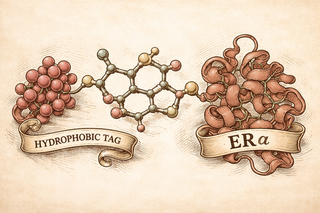
That is the problem behind this new study in Angewandte Chemie: how do you fight breast cancer cells that still depend on estrogen receptor alpha, or ERα, but have learned to shrug off standard endocrine therapy like a cat ignoring your very clear instructions? Xin and colleagues built a new class of hydrophobic tag degraders that do not merely block ERα. They try to get the cell to throw ERα in the trash [1].
The Usual Plan: Block the Signal
Many ER-positive breast cancers grow because ERα acts like a molecular foreman, telling cells which growth-related genes to switch on. Endocrine therapy tries to interrupt that chain of command. Some drugs lower estrogen. Some block the receptor. Some, like fulvestrant, help degrade it.
This works beautifully until it does not.
Cancer, viewed through an evolutionary lens, is not one enemy. It is a messy population of ambitious little opportunists. Treat it long enough and the cells with the best survival tricks expand. ESR1 mutations, altered growth pathways, receptor rewiring, and general biochemical freelancing can all help tumors keep the lights on [2]. Nature is very creative. Unfortunately, it has no ethics committee.
Enter the Hydrophobic Tag
Targeted protein degradation is a wonderfully rude therapeutic idea: instead of politely asking a disease protein to stop working, you label it for demolition. The cell’s ubiquitin-proteasome system already does this. It is basically intracellular waste management, except instead of hauling off pizza boxes, it chews up proteins [3,4].
PROTACs, one major degrader family, usually work by grabbing a target protein with one end and an E3 ubiquitin ligase with the other. That forced handshake gets the target tagged with ubiquitin and fed to the proteasome. Several ER degraders are already in clinical development, and vepdegestrant, a heterobifunctional ER degrader, received FDA approval in May 2026 for ESR1-mutated ER-positive/HER2-negative advanced or metastatic breast cancer after prior endocrine therapy [5].
Hydrophobic tag degraders take a slightly different route. They attach a greasy-looking chemical tag to a target-binding molecule. In protein land, exposed hydrophobic patches often scream, “I am misfolded, please remove me before I embarrass the cytoplasm.” The trick is making that panic button selective.
The New Study’s Plot Twist
Xin and colleagues designed ERα-targeting hydrophobic tag degraders by attaching hydrophobic amino acid tags through alkane linkers of different lengths. After chemical tuning, one compound, VI-10h, stood out [1].
In endocrine-resistant breast cancer cell models, including LCC2 and MCF-7 cells carrying resistance-linked changes such as D538G, Y537S, or EGFR-driven signaling, VI-10h reduced cancer cell growth and degraded ERα efficiently. In mouse xenograft models, including tamoxifen-resistant LCC2 tumors, it showed stronger antitumor activity than fulvestrant.
That alone would be interesting, but the mechanistic part is the real evolutionary chess move.
Using biotin-tagged hydrophobic probes and mass spectrometry, the researchers found that VI-10h recruits HSP27, also known as HSPB1. HSP27 is usually discussed as a stress-response chaperone, the cellular equivalent of someone running around with a clipboard during a fire drill. Here, it appears to act as a noncanonical adaptor, helping form an ERα-HSP27-RING1 complex that drives ERα proteasomal degradation [1].
So the degrader does not rely on the usual CRBN or VHL E3 ligase playbook. It pulls in a different cellular helper. In cancer treatment terms, that matters because resistance can emerge not just against the target, but against the degradation machinery being recruited. If the tumor has adapted to one garbage pickup route, maybe you call a different truck.
Why This Is More Than Chemical Cleverness
The bigger idea is not just “VI-10h looks promising in preclinical models,” although it does. The bigger idea is that degraders can exploit alternative protein disposal circuits. That widens the fitness landscape for drug design.
Endocrine-resistant breast cancer is hard partly because the tumor keeps finding ways to preserve ER signaling or replace it with backup growth routes. A degrader that removes ERα across multiple resistant models could, if reproduced and expanded, help close off one of cancer’s favorite escape paths. Not forever, probably. Evolution always brings snacks and a backup plan. But forcing tumor clones to adapt again can buy time, create new vulnerabilities, and potentially improve combinations with CDK4/6 inhibitors, PI3K-pathway drugs, or next-generation endocrine therapies.
The caution: this is not a patient-ready victory lap. These are cell and xenograft data. Human tumors bring pharmacology, toxicity, heterogeneity, immune effects, and the classic “mice are not tiny people wearing fur coats” problem. Still, the mechanism is genuinely useful. It gives drug designers another way to think about ERα degradation: not just which receptor ligand, not just which linker, but which cellular cleanup crew gets recruited.
Cancer evolves. Good therapies should, too.
References
-
Xin L, Song Z, Cui Y, et al. Hydrophobic Tag Degraders Overcome Endocrine-Resistant Breast Cancer by Recruiting HSP27-Mediated E3 Ligase Complex for ERα Proteasomal Degradation. Angew Chem Int Ed Engl. 2026. DOI: 10.1002/anie.202525741
-
Peng R, Liu X, Chen C-C, Guo R-T, Min J. Development of PROTACs targeting estrogen receptor: an emerging technique for combating endocrine resistance. RSC Med Chem. 2025;16:1023-1036. DOI: 10.1039/D4MD00961D
-
Tsai JM, Nowak RP, Ebert BL, Fischer ES. Targeted protein degradation: from mechanisms to clinic. Nat Rev Mol Cell Biol. 2024;25:740-757. DOI: 10.1038/s41580-024-00729-9
-
Hinterndorfer M, Spiteri VA, Ciulli A, Winter GE. Targeted protein degradation for cancer therapy. Nat Rev Cancer. 2025;25:493-516. DOI: 10.1038/s41568-025-00817-8
-
Hamilton EP, Jeselsohn RM, Vahdat LT, Hurvitz SA. PROteolysis TArgeting Chimera (PROTAC) Estrogen Receptor Degraders for Treatment of Estrogen Receptor-Positive Advanced Breast Cancer. Target Oncol. 2025;20:431-444. DOI: 10.1007/s11523-025-01137-5
Disclaimer: The image accompanying this article is for illustrative purposes only and does not depict actual experimental results, data, or biological mechanisms.