Most people think leukemia lives in the bone marrow like a rude tenant who never pays rent, but chronic myelomonocytic leukemia, or CMML, sometimes leaves home and starts causing problems in the skin, lymph nodes, lungs, kidneys, or even the central nervous system. That plot twist is the whole point of a new review in Leukemia: in some patients, the disease does not just clutter the marrow - it goes on tour (Ahmidouch et al., 2026).
CMML is already a medically awkward beast. It sits in the overlap between myelodysplastic syndromes and myeloproliferative neoplasms, which is hematology’s way of saying, "this thing refuses to color inside the lines." It features too many monocytes, those immune cells that normally help patrol your body, plus dysplastic marrow and a real risk of turning into acute myeloid leukemia, or AML (Patnaik & Tefferi, 2024; Marando et al., 2025). But the new review argues that one of the most underappreciated parts of CMML is extramedullary disease, meaning clonal leukemia cells show up outside the marrow and start acting like they own the place.
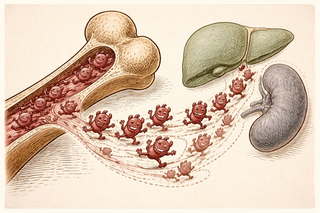
When the Problem Leaves the Building
Some extramedullary involvement in CMML is not shocking. The liver and spleen often get pulled in, partly because blood formation outside the marrow - extramedullary hematopoiesis - can reactivate under stress. That process is not random sci-fi nonsense; it is a known backup program in which blood production shifts to organs like the spleen and liver when marrow function or inflammatory signals go sideways (Barisas & Choi, 2024; Wikipedia: Extramedullary hematopoiesis).
What gets more serious, and more sneaky, is biopsy-proven non-hepatosplenic disease. The review puts that at roughly 10 to 15 percent of CMML cases, with common sites including skin, lymph nodes, serosal fluids, and soft tissue, plus occasional visceral involvement such as lung, kidney, and brain (Ahmidouch et al., 2026). In plain English: this leukemia can stop behaving like a marrow-only disorder and start masquerading as a dozen other things.
That matters because these lesions can look like infection, autoimmune inflammation, or even a second cancer. A skin lesion may not be "just a rash." Fluid around the lungs may not be "just inflammation." The disease is basically wearing a fake mustache and hoping nobody asks for ID.
The Biology Is Not Subtle. It Is Rowdy.
The bad actors here seem to include proliferative signaling, especially RAS-MAPK pathway mutations, plus adverse epigenetic lesions such as ASXL1. Those molecular changes already track with more aggressive CMML biology, and they may also help explain why certain cells become better at homing to tissues and hanging around once they get there (Ahmidouch et al., 2026; Patnaik, 2022; Marando et al., 2025). Add inflammatory cytokines to the mix and you get a disease environment that looks less like tidy pathology and more like a neighborhood where all the worst people know each other.
That fits what we already know about CMML more broadly. It is a disease of aging, clonal hematopoiesis, immune dysregulation, and chronic inflammatory signaling. In other words, the marrow is not just broken - it is broadcasting chaos.
Why Doctors Need to Be a Little Paranoid
The review’s practical message is simple: if a patient with CMML develops a strange mass, fluid collection, rash, or organ issue, clinicians should not shrug and call it coincidence. Cross-sectional imaging helps. PET-CT can help find the best biopsy target. Tissue confirmation matters. Immunophenotyping with markers like CD68, CD163, and lysozyme helps sort out whether the infiltrate is really related to CMML (Ahmidouch et al., 2026).
That sounds technical because it is technical. But the human point is blunt. If extramedullary disease gets missed, the patient may get treated for the wrong problem while the real one keeps advancing offstage like a villain in the sequel nobody asked for.
What This Could Change
Extramedullary disease in CMML links to worse outcomes, including shorter survival and a higher risk of AML transformation, especially after it appears (Ahmidouch et al., 2026). That pushes management toward systemic therapy, usually hypomethylating agents, with cytoreduction for proliferative disease, local radiation for symptomatic lesions, and early consideration of allogeneic transplant in eligible high-risk patients (Patnaik & Tefferi, 2024; Patnaik, 2022).
The bigger implication is that CMML may need to be monitored less like a neat blood disorder and more like a mobile campaign. If future genomics-informed studies can predict who is likely to develop extramedullary disease, doctors may catch it earlier and act faster. That could mean fewer diagnostic detours, fewer "maybe it’s an infection?" dead ends, and better timing for aggressive treatment in patients whose disease is clearly escalating.
For a rare leukemia, that is not a small upgrade. It is the difference between seeing the war where it is and pretending it is still confined to one trench.
References
Ahmidouch M, Deshpande P, Salib C, et al. Chronic myelomonocytic leukemia beyond the marrow: biology, patterns, and management of extramedullary disease. Leukemia. 2026. DOI: 10.1038/s41375-026-02966-7
Patnaik MM, Tefferi A. Chronic myelomonocytic leukemia: 2024 update on diagnosis, risk stratification and management. Am J Hematol. 2024;99(6):1142-1165. DOI: 10.1002/ajh.27271. PMCID: PMC11096042
Marando L, Csizmar CM, Patnaik MM. Chronic myelomonocytic leukemia: molecular pathogenesis and therapeutic innovations. Haematologica. 2025;110(1). DOI: 10.3324/haematol.2024.286061
Patnaik MM. How I diagnose and treat chronic myelomonocytic leukemia. Haematologica. 2022;107(7):1503-1517. DOI: 10.3324/haematol.2021.279500
Barisas DAG, Choi K. Extramedullary hematopoiesis in cancer. Exp Mol Med. 2024;56:549-558. Link: Nature article
Wikipedia contributors. Chronic myelomonocytic leukemia. Wikipedia. Link: CMML
Wikipedia contributors. Extramedullary hematopoiesis. Wikipedia. Link: Extramedullary hematopoiesis
Disclaimer: The image accompanying this article is for illustrative purposes only and does not depict actual experimental results, data, or biological mechanisms.