That, in plain English, is the delightful plot twist in a new Gut paper on pancreatic cancer. The study looked at cancer-associated fibroblasts, or CAFs - cells in and around tumors that have a reputation a bit like raccoons in the attic: always present, usually blamed, and surprisingly complicated once you really look at them. In pancreatic cancer, scientists often treat CAFs as accomplices to the tumor. But this paper says not so fast. One particular group, called complement-secreting CAFs or csCAFs, seems tied to better outcomes, not worse.
And in pancreatic cancer, any good news is worth sitting down for.
The Tumor’s Supporting Cast Is Weird
Pancreatic ductal adenocarcinoma is one of the nastier cancers we know. It often grows quietly, spreads early, and wraps itself in a dense, fibrous tissue barrier called the stroma. That stroma is packed with CAFs. These fibroblasts are not cancer cells themselves, but they shape the tumor’s whole social scene - who gets in, who gets out, who gets fed, and who gets shoved into a corner like the lone decent person at a very bad party.
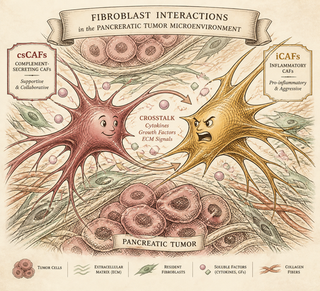
For a while, people hoped that wiping out CAFs would help. Turns out that was too simple. Some CAFs seem to help tumors grow, suppress immune cells, and make treatment harder. Others may do the opposite. Cancer biology, as usual, refused to be tidy.
This new study used single-cell multiomics, meaning the researchers looked at individual cells from several angles at once - gene activity, chromatin accessibility, and spatial location in the tumor. Basically, instead of seeing a forest, they inspected the bark, the leaves, and where each squirrel was hiding.
Meet the csCAFs: The Unexpected Good Neighbors
The key finding was that csCAFs were associated with better prognosis in pancreatic cancer. Patients whose tumors had more of these cells lived longer overall and had longer recurrence-free survival.
That alone would make people perk up. But the story gets better.
The researchers found that csCAFs overlap a lot with another CAF group called inflammatory CAFs, or iCAFs. In fact, the data suggest csCAFs may be an earlier-stage version of iCAFs. Over time, as pancreatic cancer develops, the proportion of csCAFs drops, and some may shift into a more inflammatory state.
That is a big deal. It hints that the tumor microenvironment is not fixed in stone. It may be more like bread dough - push it one way, you get a loaf; push it another, you get something flat and disappointing. The practical idea is this: maybe doctors could one day reprogram harmful CAF states back toward a more protective csCAF-like state.
Not a magic wand. More like persuading the grumpy neighbor to stop feeding the raccoons.
Why Would These Cells Help?
The “complement” in csCAFs refers to the complement system, part of the immune system involved in defense and inflammation. Complement biology is famously messy - like opening a kitchen drawer and finding three can openers, two mystery batteries, and a tiny screwdriver from 1998. Useful things are in there, but good luck sorting them quickly.
In this study, tumor regions rich in csCAFs had a friendlier immune and signaling landscape. They showed:
- Lower TGF-β ligand levels, which matters because TGF-β often promotes immune suppression and fibrosis in pancreatic cancer
- Fewer M2-like tumor-associated macrophages, the macrophage flavor often linked with tumor support
- More lipid mediators, suggesting a distinct biochemical environment
- A notable CXCL12-CXCR4 interaction involving csCAFs and T cells, though the pattern varied by metastatic site
In other words, csCAFs may help shape a tumor neighborhood that is less welcoming to cancer’s worst habits. Not perfect. Not heroic in a superhero-cape sort of way. But maybe the kind of steady, useful help that actually matters.
Why This Matters Outside the Lab
Pancreatic cancer treatment badly needs smarter options. Right now, many therapies run into the same brick wall: the tumor microenvironment protects the cancer like an overzealous bouncer who lets in all the wrong people.
If researchers can identify CAF subtypes that restrain disease - and learn how tumors lose them - then future therapies might aim to shift the stromal balance rather than just bulldozing the whole thing. That is appealing because broad attacks on stroma have sometimes backfired in pancreatic cancer [1,2].
This paper also fits a larger trend in oncology: stop treating every cell around a tumor as if it has the same job. Tumors are ecosystems. Some residents are arsonists. Some are exhausted security guards. Some are just trying to keep the plumbing working.
The Catch, Because There Is Always a Catch
Before we all sprint into the clinic waving fibroblast banners, this is still a translational study. It shows strong associations and offers a convincing model, but it does not yet prove that converting iCAFs into csCAFs will improve outcomes in patients. Biology loves to smile sweetly at us in one experiment and then throw a rake in the yard on the next one.
Still, this is exactly the kind of work that moves a field forward. It gives researchers a more precise map of a famously difficult cancer and points toward a therapeutic idea that is subtler than “destroy everything with a pulse.”
And subtle, in cancer biology, is often where the good ideas are hiding.
References
-
Chen K, Ma Y, Huang L, et al. Complement-secreting CAFs are associated with better prognosis in pancreatic cancer: single-cell multiomics. Gut. 2025. doi:10.1136/gutjnl-2025-335683
-
Biffi G, Oni TE, Spielman B, et al. IL1-induced JAK/STAT signaling is antagonized by TGFβ to shape CAF heterogeneity in pancreatic ductal adenocarcinoma. Cancer Discovery. 2019;9(2):282-301. doi:10.1158/2159-8290.CD-18-0710
-
Elyada E, Bolisetty M, Laise P, et al. Cross-species single-cell analysis of pancreatic ductal adenocarcinoma reveals antigen-presenting cancer-associated fibroblasts. Cancer Discovery. 2019;9(8):1102-1123. doi:10.1158/2159-8290.CD-19-0094
-
Hosein AN, Brekken RA, Maitra A. Pancreatic cancer stroma: an update on therapeutic targeting strategies. Nature Reviews Gastroenterology & Hepatology. 2020;17(8):487-505. doi:10.1038/s41575-020-0300-1
-
Sahai E, Astsaturov I, Cukierman E, et al. A framework for advancing our understanding of cancer-associated fibroblasts. Nature Reviews Cancer. 2020;20(3):174-186. doi:10.1038/s41568-019-0238-1
Disclaimer: The image accompanying this article is for illustrative purposes only and does not depict actual experimental results, data, or biological mechanisms.