For years, early HER2-positive breast cancer has been treated like a kitchen fire: bring the big hose, the backup hose, and maybe the neighbor’s hose too. Chemotherapy plus HER2-targeted treatment has saved a lot of lives, which is not something to mumble politely over the salad course. But chemo is also, scientifically speaking, a lot. Hair loss, fatigue, nerve issues, infections, nausea, and the general sensation that your body has become a poorly managed renovation project.
The PHERGain-2 study asks a quietly radical question: in carefully selected patients, can we skip chemotherapy at the beginning and let HER2-targeted drugs do the first round of work?
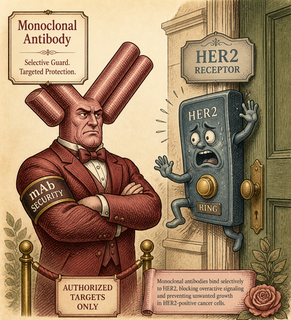
HER2: The Doorbell That Got Stuck
HER2 is a growth-signal receptor that sits on some breast cancer cells. When there is too much of it, the cancer cell gets a relentless “grow, grow, grow” message, like a group chat that nobody can mute. HER2-positive breast cancers used to be especially aggressive, but drugs such as trastuzumab and pertuzumab changed the plot.
Trastuzumab and pertuzumab are monoclonal antibodies. Think of them as two very serious bouncers who recognize the HER2 troublemaker and block its nonsense from different angles. T-DM1, also called trastuzumab emtansine, is even more theatrical: it links trastuzumab to a chemotherapy payload, turning the antibody into a targeted delivery truck with a suspiciously intense package in the back.
The Study’s Big Move
PHERGain-2 enrolled 396 adults with untreated, HER2-positive, node-negative early breast cancer. These were not giant, widely spread tumors: the cancers were 5 to 30 mm on MRI and strongly HER2-positive by central testing.
Everyone started with eight cycles of trastuzumab plus pertuzumab before surgery. Patients with hormone receptor-positive tumors also received endocrine therapy, because cancer biology loves subplots.
Then came the key move: after surgery, treatment depended on what the pathologist found. If there was no remaining invasive cancer in the breast or nodes, called a pathologic complete response or pCR, patients continued trastuzumab plus pertuzumab. If there was residual invasive disease, most received T-DM1. If lymph nodes still showed more substantial disease, chemotherapy could come back onto the guest list.
This is response-adapted treatment. Instead of giving everyone the same maximal upfront therapy, the team used the tumor’s behavior as a very blunt but useful RSVP card.
The Results: Not Bad for a Chemo-Free Opening Act
Among the 396 patients who started treatment, 391 underwent surgery. A total of 236 patients, or 59.6%, achieved pCR. That means nearly 6 in 10 had no invasive cancer detectable at surgery after HER2-targeted therapy without conventional chemotherapy.
That number matters because pCR in HER2-positive early breast cancer often predicts a better long-term outlook, though it is not a crystal ball. Cancer, rude as ever, refuses to become simple just because we bought it a nice acronym.
Quality of life was one of the co-primary endpoints. One year after treatment began, 42.8% of patients had at least a 10% decline in global health-related quality of life. That was 37.3% among patients with pCR and 51.9% among those with residual disease. So this was not a spa weekend with antibodies. Treatment still had side effects. But severe treatment-related adverse events were relatively uncommon: grade 3 or higher events occurred in 5.6%, and serious adverse events in 6.1%. One death from pneumonitis was attributed to T-DM1, a sober reminder that “targeted” does not mean “risk-free.”
Why Oncologists Are Leaning In
The exciting part is not that chemotherapy is suddenly canceled forever, clearing out its desk while security watches. The exciting part is selection. HER2-positive breast cancer has become a place where doctors can increasingly ask, “Who truly needs the full arsenal, and who might do just as well with less?”
That theme shows up across recent HER2 research. PHERGain used PET response and pathology to guide de-escalation. Other trials and reviews keep circling the same dinner-table argument: can we preserve excellent cure rates while reducing the long-term cost of treatment? The pooled WSG de-escalation analysis also supports the idea that pCR after less intensive therapy may identify patients with excellent outcomes.
The catch, and it is a real catch, is that PHERGain-2 is a single-arm phase II study. There was no randomized chemotherapy-containing control group inside this trial. Also, the abstract reports early quality-of-life, pCR, and safety data, but the 3-year recurrence-free interval is the endpoint everyone will be staring at like it owes them money.
The Real-World Promise
If these results hold up with longer follow-up and in broader studies, the impact could be very human: fewer people getting chemotherapy they may not need, fewer lingering side effects, and more treatment plans that behave like tailored suits instead of hospital-issue ponchos.
For now, chemotherapy remains central for many HER2-positive breast cancers, especially higher-risk disease. But PHERGain-2 adds to a growing argument that some early, node-negative, strongly HER2-positive tumors may be vulnerable enough to targeted therapy that chemo can wait in reserve.
That is not a small shift. That is oncology inching toward a future where the question is not “How much treatment can we throw at this?” but “How little can we give while still winning?” Frankly, that is the kind of restrained confidence we could use more of, in medicine and at dinner parties.
References
-
Garrigós L, Ruiz-Borrego M, Pérez-García JM, et al. A chemotherapy-free, pathological response-adapted strategy using trastuzumab-pertuzumab and T-DM1 in HER2-positive early breast cancer: the PHERGain-2 study. Annals of Oncology. 2026. DOI: 10.1016/j.annonc.2026.01.013
-
Pérez-García JM, et al. 3-year invasive disease-free survival with chemotherapy de-escalation using an 18F-FDG-PET-based, pathological complete response-adapted strategy in HER2-positive early breast cancer: PHERGain. The Lancet. 2024. DOI: 10.1016/S0140-6736(24)00054-0
-
Denkert C, et al. Prediction of survival after de-escalated neoadjuvant therapy in HER2-positive early breast cancer: a pooled analysis of three WSG trials. Annals of Oncology. 2025. DOI: 10.1016/j.annonc.2025.07.016
-
Loibl S, et al. Tumor biomarkers and efficacy in patients treated with trastuzumab emtansine plus pertuzumab versus standard of care in HER2-positive early breast cancer: KRISTINE. Nature Communications. 2023. PMCID: PMC9832665
-
Bardia A, et al. Management of patients with advanced-stage HER2-positive breast cancer: current evidence and future perspectives. Nature Reviews Clinical Oncology. 2024. DOI: 10.1038/s41571-023-00849-9
Disclaimer: The image accompanying this article is for illustrative purposes only and does not depict actual experimental results, data, or biological mechanisms.