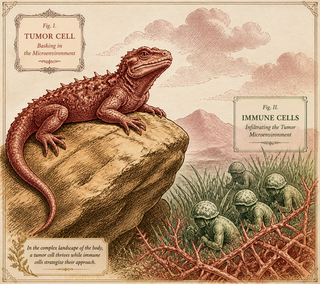
Take the left path and you see a tidy tumor cell, sitting there like a suspiciously calm lizard on a sun-warmed rock. Take the right path and the camera pulls back: immune cells crouch in the grass, connective tissue forms thorny underbrush, blood vessels snake through the terrain, and suddenly the “tumor” is less a lump than a whole unruly ecosystem with terrible zoning laws.
That wider view is where a new Cancer Cell study enters the clearing. Liang and colleagues built PathPrism, an AI framework designed to search colorectal cancer slides for spatial biomarkers - patterns based not just on what cells are present, but where they live, who they sit beside, and what kind of microscopic neighborhood they have chosen to haunt (Liang et al., 2026).
The Tumor Is Not Just the Villain. It Has a Map.
Pathologists have long read tissue slides like expert naturalists reading tracks in mud. They know that shape, crowding, invasion, inflammation, and tissue architecture can all whisper something about a cancer’s behavior.
But whole-slide images are enormous. A single digitized pathology slide can be a gigapixel wilderness. Asking a human to systematically measure every gland, immune cluster, stromal border, and cellular traffic jam is like asking someone to count every blade of grass in Jurassic Park while also watching for velociraptors.
Traditional AI can help, but many models behave like mysterious forest oracles: they give predictions, then shrug when asked why. PathPrism tries to be more civilized at the dinner table. Instead of only learning hidden patterns, it translates tissue architecture into interpretable spatial features - things closer to pathology language, such as how tumor, stroma, lymphocytes, mucus, normal tissue, and debris are arranged.
Meet PathPrism, the Patient Slide Whisperer
The authors applied PathPrism to more than 7,000 patients with colorectal cancer across 11 cohorts. That is not a little stroll through the woods. That is a full documentary crew, three helicopters, and someone named Nigel holding a clipboard.
PathPrism found hundreds of candidate biomarkers linked to survival and to molecular features such as microsatellite instability (MSI), BRAF, and TP53 mutations. MSI is what happens when a cancer cell’s DNA spellchecker stops doing its job, leaving repeated DNA sequences full of errors. In colorectal cancer, MSI status can shape prognosis and treatment options, including immunotherapy decisions.
The model also stratified potential benefit from adjuvant chemotherapy in stage II and III colorectal cancer. That matters because after surgery, doctors often face the swampy question: who needs extra chemotherapy, and who might be spared the side effects? If reproducible, spatial biomarkers could help make that call less like reading tea leaves and more like reading a map with actual trail markers.
Why Location, Location, Location Also Applies to Cancer
Cancer biology has learned, repeatedly, that cells are social. Annoyingly social. A tumor cell beside immune attack dogs is in a very different situation from a tumor cell tucked behind a wall of suppressive stroma, sipping metaphorical tea while the immune system knocks politely outside.
That is why spatial biology has become such a lively research area. Reviews in spatial cancer biology describe tumors as structured ecosystems where cell neighborhoods can affect evolution, treatment response, and survival (Janiszewska et al., 2022; Walsh and Quail, 2023). Computational pathology reviews make the same point from the slide-analysis side: AI can potentially discover image-based biomarkers that humans can see only partly, slowly, or after too much coffee (Song et al., 2023).
PathPrism fits into that movement, but with a useful twist: it emphasizes interpretability. The goal is not merely “the model says bad vibes.” The goal is closer to “this region has a recurring tissue pattern associated with worse outcome, and here is the biological neighborhood we think explains it.”
The Virtual Slide Terrarium
The paper also introduces VirtualWSI, a platform for semantic perturbation. In plain English: researchers can alter interpretable slide features in a controlled virtual setting and ask how predictions change.
Observe, if you will, the scientist gently moving lymphocytes closer to tumor regions in a digital habitat. The macrophage, confused but dignified, continues its patrol.
This does not prove that changing a pattern in real tissue would change a patient’s outcome. Virtual experiments are hypothesis generators, not clinical destiny machines. But they can help researchers decide which spatial patterns deserve closer laboratory testing.
That is valuable because spatial profiling technologies and AI tools face real hurdles: cost, cohort diversity, scanner differences, staining variation, data privacy, bias, and the eternal problem that biology enjoys being rude to tidy models. Related work in virtual spatial proteomics has shown how standard H&E slides might be used to infer richer spatial biology, but clinical translation still needs careful validation across hospitals and patient populations (Li et al., 2026; Mi et al., 2024).
The Promise, If the Tracks Hold
If PathPrism’s findings reproduce and expand, the impact could be substantial. Routine pathology slides might reveal not only what cancer looks like, but how its local ecosystem behaves: whether immune cells are entering the territory, whether stroma is forming barricades, whether certain architectures signal chemotherapy benefit, and whether molecular traits might be inferred from tissue patterns.
That would not replace pathologists. It would hand them a sharper pair of binoculars.
For patients, the dream is simple: better risk prediction, better treatment matching, fewer unnecessary toxicities, and a clearer view of what their cancer is doing in its own strange habitat. For cancer cells, those overconfident little wilderness squatters, it means the surveillance cameras are getting better.
References
-
Liang J, Jiang X, Reitsam NG, et al. Spatial biomarker discovery via interpretable semantic learning in histopathology. Cancer Cell. 2026. https://doi.org/10.1016/j.ccell.2026.05.014
-
Janiszewska M, Primi MC, Izard T. Spatial biology of cancer evolution. Nature Reviews Genetics. 2022. https://doi.org/10.1038/s41576-022-00553-x
-
Walsh LA, Quail DF. Decoding the tumor microenvironment with spatial technologies. Nature Immunology. 2023;24:1982-1993. https://doi.org/10.1038/s41590-023-01678-9
-
Song AH, Jaume G, Williamson DFK, Lu MY, Vaidya A, Miller TR, Mahmood F. Artificial intelligence for digital and computational pathology. Nature Reviews Bioengineering. 2023;1:930-949. https://doi.org/10.1038/s44222-023-00096-8
-
Li Z, Li Y, Xiang J, et al. AI-enabled virtual spatial proteomics from histopathology for interpretable biomarker discovery in lung cancer. Nature Medicine. 2026;32:231-244. https://doi.org/10.1038/s41591-025-04060-4
-
Mi H, Sivagnanam S, Ho WJ, et al. Computational methods and biomarker discovery strategies for spatial proteomics: a review in immuno-oncology. Briefings in Bioinformatics. 2024;25:bbae421. https://doi.org/10.1093/bib/bbae421
Disclaimer: The image accompanying this article is for illustrative purposes only and does not depict actual experimental results, data, or biological mechanisms.