The cancer here is extranodal NK/T-cell lymphoma, or ENKTL. It is rare, often linked to Epstein-Barr virus, and it tends to grow outside lymph nodes, usually in the upper aerodigestive tract - think nose, sinuses, and nearby real estate nobody wants a tumor renting. It can also show up in more scattered, harder-to-treat places, and advanced disease has historically been rough going [2,3].
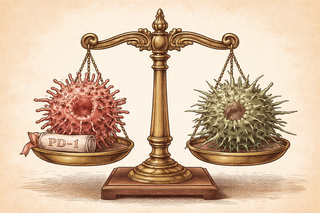
PD-1 is one of the immune system’s brake pedals. Normally that is useful. You do not want your T cells acting like caffeinated mall cops tackling everyone in sight. But cancers love loopholes, and ENKTL often uses the PD-1/PD-L1 pathway to tell immune cells, “Nothing to see here, move along” [3,4]. PD-1 inhibitors block that fake ID check and let immune cells get back to work.
What this new study actually found
This new multicenter retrospective study looked at 755 newly diagnosed patients with ENKTL. About 18% got a PD-1 inhibitor as part of first-line treatment. On paper, that group actually had more bad-risk features, which is the sort of detail that usually makes oncologists sigh into their coffee. Even so, the PD-1 group had better progression-free survival and better overall survival after a median follow-up of 32.9 months [1].
The benefit looked especially relevant in patients with more dangerous disease - advanced stage, intermediate/high-risk disease, and non-upper-aerodigestive presentations [1]. That matters, because these are the patients sitting in the infusion chair needing more than “well, let’s hope this old playbook still works.”
One especially interesting signal came from combining PD-1 blockade with asparaginase-based therapy. Asparaginase works by starving lymphoma cells of asparagine, an amino acid they struggle to make for themselves. In plain English, it is like cutting off the tumor’s snack supply while the immune system pounds on the door. According to this paper’s modeling, that combo cut event probability by about half in some higher-risk groups [1].
That does not prove magic. It does suggest the tumor may be easier to control when you hit it from both sides: direct metabolic stress plus immune unmasking. Cancer, regrettably, is often a group project.
Why patients might care about this one
For someone newly diagnosed with advanced ENKTL, the hardest part is not the acronym. It is the reality that first treatment has to count. Relapsed ENKTL can be brutal, and while asparaginase-based regimens improved outcomes over older chemotherapy, frontline options still leave too many patients with progression, infection, or both [2,5].
This study hints that adding PD-1 inhibition earlier may delay that first big setback. The authors’ multi-state analysis suggested the main gain was delaying progression rather than dramatically changing survival after relapse [1]. That may sound technical, but it is not small. More time before progression can mean more time feeling better, more time out of the hospital, and more time for the next treatment decision to happen on your terms instead of in a crisis.
The safety story also matters. Adding PD-1 therapy increased expected blood-related toxicities, which is not nothing. But the study also found fewer severe or fatal infections and rare severe immune-related side effects overall [1]. In a disease where treatment itself can be punishing, “more effective without setting the whole house on fire” is a respectable achievement.
The catch, because there is always a catch
This was not a randomized trial. It was a retrospective study, which means researchers looked back at what happened rather than assigning treatments prospectively. They used solid statistical methods, including matching and landmark analyses, but they still cannot eliminate every hidden bias [1].
So no, this is not the part where we spike the football and rewrite every guideline by lunch. But it is the kind of large real-world signal that gets people’s attention. It also fits with recent work showing that ENKTL biology, especially in higher-risk and non-upper-aerodigestive disease, may make some patients particularly good candidates for PD-1-based strategies [4]. And in relapsed disease, anti-PD-1 therapy has already shown meaningful activity, which makes the move into first-line treatment feel less like a wild gamble and more like the next logical episode [6].
If these results hold up in prospective randomized trials, the real-world impact could be straightforward and enormous: better odds that the first treatment actually keeps the disease pinned down, especially for patients who start out with the deck stacked against them.
References
-
Liu H, Sun M, Wang C, et al. Outcomes With First-Line PD1 Inhibitors in Extranodal NK/T-Cell Lymphoma: A Comparative Analysis From a 755-Patient Multicenter Cohort. Am J Hematol. 2025. DOI: https://doi.org/10.1002/ajh.70341
-
Reneau JC, Shindiapina P, Braunstein Z, et al. Extranodal Natural Killer/T-Cell Lymphomas: Current Approaches and Future Directions. J Clin Med. 2022;11(10):2699. DOI: https://doi.org/10.3390/jcm11102699 PMCID: https://pmc.ncbi.nlm.nih.gov/articles/PMC9145443/
-
Major A, Porcu P, Haverkos BM. Rational Targets of Therapy in Extranodal NK/T-Cell Lymphoma. Cancers (Basel). 2023;15(5):1366. DOI: https://doi.org/10.3390/cancers15051366 PMCID: https://pmc.ncbi.nlm.nih.gov/articles/PMC10000128/
-
Chen Z, Huang H, Huang H, et al. Genomic features reveal potential benefit of adding anti-PD-1 immunotherapy to treat non-upper aerodigestive tract natural killer/T-cell lymphoma. Leukemia. 2024. PMID: https://pubmed.ncbi.nlm.nih.gov/38378844/
-
Yamaguchi H, Suzuki R, Kinoshita T, et al. Improved prognosis of advanced-stage extranodal NK/T-cell lymphoma: results of the NKEA-Next study. Leukemia. 2025. PMCID: https://pmc.ncbi.nlm.nih.gov/articles/PMC11976271/
-
Marouf A, Chaubard S, Liévin R, et al. Efficacy of anti-PD1 therapy in extranodal NK/T cell lymphoma: A matched cohort analysis from the LYSA. Hemasphere. 2025;9(1):e70081. DOI: https://doi.org/10.1002/hem3.70081 PMCID: https://pmc.ncbi.nlm.nih.gov/articles/PMC11746926/
Disclaimer: The image accompanying this article is for illustrative purposes only and does not depict actual experimental results, data, or biological mechanisms.