Cancer biology often feels like a badly managed renovation: knock down one wall, and a hidden crawlspace appears full of wiring nobody warned you about. That is more or less the vibe of a new Cancer Cell paper on lung cancer, where researchers found that after EGFR-targeted drugs push tumors into a sleepy, hard-to-kill state, those lingering cells hang out a molecular sign that may finally make them easier to hunt down.
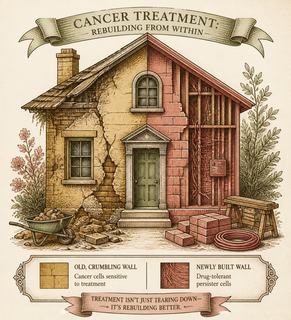
The short version: in EGFR-mutant lung cancer, drugs called EGFR tyrosine kinase inhibitors, or TKIs, can work spectacularly well - until they don't. A new study highlighted in Cancer Cell suggests that the surviving "drug-tolerant persister" cells may become vulnerable to a target called TROP2. And that opens the door to a strategy that sounds almost suspiciously tidy: first induce the vulnerable state with one drug, then target and kill those holdouts with another.
Not bad for cells whose entire brand is "I refuse to die on schedule."
The cells that never quite leave the party
EGFR-mutant non-small cell lung cancer has been one of oncology's major precision-medicine success stories. Drugs like osimertinib can shut down the cancer-driving EGFR signal and shrink tumors dramatically. But cancer, being cancer, keeps a backup plan in the glove compartment.
One of those plans involves drug-tolerant persister cells. These are not necessarily classic resistant mutants right away. They are more like a stubborn subset that survives the first wave of treatment by slipping into a temporary, adaptable state. Think of them as the few bar patrons still lurking after the lights come on, pretending not to hear the staff stacking chairs. They are sparse, sneaky, and dangerous because they can seed later relapse and full-blown resistance.
Persister states have become a big deal across oncology because they may explain why many targeted therapies work beautifully at first and then lose steam. Reviews in recent years have framed persisters as a distinct biological problem, not just a footnote on the way to resistance (Marine et al., 2020), (Guler et al., 2025).
Enter TROP2, stage left
The paper discussed by Izumi, Kobayashi, and Halmos centers on TROP2, a cell-surface protein already familiar in cancer therapeutics because it can be targeted by antibody-drug conjugates, or ADCs. ADCs are a bit like guided missiles with better manners: an antibody recognizes a marker on the cancer cell, then delivers a toxic payload directly to it.
What makes this finding interesting is not just "TROP2 exists." It is that EGFR inhibitor treatment appears to create or enrich a TROP2-positive persister population. In other words, the very drug that suppresses the bulk tumor may also expose a new weakness in the leftovers.
That is the deliciously strange part. The first treatment changes the architecture of the surviving cancer cells, and the second treatment exploits that renovation before the tumor can open a new illicit business in the basement.
This concept - "induce-target-kill" - is clever because it stops treating residual disease as an unfortunate afterthought. Instead, it treats the aftermath of therapy as its own targetable phase.
Why this matters beyond one lung cancer subtype
TROP2 is already clinically relevant. ADCs targeting TROP2, such as sacituzumab govitecan, have shown activity in several cancers and helped establish TROP2 as more than just another acronym trying to elbow its way into oncology (Bardia et al., 2021), (Rugo et al., 2022). Other TROP2-directed ADCs, including datopotamab deruxtecan, have also drawn serious attention in lung cancer and beyond (Meric-Bernstam et al., 2023).
So this is not a case of discovering a target that lives only in the fever dream of a preclinical figure legend. TROP2 already has therapeutic machinery built around it. That makes the translational leap feel much shorter.
And the broader lesson is arguably even bigger: the state a cancer enters after treatment may be as important as the state it started in. That is a shift in mindset. We often think of therapy as a hammer hitting a static nail. Tumors are less nail, more shape-shifting raccoon with lock-picking skills.
The catch, because there is always a catch
Before anyone starts composing triumphant movie trailers, a few caveats matter.
First, this is about a very specific biological setting - EGFR-mutant lung cancer under TKI pressure. Whether the same induced vulnerability shows up consistently across patients, treatment timing, and tumor subclones still needs careful testing.
Second, persister biology is messy. These cells can be rare, plastic, and annoyingly good at changing identities. If TROP2 expression rises only in some persisters, then timing and patient selection will matter a lot.
Third, ADCs are powerful but not carefree. They come with toxicity, dosing questions, and the usual real-world issue that tumors do not read the protocol and behave accordingly.
Still, the idea is compelling because it goes after the cells most likely to cause trouble later. Not the loud majority, but the quiet few in the back row.
The real promise: catching relapse before it gets dramatic
If this strategy holds up, it could change how we think about targeted therapy success. Instead of waiting for resistance to emerge and then scrambling after it, clinicians might hit the residual persister pool early - while it is small, exposed, and still wearing its TROP2 name tag.
That could mean longer responses, delayed resistance, and maybe fewer cases where an initially excellent therapy turns into a frustrating game of molecular whack-a-mole.
Which, in cancer treatment, counts as genuine progress and not just optimistic interior decorating.
References
-
Izumi M, Kobayashi SS, Halmos B. Targeting drug-tolerant persister cells: Let's bring on the TROPs! Cancer Cell. 2026; DOI: 10.1016/j.ccell.2026.05.019
-
Marine JC, Dawson SJ, Dawson MA. Non-genetic mechanisms of therapeutic resistance in cancer. Nat Rev Cancer. 2020;20(12):743-756. DOI: 10.1038/s41568-020-0257-4
-
Guler GD, Tsimberidou AM, et al. Drug-tolerant persister cells in cancer: mechanisms and therapeutic opportunities. Mol Cancer. 2025;24:39. PMCID: PMC11892593
-
Bardia A, Hurvitz SA, Tolaney SM, et al. Sacituzumab Govitecan in Metastatic Triple-Negative Breast Cancer. N Engl J Med. 2021;384(16):1529-1541. DOI: 10.1056/NEJMoa2028485
-
Rugo HS, Bardia A, Tolaney SM, et al. TROPiCS-02: Sacituzumab Govitecan in Hormone Receptor-Positive/HER2-Negative Metastatic Breast Cancer. J Clin Oncol. 2022;40(29):3365-3376. DOI: 10.1200/JCO.21.01508
-
Meric-Bernstam F, Johnson ML, et al. Datopotamab Deruxtecan in Advanced or Metastatic NSCLC: Results From the TROPION-PanTumor01 Study. J Clin Oncol. 2023;41(29):4874-4883. DOI: 10.1200/JCO.22.01859
Disclaimer: The image accompanying this article is for illustrative purposes only and does not depict actual experimental results, data, or biological mechanisms.