The road from ductal carcinoma in situ to invasive breast cancer has checkpoints, detours, and one suspicious-looking lane closure where the immune system keeps getting waved away.
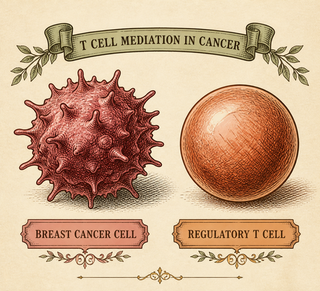
That lane closure, according to Bui and colleagues in Cancer Cell, may be run by a specific crew of immune cells: cycling regulatory T cell precursors, or cycTregs, which sounds less like biology and more like a stealth-mode startup that just raised Series A funding from the tumor microenvironment [1].
The Precancer Problem
DCIS is breast cancer that has not yet broken out of the milk duct. Think of it as a bad tenant still inside the apartment, before it starts knocking down walls and expanding into the hallway.
The clinical challenge is that DCIS does not behave the same way in everyone. Some lesions may never become dangerous. Others can progress to invasive breast cancer. Doctors have good tools, but not perfect crystal balls, so patients can face overtreatment, undertreatment, or the deeply annoying medical gray zone where everyone is technically doing their best and nobody gets to relax [2,3].
This new study asks a sharp question: what changes in the immune neighborhood as DCIS becomes invasive breast cancer?
Meet the Immune System’s Compliance Department
Regulatory T cells, or Tregs, are not villains by default. Your body needs them. Without them, the immune system can start attacking normal tissue like a moderation algorithm with no appeal process.
But tumors are excellent product managers. They find useful features and repurpose them. In cancer, Tregs can suppress the CD8 T cells that would otherwise attack tumor cells. The bodyguards show up, but someone has revoked their building access.
Bui and colleagues mapped immune cells across normal breast tissue, DCIS, and invasive breast cancer using transcriptomic profiling in large patient cohorts. The big shift between DCIS and invasive disease centered on T cells and myeloid cells. Then the plot narrowed: cycTregs stood out as a conductor of immunosuppression in invasive breast cancer [1].
"Conductors" is the paper’s word, and it fits. These cells were not merely loitering. They appeared to coordinate a broader immune escape program.
The Startup Stack: Dendritic Cells, Fibroblasts, IL-33
The team found that cycTreg frequency predicted several things that matter: cytotoxic CD8 T cell activity, T cell receptor diversity, disease-specific survival in invasive breast cancer, and recurrence in DCIS [1]. That is a lot of dashboard metrics for one immune cell subtype.
In a rat breast cancer model, cycTregs behaved like precursors to mature Tregs. They were inducible by tumor-localized type 2 dendritic cells, which are normally antigen-presenting cells that help tell T cells what to do. Here, the instruction manual seems to get rewritten in the tumor’s favor.
Then came another layer: tumors treated with OX40 and PD-L1 therapies revealed an IL-33-mediated signaling loop between fibroblasts and cycTregs [1]. Fibroblasts are structural support cells, but in tumors they can become less "helpful scaffolding" and more "middle management with a hidden agenda." IL-33 is a cytokine, a messenger molecule, and in this setup it looks like part of the tumor’s internal Slack channel for immune suppression.
Disrupting that loop boosted antigen-experienced CD8 T cells inside tumors and improved systemic immunosurveillance in the model [1]. Translation: block the bad chat thread, and the immune system may remember what it came to do.
Why This Is a Big Deal
Cancer immunotherapy has already changed treatment for several cancers, but breast cancer has been a tougher market. Checkpoint inhibitors can work, especially in some triple-negative breast cancers, yet many tumors remain cold, resistant, or weirdly good at ghosting immune attack.
Tregs are already viewed as attractive but tricky targets [4,5]. The hard part is precision. Wiping out all Tregs would be like firing the entire compliance department because one office helped the fraud team. You might stop the scam, but now the building is on fire.
That is why a precursor-like, tumor-associated cycTreg population is interesting. If future studies confirm these findings, cycTregs could become a more specific target: not "delete immune regulation," but "interrupt this tumor-friendly version of it."
For DCIS, the long-term dream is even cleaner: better prediction of which lesions are likely to progress, and perhaps immune-based prevention strategies before invasion happens. That would move cancer care upstream, where the road is still narrower and the exits are still open.
The Bottom Line
This study does not mean a new treatment arrives tomorrow. Biology does not ship like software, and the FDA does not accept "works on my rat model" as a launch plan.
But it gives researchers a more detailed map of immune escape during breast cancer progression. cycTregs may be one of the traffic controllers helping tumors move from contained to invasive disease. If scientists can jam that signal without causing immune chaos, breast cancer prevention and immunotherapy may get a sharper, smarter playbook.
References
-
Bui TM, Jimenez ER, Li Z, et al. Identification of cycling regulatory T cell precursors as conductors of immune escape during breast carcinoma progression. Cancer Cell. 2026. https://doi.org/10.1016/j.ccell.2026.03.015
-
Casasent AK, Almekinders MM, Mulder C, et al. Learning to distinguish progressive and non-progressive ductal carcinoma in situ. Nature Reviews Cancer. 2022;22:663-678. https://doi.org/10.1038/s41568-022-00512-y
-
Wang J, Li B, Luo M, et al. Progression from ductal carcinoma in situ to invasive breast cancer: molecular features and clinical significance. Signal Transduction and Targeted Therapy. 2024;9:83. https://doi.org/10.1038/s41392-024-01779-3
-
Shan F, Somasundaram A, Bruno TC, Workman CJ, Vignali DAA. Therapeutic targeting of regulatory T cells in cancer. Trends in Cancer. 2022;8:944-961. https://doi.org/10.1016/j.trecan.2022.06.008
-
Tay C, Tanaka A, Sakaguchi S. Tumor-infiltrating regulatory T cells as targets of cancer immunotherapy. Cancer Cell. 2023;41:450-465. https://doi.org/10.1016/j.ccell.2023.02.014
Disclaimer: The image accompanying this article is for illustrative purposes only and does not depict actual experimental results, data, or biological mechanisms.