A cancer cell’s message can take a surprisingly eventful road trip: written in RNA, stamped with tiny chemical labels, handed to molecular tour guides, then routed toward “grow,” “hide,” or “please stop making trouble,” depending on who is reading the map.
In this new Blood study, Hu and colleagues focus on one of those map-readers: IGF2BP2, a protein that recognizes m6A, short for N6-methyladenosine. That sounds like the password to a very exclusive biochemistry nightclub, but the idea is simple enough: m6A is a small chemical tag placed on RNA. These tags help cells decide which messages get used, stored, translated into protein, or tossed out like junk mail from a cellular printer that never asked for your consent.
The puzzle piece here is peripheral T-cell lymphoma, or PTCL, a rare, aggressive family of lymphomas that starts in mature T cells. PTCL is not one tidy disease. It is more like a drawer full of cables: technically organized by someone, somewhere, but deeply unhelpful at first glance. Clinically, that matters because many PTCLs grow fast, relapse often, and still lack the neat biomarker-driven treatment playbook that has helped some other cancers.
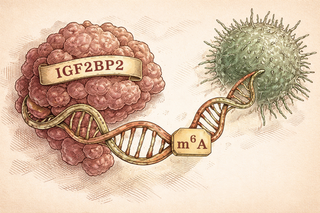
The Reader in the Room
The researchers found that IGF2BP2 was highly expressed across common nodal PTCL subtypes, including in external datasets and in their own RNA sequencing set from 196 newly diagnosed patients. That is the first “aha” moment: this was not a weird one-off signal hiding in a dusty corner of one dataset. It kept showing up.
Then they asked the obvious next question: what is IGF2BP2 actually doing?
In lab experiments and mouse models, IGF2BP2 helped lymphoma cells grow. But the more interesting twist was that it also seemed to make the tumor neighborhood less friendly to CD8+ T cells, the immune system’s tiny bouncers that specialize in removing suspicious cellular guests. In tumors with more IGF2BP2 activity, fewer of these CD8+ T cells got into the action.
That is bad news because a tumor that grows faster and keeps immune attackers at arm’s length is not just cheating at one game. It brought extra dice.
The Endocytosis Escape Hatch
The mechanism points to endocytosis, the process by which cells pull material from their surface into internal compartments. Think of it as the cell’s recycling and retrieval system. Useful in normal life. Potentially sketchy when a tumor starts using it like a trapdoor.
Hu and colleagues found that IGF2BP2 binds to RNAs for several endosome-related genes, including RAB4, VPS35, RAB9, and STAM, helping keep those RNA messages stable. More stable messages can mean more of the proteins that help endocytosis run. In this study, that translated into increased internalization of membrane proteins.
Why should you care about membrane proteins? Because the cell surface is where a lot of immune recognition happens. It is the front porch, the name tag, the “hello, I am not a problem” sticker. If cancer cells get better at pulling important surface signals inward, they may become harder for immune cells to spot or attack. It is cellular witness protection, but with worse ethics.
The Drug Clue
The team also tested CWI1-2, a compound that targets IGF2BP2. In cell lines and patient-derived xenograft models, CWI1-2 suppressed endocytosis and slowed tumor growth. That does not mean patients now have a ready-made treatment. This is preclinical work, and cancer biology has a long history of promising leads that later say, “Actually, I have commitment issues.”
Still, the result is intriguing because it suggests a two-for-one strategy: hit the lymphoma cell’s growth machinery and potentially loosen its grip on the immune escape hatch at the same time.
Why This Puzzle Piece Fits
This study sits inside a bigger research pattern. m6A biology has become a major cancer topic because RNA does not just passively carry instructions. It gets edited, tagged, interpreted, and rerouted. Reviews in recent years have shown that m6A writers, erasers, and readers can influence RNA stability, translation, immune biology, and cancer progression. IGF2BP proteins are especially interesting because they often stabilize cancer-promoting RNA messages, acting less like librarians and more like overprotective archivists for the tumor’s worst ideas.
PTCL desperately needs these kinds of clues. Reviews of the field emphasize the same recurring headache: PTCL is rare, biologically diverse, and hard to treat with one-size-fits-all therapy. The new IGF2BP2 study does not solve the whole puzzle, but it gives researchers a sharper edge piece: a molecular reader that may connect tumor growth, RNA modification, endocytosis, and immune evasion.
That is the satisfying part. Not “we found a protein, please clap,” but “we found a protein sitting at the intersection of several suspicious roads.” In cancer research, intersections are where the good detective work happens.
What Comes Next
The big next steps are predictable but necessary: confirm these findings in more patient samples, define which surface proteins matter most, test whether IGF2BP2 levels predict outcomes or treatment response, and figure out whether IGF2BP2-targeting drugs can be made safe and effective enough for real patients.
If that works, this line of research could help turn PTCL from a messy cable drawer into something more map-like: still complicated, but with routes clinicians can actually follow.
References
-
Hu S, Qin Y, Yi HM, et al. N6-methyladenosine reader IGF2BP2 in T-cell lymphoma. Blood. 2026. doi:10.1182/blood.2026034186
-
Sun CY, Cao D, Du BB, Chen CW, Liu D. The role of Insulin-like growth factor 2 mRNA-binding proteins (IGF2BPs) as m6A readers in cancer. International Journal of Biological Sciences. 2022;18(7):2744-2758. doi:10.7150/ijbs.70458, PMCID: PMC9066119
-
Hong J, Xu K, Lee JH. Biological roles of the RNA m6A modification and its implications in cancer. Experimental & Molecular Medicine. 2022;54:1822-1832. doi:10.1038/s12276-022-00897-8
-
O'Connor OA, Ma H, Chan JYS, Kim SJ, Yoon SE, Kim WS. Peripheral T-cell lymphoma: From biology to practice to the future. Cancer Treatment Reviews. 2024;129:102793. doi:10.1016/j.ctrv.2024.102793
-
Zhao X, et al. Therapeutic challenges in peripheral T-cell lymphoma. Molecular Cancer. 2024;23:2. doi:10.1186/s12943-023-01904-w, PMCID: PMC10765866
Disclaimer: The image accompanying this article is for illustrative purposes only and does not depict actual experimental results, data, or biological mechanisms.