Cancer is a sneaky saboteur. It slips into your body's security network, steals a badge, and convinces part of the emergency response team to start locking the exits instead of chasing the intruder. That, in a nutshell, is the weird little drama at the heart of a new Immunity paper on neutrophils, immunotherapy, and interferon-gamma - a molecule that turns out to act less like a simple on-switch and more like a control signal with some alarming side effects.
The immune system's "help desk" has a ticketing problem
If you've heard about cancer immunotherapy, you've probably heard the broad pitch: take the brakes off immune cells so they can attack tumors. Drugs that block PD-1, PD-L1, or CTLA-4 have done exactly that for some patients, and the results can be remarkable. But they do not work for everyone. Tumors are very good at building failure modes into the system.
This new study by Pei and colleagues asks a sharp question: what are neutrophils doing in that mess? Neutrophils are the immune system's rapid-response crew - abundant, fast, and usually better known for handling infections than starring in cancer biology. But tumors recruit them into the neighborhood, and once there, they can either help or hinder the anti-cancer response.
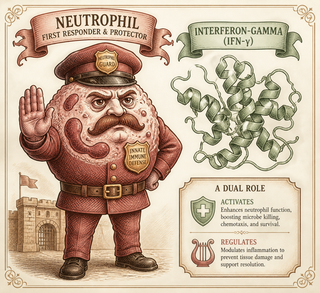
Plot twist: in these experiments, neutrophils often acted like bouncers hired by the wrong guy.
A strange case of friendly fire
The researchers used mouse models to test what happens during immunotherapy when neutrophils are removed or altered. They found that neutrophils were a major reason immunotherapy failed when treatments targeted either T cells or myeloid cells. In other words, while the therapy tried to energize the anti-tumor immune response, neutrophils were standing nearby hitting the circuit breaker.
How? The key clue was PD-L1, a protein that tumors and immune cells can use to suppress T cell activity. After immunotherapy, neutrophils ramped up PD-L1. That matters because PD-L1 can bind PD-1 on T cells and tell them, essentially, "great enthusiasm, please sit down."
The especially interesting part is what drove that change. It was interferon-gamma, or IFN-γ, a cytokine produced by cytotoxic lymphocytes - the very cells you want fighting cancer. IFN-γ usually gets cast as one of the heroes of anti-tumor immunity, and often it is. But here it also created an awkward feedback loop: activated killer cells produced IFN-γ, and that IFN-γ instructed neutrophils to become more suppressive by increasing PD-L1. Congratulations, the system optimized itself into partial self-sabotage.
Biology really does enjoy wiring things like a startup's first backend deployment.
IFN-gamma: hero, villain, or badly supervised middle manager?
To show this wasn't just a coincidence, the authors used genetics to delete either cd274 - the gene encoding PD-L1 - or Ifngr1, part of the IFN-γ receptor, specifically in neutrophils. That let them test whether neutrophils themselves were directly receiving the IFN-γ signal and acting on it.
They were.
Without that IFN-γ-driven suppressive program, neutrophils did something much more helpful: they shifted into a phenotype that supported immunotherapy instead of blocking it. Same cell type, different operating mode. The switch was not random. It depended on type II interferon signaling.
That is the headline worth underlining: IFN-γ helps determine whether neutrophils become allies or liabilities during cancer immunotherapy.
Why this matters outside the mouse cage
This study adds to a growing body of work showing that cancer treatment is not just about "turning on T cells." It is about managing an entire ecosystem of cells, signals, checkpoints, and workarounds. Tumors are less like a single bad component and more like a badly designed distributed system with hostile nodes.
For patients, the implication is pretty practical. If this biology holds up in people, future immunotherapy might work better by targeting the suppressive neutrophil response alongside the usual checkpoint pathways. Instead of only removing the brake from T cells, you might also stop neutrophils from reinstalling a backup brake two minutes later.
That could mean better biomarker strategies too. If neutrophil PD-L1 or IFN-γ-response signatures predict resistance, clinicians might someday use them to identify who needs combination treatment. Not glamorous, but then neither is debugging a server farm at 2 a.m., and somehow that still matters.
The catch, because there is always a catch
This is preclinical work, and mouse immunology does not come with a guaranteed upgrade path to humans. Neutrophils are notoriously context-dependent, and human tumors are messy in ways lab models only partly capture. Also, IFN-γ is not "bad." It remains central to anti-tumor immunity. The real lesson is subtler: the same signal can improve one part of the immune response while creating drag somewhere else.
That is what makes this paper interesting. It does not offer a cartoon story where one molecule is good and one cell is bad. It shows a control loop. Push the system here, and a suppressive counter-response appears over there.
Which, honestly, feels extremely on brand for both engineering and immunology.
References
-
Pei S, Pan Y, Liang H, Lei L, Lin Q, Mi J, Ravetch JV, Soehnlein O, Karlsson MCI. Neutrophil regulation of immunotherapy for cancer is controlled by type II interferon. Immunity. 2026;S1074-7613(26)00214-4. doi:10.1016/j.immuni.2026.05.014
-
Hegde PS, Chen DS. Top 10 challenges in cancer immunotherapy. Immunity. 2020;52(1):17-35. doi:10.1016/j.immuni.2019.12.011
-
Binnewies M, Roberts EW, Kersten K, et al. Understanding the tumor immune microenvironment and its implications for immunotherapy. Nat Med. 2025 update on ongoing concepts and translation. See PubMed for related overview articles on tumor immune ecosystems and myeloid regulation.
-
Veglia F, Sanseviero E, Gabrilovich DI. Myeloid-derived suppressor cells in the era of increasing myeloid cell diversity. Nat Rev Immunol. 2021;21(8):485-498. doi:10.1038/s41577-020-00490-y
-
Shaul ME, Fridlender ZG. Tumour-associated neutrophils in patients with cancer. Nat Rev Clin Oncol. 2019;16(10):601-620. doi:10.1038/s41571-019-0222-4
Disclaimer: The image accompanying this article is for illustrative purposes only and does not depict actual experimental results, data, or biological mechanisms.