The tumor microenvironment forecast is cloudy with a chance of immune suppression, scattered calcium storms, and a stubborn low-pressure system of cancer cells acting as if zoning laws do not apply to them.
That is the neighborhood where cancer vaccines have to work. Not in a clean textbook diagram, alas, but in living tissue, where signals slosh around, immune cells get confused, and tumors build the biological equivalent of a velvet rope outside the club. For decades, we have known that T cells can be ferocious little inspectors when they recognize the right molecular badge. The trouble has been getting that badge - the antigen - delivered to the right immune cell, at the right place, in the right cellular compartment, with enough drama to make the immune system care.
A new study by Bai and colleagues in Advanced Materials takes a wonderfully physical approach to that old problem: instead of only asking what a vaccine particle carries, they ask what shape it should be. Their answer? Make it spiky. Not medieval-mace spiky, one hopes, but nanotechnologically spiky enough to wake up dendritic cells.
The Package Is Not Just the Package
Subunit vaccines are tidy creatures. They use selected pieces of a pathogen or tumor rather than the whole unruly thing. That can make them safer and easier to design, but it also means they often whisper when you need them to sing bass-baritone.
For strong CD8+ T cell immunity, dendritic cells must perform a special bit of immunological choreography called cross-presentation. They take material from outside the cell and display fragments on MHC class I molecules, the system normally used to show off what is happening inside a cell. It is a bureaucratic exception with life-or-death consequences. Without it, killer T cells may never receive a clear wanted poster for the target.
This matters in cancer because many tumors survive not by being invisible, but by being poorly introduced. The immune system is full of capable tiny bodyguards, but someone has to hand them the correct photograph and say, “This one. Please stop this one.”
Enter the Spikes
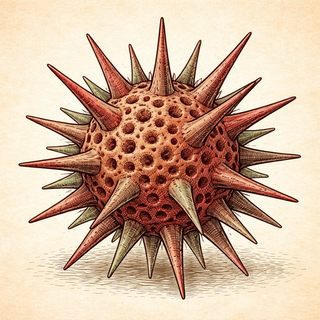
Bai and colleagues built mesoporous silica nanoparticles - tiny porous carriers, rather like microscopic pumice stones with lab coats - in three surface styles: smooth, short-spiked, and long-spiked. The long-spiked version, called SNL, performed best at delivering antigen peptides and activating antigen-presenting cells.
The clever part is the proposed mechanism. The spiky particles appear to mechanically stimulate Piezo1, a mechanosensitive ion channel. Piezo1 is one of those proteins that reminds biologists the cell is not merely a bag of chemistry; it is also a tense, squishy, responsive object. When Piezo1 senses mechanical force, calcium can flow into the cell. Calcium, in immunology, is less “dietary supplement” and more “someone pulled the fire alarm.”
That calcium influx promoted dendritic cell activation and helped route antigen toward the endoplasmic reticulum, or ER. The ER is not glamorous. It sounds like hospital signage and looks like folded laundry under a microscope. But for cross-presentation, it can be prime real estate, because antigen handling and MHC class I loading often depend on ER-linked machinery.
I confess a historical fondness for this. Those of us who remember the long march from early interferon enthusiasm to modern checkpoint blockade have learned that immune activation is rarely about one heroic molecule. It is logistics. Who picks up the antigen? Which lymph node does it reach? Which compartment gets the cargo? Cancer immunotherapy, like faculty meetings, often fails because the right people were not in the right room.
Adding a STING to the Story
The authors then loaded the spiky nanoparticles with both antigen peptides and 2'3'-cGAMP, an agonist of the cGAS-STING pathway. STING signaling is one of the immune system’s internal alarm circuits for misplaced DNA and danger. Vaccine scientists like it because it can help push dendritic cells toward the kind of activation that supports T cell responses.
This pairing made biological sense: deliver the antigen and the alarm together. In the study, the combination produced strong CD8+ T cell responses, delayed tumor progression in lymphoma and cervical cancer models, and supported cross-protective immunity in a SARS-CoV-2 vaccination model.
Now, before anyone runs into the street shouting that spiky silica has solved cancer, let us take a breath and perhaps a small medicinal biscuit. These are preclinical findings. Mouse tumors have disappointed more human oncologists than I can politely count. Delivery systems must still prove safety, manufacturing consistency, durability, dosing, and real-world benefit in humans.
But the idea is intriguing because it treats nanoparticle shape as an active design feature, not decorative packaging. That is a shift worth noticing.
Why This Could Matter
Modern cancer vaccines have improved because we understand more about neoantigens, dendritic cells, adjuvants, and T cell exhaustion. Reviews in Nature Reviews Cancer have emphasized that therapeutic cancer vaccines need better antigen selection, better delivery, and better immune activation, not simply more optimism in a syringe (Saxena et al., 2021; Jhunjhunwala et al., 2021). Work on adjuvants has likewise shown that innate immune signals shape the strength and flavor of adaptive immunity (Pulendran et al., 2021). STING agonists remain promising but tricky, partly because delivery has been a persistent nuisance, as delivery often is - the FedEx problem of molecular medicine (Wang et al., 2021).
If this morphology-driven strategy holds up, it could help vaccine designers build particles that do three things in sequence: travel to lymph nodes, activate dendritic cells, and steer antigen into the cross-presentation pathway. That is less like mailing a flyer and more like sending a trained courier who knows the building, charms the receptionist, and finds the correct filing cabinet.
For a field that has spent half a century learning that the immune system notices not only what it sees but how it is shown, that is a handsome little lesson.
References
Bai S, Xue Y, He C, Xiong K, Luo T, Tang X, Xu Y, Qiao N, Qin M, Zhong X, He P, Wei H, Ou Y, Du G, Sun X. A Morphology-Driven Cascade Delivery of Antigens for Potent T Cell Immunity. Advanced Materials. 2026. DOI: 10.1002/adma.73396. PMID: 42176335.
Jhunjhunwala S, Hammer C, Delamarre L. Antigen presentation in cancer: insights into tumour immunogenicity and immune evasion. Nature Reviews Cancer. 2021;21:298-312. DOI: 10.1038/s41568-021-00339-z.
Pulendran B, Arunachalam PS, O'Hagan DT. Emerging concepts in the science of vaccine adjuvants. Nature Reviews Drug Discovery. 2021;20:454-475. DOI: 10.1038/s41573-021-00163-y.
Saxena M, van der Burg SH, Melief CJM, Bhardwaj N. Therapeutic cancer vaccines. Nature Reviews Cancer. 2021;21:360-378. DOI: 10.1038/s41568-021-00346-0.
Wang J, Li P, Wu MX. Delivery of STING agonists for adjuvanting subunit vaccines. Advanced Drug Delivery Reviews. 2021;179:114020. DOI: 10.1016/j.addr.2021.114020.
Disclaimer: The image accompanying this article is for illustrative purposes only and does not depict actual experimental results, data, or biological mechanisms.