Archaeologists brush away dirt to figure out who ran the old city, and this colorectal cancer paper does something oddly similar - except the buried artifacts are immune cells, the ruins are tumour-draining lymph nodes, and the suspicious clue sitting in the middle of it all is a molecule called SPP1. Which, to be honest, sounds less like a cancer signal and more like a Wi-Fi password someone forgot to change.
The body’s pantry has a problem
In colorectal cancer, tumour-draining lymph nodes are like the nearest neighborhood kitchen to the main disaster. They sit close to the tumour and help coordinate immune responses. In theory, that should make them a handy place for your body to whip up an anti-cancer meal. In practice, cancer keeps sneaking in with a terrible recipe and somehow convinces everyone to keep cooking from it.
That is the big question behind this study: what is happening inside the lymph nodes closest to colorectal tumours, and can researchers find a target worth shutting down?
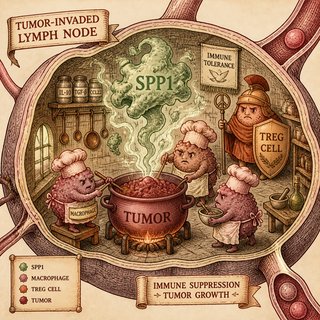
The team looked at samples from seven patients with colorectal cancer and compared four matched tissue types: the main tumour, nearby normal tissue, tumour-free lymph nodes, and tumour-invaded lymph nodes. Using single-cell RNA sequencing, they examined individual cells one by one - basically reading tiny recipe cards to see what each cell thought it was supposed to be making.
And what stood out? A strong signal around SPP1, also known as osteopontin, in tumour-invaded lymph nodes.
Meet SPP1: the ingredient that keeps showing up
SPP1 is not new to cancer biology. It has turned up before in studies of inflammation, tissue remodeling, metastasis, and immune suppression. But this paper zooms in on how it may shape the immune scene inside tumour-invaded lymph nodes in colorectal cancer.
The study suggests that SPP1-positive macrophages - immune cells that should act a bit like cleanup cooks and security staff rolled into one - may instead help create a menu that favors the tumour. Worse, they appear to interact with regulatory T cells, or Tregs, which are the peacekeeping cells of the immune system. Normally, Tregs stop the immune response from boiling over and scorching the whole kitchen. That is useful in healthy tissues. Around cancer, though, too much peacekeeping can mean the tumour gets to keep simmering undisturbed.
The researchers dug into this with lab experiments, CRISPR-based gene knockout in primary Tregs, mouse models of lymph node metastasis, and additional multi-omics analyses. They also tested ways to interfere with the pathway, including siSPP1 delivered in lipid nanoparticles and an anti-CD44 antibody.
That last detail matters because CD44 is one of the molecules SPP1 can signal through. If SPP1 is the pushy cook yelling bad instructions across the room, CD44 may be one of the ears listening.
Why this is interesting beyond one molecule with an awkward name
A lot of cancer research focuses on the main tumour. Fair enough - that is the house fire. But this paper pays close attention to the nearby lymph nodes, which may function more like the command pantry where ingredients, instructions, and backup staff get sorted.
That shift in focus is clever. If tumours are not just growing locally but also training the immune system in nearby lymph nodes to tolerate them, then treating only the primary tumour may be like scraping mold off the casserole while leaving the spoiled cream in the fridge. Technically you did something. Practically, dinner is still a gamble.
This matters because colorectal cancer does not spread in a vacuum. Metastasis and immune escape depend on communication between many cell types. If SPP1 helps build an immune-suppressive niche in these lymph nodes, then blocking that signal could, in principle, make it harder for cancer to set up shop elsewhere.
The real-world promise, if this recipe holds up
If these findings prove reproducible in larger studies, they point toward a few practical possibilities:
- Better biomarkers - SPP1-related immune patterns in tumour-draining lymph nodes might help identify patients at higher risk of progression or metastasis.
- New treatment combinations - therapies targeting SPP1, CD44, or the macrophage-Treg interaction could potentially pair with immunotherapy or more standard colorectal cancer treatments.
- Smarter use of lymph node biology - instead of treating lymph nodes as passive checkpoints, clinicians may increasingly see them as active immune training grounds.
That is exciting because immunotherapy has transformed some cancers, but colorectal cancer has been a mixed bag, especially outside the mismatch repair-deficient subgroup. Many tumours remain frustratingly good at dodging immune attack. Papers like this try to answer why.
A few lumps in the batter
Before we declare SPP1 the villain of the week, a little kitchen-table caution is healthy.
This study is sophisticated, but the patient sample for the single-cell work is still relatively small. Mouse models help, but mice are not tiny people in sweaters. And even when a pathway looks compelling, drugging it safely in humans is a whole separate bake-off with plenty of failed soufflés along the way.
SPP1 also does more than one job in the body, so blocking it could have trade-offs. Cancer biology loves nothing more than taking one neat idea and turning it into a 14-step stew.
Still, this is exactly the kind of work that moves the field forward: careful mapping, smart validation, and a target connected to actual immune behavior rather than vague hand-waving.
The takeaway
This study argues that in colorectal cancer, tumour-invaded lymph nodes are not just bystanders. They may be active sites where SPP1-positive macrophages help coach immune suppression, partly through interactions with Tregs and CD44-linked signaling. In plain language: the tumour may be sending a bad recipe into the nearest kitchen, and the staff there are accidentally helping plate the meal.
That does not mean the case is closed. But it does mean researchers found a promising place to keep digging.
References
-
Wang J, Zhou M, Tan B, et al. SPP1. Gut. 2025. doi:10.1136/gutjnl-2025-337038
-
Mantovani A, Marchesi F, Malesci A, Laghi L, Allavena P. Tumour-associated macrophages as treatment targets in oncology. Nat Rev Clin Oncol. 2017;14(7):399-416. doi:10.1038/nrclinonc.2016.217
-
Binnewies M, Roberts EW, Kersten K, et al. Understanding the tumor immune microenvironment. Nat Med. 2018;24(5):541-550. doi:10.1038/s41591-018-0014-x PMCID:PMC5998822
-
Deng W, Zhang Y, Cai J, et al. Osteopontin as a marker and driver of the tumor microenvironment in cancer. Signal Transduct Target Ther. 2025;10:26. doi:10.1038/s41392-024-02185-3 PMCID:PMC11798460
-
Fridman WH, Zitvogel L, Sautes-Fridman C, Kroemer G. The immune contexture in cancer prognosis and treatment. Nat Rev Clin Oncol. 2017;14(12):717-734. doi:10.1038/nrclinonc.2017.101
Disclaimer: The image accompanying this article is for illustrative purposes only and does not depict actual experimental results, data, or biological mechanisms.