Dear immune system, we need to talk. While you were running your usual security ops, some colorectal cancer cells apparently rebranded themselves as fetal gut tissue, hired the neighborhood fibroblasts as growth consultants, and started laying groundwork for metastasis before the big launch. Not ideal.
That is the big idea behind a Cancer Cell commentary on new work showing that early colorectal tumors can slip into oncofetal cell states - meaning they start acting a bit like cells from the developing embryo rather than well-behaved adult colon tissue [1]. And if that sounds like cancer doing a weird product pivot, that is because it kind of is.
The unsettling rebrand: adult tumor, fetal software
Let’s translate the jargon before it bites anyone.
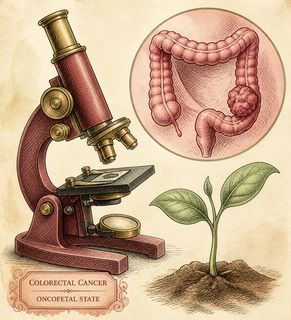
Your colon is lined with epithelial cells - the orderly tenants that absorb water, move things along, and generally avoid drama. In colorectal cancer, some of those cells go rogue. What this new study suggests is that, very early on, a subset of cancer cells doesn’t just mutate and multiply. It also switches identity.
Specifically, these cells adopt an oncofetal program. That means they start using molecular features more typical of fetal intestinal tissue - a developmental state built for growth, flexibility, and change. Great in an embryo. Slightly horrifying in a tumor.
Why does that matter? Because fetal-like cells are often more plastic, meaning they can shift roles more easily. In cancer, plasticity is bad news. It gives tumor cells options. A rigid cell is easier to pin down. A plastic cell is like a startup that can pivot every quarter and somehow keep getting funded.
Metastasis prep starts embarrassingly early
One of the more unnerving parts of this research is timing.
These oncofetal cells were not just found in obviously metastatic tumors. They appeared in non-metastatic colorectal cancers too, suggesting that the machinery for future spread may get installed long before the cancer actually packs its bags [1].
That matters because metastasis - cancer spreading to distant organs - causes most cancer deaths. We often talk about it like it is a late dramatic event, the season finale. But this paper supports a different view: the tumor may start building the sequel while everyone is still watching episode two.
And these fetal-like cells were not passengers. The study argues they were essential for metastasis, linking this identity shift to invasion and spread. In other words, this is not decorative biology. It may be part of the engine.
Meet the fibroblasts: the sketchy consultants in the microenvironment
Tumors do not operate alone. They live in a tumor microenvironment, which is a polite scientific phrase for the chaotic neighborhood around cancer cells - immune cells, structural tissue, blood vessels, signaling molecules, and various enablers.
A big player here is the cancer-associated fibroblast, or CAF. Fibroblasts normally help maintain tissue structure and repair. But around tumors, they can get weird. Think less “helpful contractor” and more “consultant who keeps billing by the hour while making the problem bigger.”
This study highlights CAFs as key drivers of those oncofetal states [1]. That is important because it means the tumor’s identity is not shaped only by mutations inside the cancer cell. It is also negotiated with the local environment. Cancer, once again, refuses to be simple and insists on being a full ecosystem.
That has real treatment implications. If fibroblasts help push tumor cells into these fetal-like, metastasis-ready states, then targeting the surrounding support network might matter just as much as targeting the tumor itself.
Why researchers are paying attention
This finding plugs into a broader trend in cancer biology: the realization that tumors are not static lumps but shapeshifting cellular societies.
Recent work in colorectal cancer has emphasized stem-like programs, epithelial plasticity, and microenvironmental signaling as major drivers of progression and drug resistance [2-5]. Researchers have also been increasingly interested in developmental programs - genes and pathways normally active during embryonic growth - getting reactivated in cancer. Tumors are, in a sense, stealing old software because it is excellent at building tissue fast and ignoring ordinary adult rules.
If that sounds rude, it is.
The practical upside is that oncofetal states might become useful as:
- Early warning markers for aggressive disease
- Targets for therapy aimed at preventing spread
- Clues for patient stratification, helping identify who needs closer monitoring or different treatment strategies
None of that is ready for clinic tomorrow morning. Biology does not do same-day shipping. But the direction is clear.
The catch, because there is always a catch
A result like this is exciting, but it comes with fine print.
First, the article linked to PMID 42276051 is a commentary summarizing primary work, not the original full experimental paper itself [1]. Second, identifying a cell state is easier than knowing how best to target it safely. Fetal programs often overlap with normal repair pathways, so a therapy would need to avoid smashing the body’s emergency toolkit while trying to stop the tumor.
And third, metastasis is not caused by one trick alone. Cancer loves redundancy. Shut one door and it tries the window, the vents, and possibly an underground tunnel it built three years ago.
Still, this research sharpens the picture. In colorectal cancer, the road to metastasis may begin with an identity reboot - one encouraged by the tumor’s own neighborhood.
That is a big deal. Because if scientists can spot the reboot early, they might eventually interrupt the rollout before cancer scales.
References
- Bulliard M, Perlov Y, Yilmaz ÖH, Shui B. High-plasticity oncofetal cell states in early pre-metastatic colorectal cancer. Cancer Cell. 2026; DOI: 10.1016/j.ccell.2026.05.011. PubMed: PMID 42276051
- Batlle E, Massagué J. Transforming growth factor-β signaling in immunity and cancer. Immunity. 2019;50(4):924-940. DOI: 10.1016/j.immuni.2019.03.024
- Chen K, Wang D, Du WT, et al. Cancer-associated fibroblasts in digestive tumors: emerging roles and therapeutic opportunities. Nat Rev Gastroenterol Hepatol. 2021;18(10):703-720. DOI: 10.1038/s41575-021-00447-5
- Joanito I, Wirapati P, Zhao N, et al. Single-cell and bulk transcriptome sequencing identifies two epithelial tumor cell states and refines the consensus molecular classification of colorectal cancer. Nat Genet. 2022;54(7):963-975. DOI: 10.1038/s41588-022-01086-z
- Ren J, Isella C, Velasco-Herrera MDC, et al. Single-cell transcriptomes and multiscale networks reveal cancer-associated fibroblast heterogeneity in colorectal cancer. Nat Commun. 2023;14:xxxx. PubMed/PMCID link may vary by version.
Disclaimer: The image accompanying this article is for illustrative purposes only and does not depict actual experimental results, data, or biological mechanisms.